Mohamed El-Orabi, Egypt’s former Foreign Minister, ruled out the possibility of a large-scale military confrontation erupting in the Middle East during the current phase, indicating that the prevailing strategic approach currently centers on “fragmenting the regional structure” and weakening central state and national systems in the region.
El-Orabi clarified that a conventional military confrontation requiring the deployment of massive ground forces is considered an “unlikely scenario” under current circumstances, arguing that airstrikes or limited operations rarely produce fundamental shifts on the ground, and may paradoxically lead to strengthening the targeted regime’s position rather than weakening it (through rallying popular support around it).
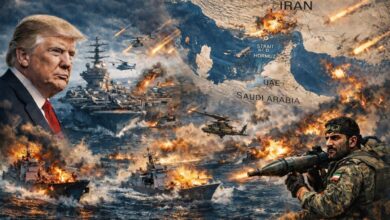
The prominent Egyptian diplomat pointed in his statements to the escalating tensions between Washington and Tehran since early January, where U.S. President Donald Trump threatened potential military intervention in response to Iranian authorities’ suppression of domestic protests, while categorically ruling out sending ground troops.
El-Orabi noted that limited external strikes – such as those targeting Iranian facilities in June 2025 – do not lead to regime collapse, but rather aim to exhaust them and constrain their ability to develop their military arsenal or nuclear program, while maintaining pressure to ensure Iran does not become a strategic threat to Israel.
He also dismissed the replication of the Venezuelan model in the Iranian case, explaining that Iranian social fabric is characterized by a more deeply rooted national and patriotic sentiment, in addition to the pivotal role of the Revolutionary Guards in controlling the state’s key institutions.
El-Orabi emphasized that the strategy of “regional fragmentation” has become the dominant approach currently, citing the situations in Sudan, Yemen, Libya, and Syria, where Israel – with implicit American support in some contexts – is working to undermine Iranian influence and secure its regional hegemony by fueling internal conflicts and pushing toward the division of national entities.