Ibrahim Shaglawy
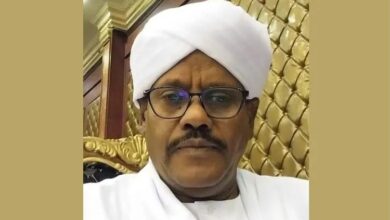
At a time when Khartoum has begun to regain its pulse with the return of the government to carry out its executive duties from the heart of the capital, the relocation of ministries, and the resumption of work by state institutions, Mohamed Al-Faki Suleiman, a leader in the Civil Democratic Alliance “Sumoud” and a former member of the Transitional Sovereignty Council, stated to Al-Hadath channel the day before yesterday: “Residents of the capital need to return to their homes, but Khartoum will not stabilize except through a political agreement under international supervision via the Quartet platform,” in a statement that reflects a complete disconnection from the transformations taking place on the ground and reproduces the discourse of external guardianship under the guise of “stability.”
This talk is not neutrality, but a disgraceful political neutralization that equates the state with those who take up arms against it, and distorts the will of a people who have in fact begun to reclaim their homeland. Neutrality, according to moral standards, does not mean equating those who protect the state with those who seek to dismantle it, nor does it justify suspending national belonging at the moment of political disagreement, nor can it cover regional greed that seeks Sudan’s resources under human-rights pretexts.
This statement cannot be isolated from the broader political context, where forces that attempted to seize power through the Rapid Support Forces’ gun on April 15, 2023, backed by regional and international support and by actors coveting the country’s resources, stand behind a so-called “neutral” discourse, while in practice showing hostility toward the institution that bears the burden of protecting the state at a moment of existential threat.
Neutrality, according to established political standards, does not mean equating the state with the militia, nor does it justify suspending national belonging at the first political disagreement, nor turning the homeland into a gray zone between the legitimacy of the state and the weapons of rebellion.
This debate gains a compounded moral dimension in light of the description by human rights organizations, the British press, and the United Nations High Commissioner for Human Rights, Volker Türk, of the war in Sudan as a war “fought by proxy in pursuit of natural resources.” This description places every political position on a clear moral scale, where taking sides or claiming neutrality becomes a calculated political act, not a detached discourse or isolated human-rights slogans.
Nor is this evasive discourse new; it comes at a time when Sudan has, in practice, moved beyond the logic of the “Quartet.” The state no longer deals with this platform as a political reference or a legitimate framework for managing its crisis, but has redefined its regional and international relations on the basis of sovereignty and parity, rejecting any collective guardianship that did not arise from a UN decision or a mandate from its national institutions.
Thus, the monopoly of this conspiratorial framework has been stripped away, and the crisis has shifted from being an externally managed file to a Sudanese–regional path that recognizes what is happening not as an internal conflict, but as an existential battle against an externally backed armed rebellion.
Khartoum does not return through platforms or agreements intended to re-enable the militia and its supporters, but through national will, the extension of sovereignty, and the restoration of the state to its natural place. Whoever insists on conditioning its stability on the gate of the outside merely postpones its return in the name of peace and barters its sovereignty under the banner of “neutrality.”
These uprooted political forces represented by Mohamed Al-Faki will continue to invent a discourse of demolition whenever Sudanese see their state regaining balance and stature, and whenever recovery pulses through the veins of social, political, and security life. Their existence is not nourished by stability, the restoration of security, and recovery, but by chaos and fracture; they do not flourish in the light of the state, but in the shadows of the militia.
These so-called activists do not mortgage only their own will; they attempt to mortgage the entire people to regional greed, trade sovereignty for the illusion of “international legitimacy,” and replace national belonging with agendas run from beyond the borders.
Yet when the state regains itself through national will, it topples illusions of guardianship, thwarts bets on demolition, and proceeds—despite the cawing—on its path toward a Khartoum that returns with recovery and security, and a nation that rises through sacrifice.
In this context, every talk of “stability conditioned on the Quartet” becomes nothing more than attempts to turn back the clock, while the reality on the ground affirms: “Khartoum is not a bargaining chip for disgraceful negotiation,” nor is the will of the people subject to delay or bargaining, and national sovereignty is seized from within and imposed through steadfastness, sacrifice, and the capacity to redefine independence before the world.
And according to #Face_of_Truth, Khartoum will not submit to blackmail again, nor can any office or foreign platform reshape its will or suspend its sovereignty.
The state has regained the initiative, the people have begun to reclaim their homeland, and those who insist on foolish neutrality or pitiful appeasement will be nothing but witnesses to their defeat before the solid will of the nation and a history written with the sustenance of values and blood.
Wishing you well and in good health