
The Middle East: Unprecedented Challenges and a Fragile Stability
Political, security, strategic, and economic fluctuations currently define the Middle East, appearing much like the crater of a smoldering volcano. The region remains in a state of constant ferment; no sooner does one conflict subside than it is ignited by the embers of another. According to various analyses, this stage—shrouded in heavy clouds—is the most sensitive yet, due to the intricate overlapping of interests among global and regional powers. These actors view the Middle East as a coveted prize, rich in wealth and reserves of oil, gold, and precious minerals. Furthermore, its maritime gateways wield significant influence over global trade, food security, and the international economic and security landscape.
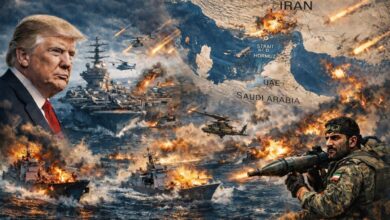
These multi-dimensional conflicts, driven by divergent visions, ideologies, and goals, have birthed a polarization devoid of harmony. The ultimate aim is to seize control of the engines of global politics and economy, thereby dictating the compass of public opinion and decision-making in all its forms. Such strife has left the entire region on the brink of explosion; unless the escalating repercussions are addressed, they threaten to trigger a devastating war that “leaves nothing behind.”
Several files dominate the Middle Eastern scene, most notably the “Palestinian Cause.” The ongoing armed conflict has birthed a stifling humanitarian crisis that has yet to move the global conscience. The international community appears increasingly complacent—even reconciled—to the massacres committed by the “Israeli occupation,” which has bypassed all international laws and regional norms. This unfolds amidst a suspicious silence, characterized by a submissiveness toward violations that history will record as the most harrowing of all.
The Israeli occupation continues its obstinacy, emboldened by a perceived immunity from international punishment. This has led to a persistent disregard for all previously concluded peace agreements, the latest being the Cairo Accord. Such defiance further complicates the Palestinian cause, dragging it into a cycle of continuous military escalation that violates every treaty and covenant. The price is paid by the Palestinian citizen, who has endured agonies that the very walls, sands, and steadfast mountains would disavow.
Not far from this is the Iranian expansion in various regional issues, including those linked to the Palestinian-Israeli confrontations. International and regional institutions continue to pressure Tehran, citing its financial and military support for Palestinian factions. Observers attribute this Iranian influence to Tehran’s tireless pursuit of a pivotal political and security role in the Middle East—aiming to assert itself as a formidable regional power that cannot be sidelined in global equations. This is in addition to achieving Iran’s strategic goals in this volatile region, which oscillate between political, religious, and sectarian ambitions.
Consequently, Iran now finds itself facing the “scepter of American arrogance,” which seeks to curb any rising power in the region through a “carrot and stick” policy, the brandishing of sanctions, and shifts toward military intervention, as witnessed recently. The relationship between Washington and Tehran remains saturated with a total lack of trust, particularly regarding the nuclear file, support for Palestinian factions, and concerns involving Hezbollah and Syria.
In a related context, the “Saudi-Emirati” friction has reached its peak due to conflicting interests in the Yemeni and Sudanese landscapes, as well as matters pertaining to the general security and stability of the Red Sea. To a casual observer, the two nations might seem aligned due to their membership in the Gulf Cooperation Council (GCC). However, the turbulent and tense reality paints a “grim” picture of Gulf relations. Footsteps are diverging rapidly due to foreign policies driven by ambition rather than the emotional ties of kinship. This is often masked by “resonant diplomatic rhetoric” in the media, intended merely to soften the intensity of the rift between Middle Eastern parties.
Compounding the regional complexity is the absolute American backing of the Israeli occupation’s actions in Palestine and elsewhere. This pushes toward an escalation that could ignite a regional war, torpedoing all efforts aimed at reaching a settlement or maintaining the current de-escalation.
In the heat of these events, observers suggest that regional de-escalation will not succeed—especially regarding the Palestinian cause and the Iranian nuclear file. This is because the solutions under discussion fail to address the root causes of the crisis, which carry the “genetic seeds” of continuity and recurring violations across the Middle East. The current scene, replete with military mobilizations and preparations that contradict peace talks, gives a strong impression that the region is on the verge of a “Great Explosion” that could occur at any moment.
Successive crises, fueled by a feverish race for influence, interests, armament, and repositioning, may render a solution more fragmented—if not impossible—for the time being. This leaves the Middle East, the world’s energy hub, standing upon a “fragile wall” that threatens current stability and strengthens the chances of sharp polarization. If things continue as they are, high-cost military options remain the most likely path forward.
By: Badreldin Abdulrahman (Wad Ibrahim)