Chad / France: Strategic Repositioning Amid Sudan Concerns and Rebel Threats
Hassan Youssef Zarma — Brown Land West Africa Correspondent
The relationship between Chad and France is undergoing a phase of careful recalibration, particularly following the official visit made by Chadian President Mahamat Idriss Déby to the Élysée Palace. This visit cannot be read in isolation from the tense regional context — chief among its elements being the ongoing war in Sudan, and the internal security challenges facing N’Djamena, especially the threat of rebel movements returning across the borders.
First: Chad Caught Between Two Fires — The Sudan War and Border Fragility
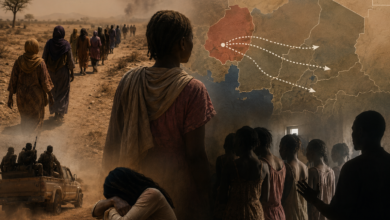
Since the conflict between the Sudanese army and the Rapid Support Forces erupted in April 2023, the Chad-Sudan border has transformed into a soft underbelly, both in security and humanitarian terms. The repercussions are not limited to the influx of hundreds of thousands of refugees, but extend to the spread of weapons across the Darfur region bordering Chad, cross-border movements of armed groups, and the possibility that Chadian rebels could exploit the Sudanese chaos to reorganize their ranks.
Historically, Sudanese territory has served as a refuge for some Chadian opposition factions, and the long shared border has been used as a supply line. N’Djamena therefore watches any security vacuum in Darfur with deep concern, fearing it could be transformed into a platform for destabilizing the country from within.
Second: The Rebel Specter and Regime Stability
Since the death of President Idriss Déby in 2021, the transitional authority led by his son — the current president — has faced a dual challenge: consolidating political legitimacy domestically, and preventing the return of armed insurgency scenarios that have long threatened the capital.
Despite the authorities’ success in containing some factions through dialogue, the volatile regional environment could revive insurgent projects, particularly if they find a geographical haven in Sudan or receive indirect support from competing regional actors.
Third: France and the Redefinition of the Security Partnership
The withdrawal of French forces from Chad was not the end of military cooperation, but rather the beginning of a more cautious phase with a lower public profile. Paris, which reorganized its military presence in the Sahel following its withdrawals from Mali and Niger, recognizes that Chad represents a geostrategic pivot point at the heart of the Sahel and Sahara, a barrier against the spread of extremist groups toward Central Africa, and a traditional partner in counterterrorism affairs.
Yet the equation has shifted. N’Djamena today seeks a balanced partnership that preserves its sovereignty and diversifies its international options, while Paris is keen to maintain its influence without appearing as a tutelary power.
Fourth: Converging Interests in the Shadow of the Sudan War
In light of the Sudanese war, French and Chadian interests converge on several points: preventing a comprehensive security collapse in Darfur that could threaten regional stability; monitoring the movements of armed groups and preventing the repositioning of Chadian rebels; and containing humanitarian fallout that could transform into a political crisis within Chad itself.
Here, security cooperation takes on a preemptive character — intelligence sharing, logistical support, and undisclosed coordination on border surveillance.
Fifth: Scenarios for the Coming Phase
Three main scenarios can be outlined. The first is **cautious stability**: containing the fallout of the Sudan war and strengthening security coordination between N’Djamena and Paris, with slow progress on the development track. The second is **border unraveling**: an expansion of fighting in Darfur and a resurgence of Chadian rebel activity, which could push Chad to request broader security support. The third is **regional repositioning**: Chad diversifying its international partners — Russia, Turkey, Gulf states — in a way that reshapes the balance of French influence.
Conclusion
The Chad-France rapprochement is not merely a warming of a historical relationship, but a strategic repositioning at a sensitive regional moment. N’Djamena understands that its internal security is directly tied to the outcome of the war in Sudan, and that any disruption in Darfur could swiftly rebound on its political stability.
Paris, for its part, sees Chad as the last stronghold of its organized military influence in the Sahel, and seeks to maintain a pragmatic partnership grounded in mutual interests rather than colonial legacy.
Ultimately, Chad is navigating between two anxieties: avoiding the contagion of the Sudanese war, and preventing the resurrection of insurgency. Between these two challenges, the contours of a new chapter in its relationship with France are taking shape — a chapter whose headline is security first, but on terms of sovereignty clearer than at any previous point.