
The Chinese Five-Point Initiative
By: Mohamed Saad Kamel
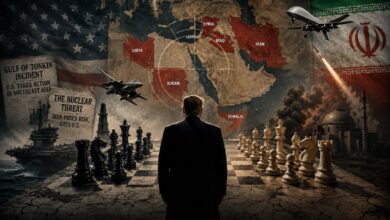
Amidst the unprecedented escalation witnessed in the Gulf and Middle East regions over the past two years, and the subsequent global economic crises and fears of their persistence, China emerges as an international actor seeking to redirect the course of crises toward political solutions by proposing initiatives based on de-escalation and the promotion of stability. Within this framework, the “Five-Point Initiative”—proposed by Beijing in cooperation with Pakistan—presents an integrated vision to contain conflicts and prevent the region from sliding into a more dangerous and uncontrollable cycle.
This initiative was not an isolated proposal, but rather an extension of a consistent approach in Chinese foreign policy, manifested in its positions toward various international crises, particularly in tension-prone areas like the Middle East and Africa. It reflects a deep-rooted approach based on respecting state sovereignty, prioritizing dialogue over confrontation, and linking stability to economic development. Beijing is keen to push toward peaceful solutions and avoid escalation, while strengthening economic partnerships as a means to build trust and achieve mutual interests.
The initiative is built upon five main pillars, beginning with a call for an immediate cessation of hostilities and concluding with an emphasis on the primacy of the United Nations Charter. The cessation of hostilities is the primary and fundamental factor for containing rising tensions, while ensuring the delivery of humanitarian aid to affected areas. Furthermore, the initiative emphasizes the necessity of launching an urgent negotiation process that preserves the sovereignty and territorial integrity of states, restoring diplomacy as the sole option for settling disputes.
Focusing also on the humanitarian and legal dimensions, the initiative stresses the protection of civilians and critical infrastructure, calling for adherence to international humanitarian law and an end to the targeting of non-military facilities. It also places special importance on securing shipping lanes, foremost among them the Strait of Hormuz, given its status as a vital artery for global trade and energy supplies in light of the increasing threats to maritime traffic in the region.
The initiative concludes by affirming the priority of the United Nations Charter and calling for the strengthening of international multilateralism, leading to the construction of a comprehensive and sustainable framework for peace based on the rules of international law.
In recent hours, the world witnessed a notable development reflecting the intersection of this vision with reality: the United States announced its acceptance of a proposal submitted by Pakistan for a temporary two-week ceasefire with Iran. This step aims to contain the escalation and create an atmosphere conducive to a potential negotiation track. Although this truce remains limited in time and surrounded by mutual conditions, it reflects, in its essence, a practical convergence with the substance of the Five-Point Initiative, particularly regarding the cessation of hostilities, securing shipping lanes, and prioritizing diplomatic solutions.
On a broader scale, this initiative can be read within the context of a gradual shift in the nature of China’s role on the international stage, from an economic partner to a diplomatic actor seeking to influence the trajectories of major crises. This is also evident in its relations with a number of developing countries.
Ultimately, the Chinese Five-Point Initiative represents an attempt to restore the standing of diplomacy at an international moment characterized by high levels of tension and uncertainty. While its chances of success remain contingent on the will of the parties involved, it offers an alternative model for conflict management based on de-escalation, balance, and the pursuit of sustainable peace.