The Berlin Conference: A Poisoned Chalice
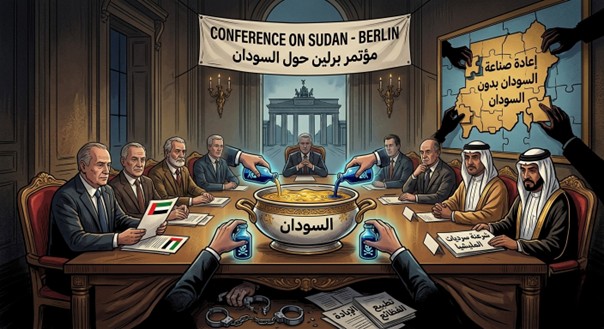
An attempt to remake Sudan without Sudan
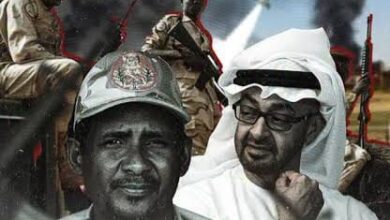
Normalizing genocide and legitimizing militia narratives to advance the Emirati agenda.
10 April 2026
Berlin Conference scheduled for April 15, 2026, is officially presented as the Third International Ministerial Conference on Sudan. The announcing hosts—Germany, the African Union, the European Union, France, the United Kingdom, and the United States—state its goal is to mobilize humanitarian support and advance peace efforts amid expanding displacement, mass atrocities, and worsening humanitarian needs. But the problem is not the principle of holding an international conference on Sudan; it is the political structure within which this conference has been framed, which in its current form makes it closer to a tool for restructuring Sudanese political representation than an equitable platform to help Sudan.
1) Because it is a conference about Sudan without the Sudanese state itself.
The most dangerous aspect of the current format is that the Sudanese government has been excluded from the invitation list, which has triggered official objection and rejection from other political forces who see this as a fundamental flaw in legitimacy and representation. This is not merely a protocol issue; it is about who has the right to speak for Sudan on humanitarian, political, and sovereign matters. When those with legal authority over the state are excluded, and the door is opened for other actors to fill this vacuum, the conference effectively becomes part of a battle over legitimacy rather than a framework for resolving the crisis.
2) Because the stated purpose is humanitarian, but the actual structure is political.
Official rhetoric describes the conference as a platform for mobilizing aid and coordinating international efforts, but German and European official statements also explicitly link it to progress in mediation tracks and advancing the Quad and Quint processes. Furthermore, the preparatory meeting in Addis Ababa aimed to form a committee to manage a Sudanese-Sudanese dialogue. Here lies the core problem: the “humanitarian concern” banner is being used to cover an actual transition toward externally engineering the political track. In other words, the conference does not stop at raising funds; it approaches arranging who speaks, who is excluded, and who is given the status of internationally “acceptable civilian.”
3) Because the selection of invitees follows a selective, not representative, approach.
The objections raised about the conference focus not only on the government’s exclusion but also on the nature of the invitations themselves: who was invited, who was not, and by what criteria. Published reports over the past few days mention invitations extended to dozens of individuals from blocs, parties, and organizations, while Sudanese political forces have protested that this is being done in an unbalanced manner, with over-representation of entities linked to specific alliances—including forces accused of being close to the “Foundation” (Taqaddum) or to the political narrative that provides vague cover for the militia and its allies. In this sense, the conference ceases to be a mere listening space and turns into a political screening mechanism that grants differential legitimacy to some forces over others.
4) Because some “symbols from inside” may be used as misleading token tools to divide Sudanese ranks.
When Western capitals select specific Sudanese figures and present them as the “voice of the inside,” the “civil conscience,” or the “acceptable alternative,” they do not reflect Sudanese reality so much as recode it according to their political needs. This type of selection does not produce national representation; it produces a network of local intermediaries whose function is to give the external scene a Sudanese cover. Therefore, the issue is not who is more famous or acceptable abroad, but who benefits from turning internal division into material manageable by international actors. Here, some Sudanese attendees become tools to legitimize an external track rather than unify the national front. The same reports confirm that decisions of invitation and exclusion have themselves become a source of tension around the conference.
5) Because the conference opens the door to re-presenting Abdullah Hamdok’s group and those with him as the sole civilian address, despite their documented ties to the UAE, which is implicated in supporting the militia.
The problem here is not the right of any Sudanese political actor to be heard, but the reproduction of the symbolic monopoly over representation. Berlin itself hosted a discussion in January 2026 with a delegation from “Somoud” led by Abdullah Hamdok, and political meetings took place in the German capital with the same delegation regarding “peace tracks” and Germany’s role and the upcoming conference. This alone does not prove that Hamdok will be officially presented as the sole representative of Sudanese people, but it clearly reveals which camp is being symbolically qualified within the European space as the preferred civilian front. The danger here is that Sudan’s political diversity becomes reduced to a spectacle: an excluded government, other marginalized forces, while a specific group is remarketed as the sole natural expression of “civilian rule” and the “Sudanese people.”
6) Because all this suggests an attempt to redraw Sudan’s political map according to external tastes.
The conference, in this arrangement, appears not merely as a framework for assistance but as part of a broader attempt to determine who the acceptable partners in post-war Sudan are. This is a known mechanism in post-conflict crises: the political field is reshaped through external selection, not through actual national weight. The result is that the political map is built not on popular mandate, institutional capacity, or position on the war and its responsibilities, but on suitability to Western circles: who can speak their language, who accepts their ceilings, who does not complicate their regional equations. In this sense, the conference becomes not just a meeting about Sudan but an attempt to manufacture the political Sudan that certain capitals prefer.
7) Because dealing with the UAE as a partner in the track, despite its record in the war, undermines any claim to neutrality.
Precision is needed here: The UAE is not among the six parties officially announced as hosts of the Berlin Conference. But the political problem remains for two reasons: First, the conference operates within a broader mediation structure that includes the Quad, which includes the UAE. Second, Abu Dhabi continues to be treated internationally as a legitimate negotiating actor despite the accumulation of serious evidence of its military support for the Rapid Support Forces (RSF). Amnesty International stated clearly in May 2025 that it had documented advanced Chinese weapons “most likely re-exported from the UAE” to RSF forces, in violation of the arms embargo. Furthermore, the German SWP Foundation described the UAE as a supporter of the RSF militia and noted that the UAE, alongside other parties, was able to block a joint final statement even at the London Conference in 2025. Adding to this the February 2026 report of the UN Fact-Finding Mission, which concluded that the pattern of RSF operations against non-Arabs in El Fasher bears “the hallmarks of genocide,” keeping Abu Dhabi within the structure of the diplomatic track without serious accountability appears not as neutrality, but as normalization with one of the most significant external enablers of the war.
Moreover, the evidence of UAE complicity in supporting genocide and RSF crimes in Sudan is extensive and includes:
1) The first piece of evidence is the existence of a procurement and financing structure linked to the RSF inside the UAE itself, not outside it.
Since June 2023, the US Treasury imposed sanctions on Tradive General Trading L.L.C., a UAE-based company, describing it as a front company controlled by an RSF officer, which purchased vehicles for the militia—some of which were possibly modified and weaponized for use in Khartoum and elsewhere. Then in October 2024, the US Treasury stated that Algoney Hamdan Daglo, the RSF’s procurement director, controlled front companies including Tradive, which “imported vehicles into Sudan for the RSF.” Then in January 2025, Washington moved from targeting one company to targeting a broader UAE network, explicitly stating that Capital Tap Holding, based in the UAE, “provided funds and military equipment” to the RSF, and also named other UAE-based companies used to conceal transactions, finance the network, and transport gold to Dubai. This is not a general political suspicion; it is an official US description of a support, financing, and procurement network operating from inside the UAE.
2) The second piece of evidence is that the “humanitarian corridor” in Amdjarass emerged early as an ideal cover for a suspicious logistical structure.
The UAE itself announced on July 4 and 9, 2023, the establishment and opening of a field hospital in Amdjarass, Chad, presenting it as part of its humanitarian support for Sudanese fleeing the war. But this official announcement is important because it proves the UAE established an early, fixed operational foothold in a border town close to Darfur, under a humanitarian cover. Later, the matter was no longer just about the existence of a hospital but the question: Was the hospital the goal, or the cover? The value of this evidence lies in combining two things: the declared UAE presence in Amdjarass on one hand, and then UN and journalistic reports linking the same site to supply operations for the RSF on the other. That is, the humanitarian structure was no longer separate from military suspicion; it became organically attached to it.
3) The third piece of evidence, and among the strongest, is the air bridge from the UAE to Amdjarass and what UN and Reuters reports revealed about it.
In January 2024, Reuters reported that UN sanctions experts described allegations of the UAE providing military support to the RSF via Amdjarass as “credible,” and that this support occurred “several times weekly.” Then in December 2024, Reuters published a broader investigation based on flight data and satellite imagery, stating that at least 86 flights had departed from UAE airports to Amdjarass since the war began, and that total flights on this route reached 170, many operated by companies previously accused in UN reports of transferring arms from the UAE to Haftar in Libya. Most importantly, Reuters reviewed video from the tarmac showing boxes bearing the UAE flag, which weapons experts said were likely ammunition or weapon boxes, not humanitarian aid. Relief workers also stated that the actual volume of aid did not approach the volume the UAE claimed to have sent. These are not small gaps; they are a structural gap between the Emirati narrative and the physical evidence on the ground.
4) The fourth piece of evidence is that the support pattern did not stop when exposed; it adapted and shifted to alternative routes, suggesting a policy, not a transient initiative.
According to a Reuters investigation in December 2025, Kufra in southeastern Libya, under the control of a UAE ally, became a vital corridor for weapons, fuel, and fighters to the RSF. Reuters quoted more than one official and expert stating that this route helped the RSF regain momentum after losing Khartoum, and linked flights to Kufra with airlines previously accused of transferring weapons from the UAE on other routes. Reuters also reported that the Wall Street Journal quoted US officials saying the UAE had intensified weapons shipments to the RSF via Libya and Somalia. Then in March 2026, Le Monde wrote that the UAE had reorganised its supply network through Ethiopia and the Central African Republic, with frequent flights by aircraft linked to companies with Emirati connections, and the newspaper mentioned a training camp in Ethiopia established for Sudanese allies of the UAE in 2025. The significance of this evidence is that what we are seeing is not a “single airport suspicion,” but a supply system that changes its routes whenever pressure increases on a previous route.
5) The fifth piece of evidence is highly material: UAE-manufactured equipment and vehicles appeared in the hands of the RSF inside Sudan, particularly in Darfur.
In July 2024, Amnesty International stated it had identified the use of modern UAE-manufactured armoured personnel carriers by RSF forces in Darfur. Then in November 2024, it went further, documenting that UAE Nimr Ajban vehicles used by the RSF were equipped with the French Galix defence system, and considered that the presence of these systems in Sudan likely constituted a violation of the Darfur arms embargo. The implication is twofold: first, the weapon or combat platform itself is of Emirati origin; second, its presence in the theatre of operations is no longer a political claim but something visually identified and verified through images and clips published from the battlefield.
6) The sixth piece of evidence is tracing the munitions themselves back to the UAE, not just flights or vehicles.
In April 2025, Reuters revealed that a UN expert team was investigating how Bulgarian mortar shells reached an RSF supply convoy in Darfur, after it emerged that the same serial numbers traced back to a shipment that Bulgaria said it exported to the UAE in 2019, and Sofia added that it had not granted permission for re-export to any third party. This is highly significant because we move here from the level of “the UAE likely facilitated” to the level of the munitions themselves leading back to the UAE in the chain of custody. Then in May 2025, Amnesty International announced it had identified the use of Chinese GB50A guided bombs and AH-4 155mm howitzers in Sudan, stating these weapons were most likely re-exported from the UAE to Sudan, in clear violation of the Darfur embargo. With this type of tracing, the issue ceases to be merely a geopolitical narrative and becomes a sequential investigation into weapons supply routes.
7) The seventh piece of evidence is that international and Western governmental institutions no longer treat the allegation as merely Sudanese propaganda, but as a credible claim requiring action.
In January 2025, two members of the US Congress, Senator Chris Van Hollen and Representative Sara Jacobs, stated they had concluded that the UAE is providing weapons to the RSF, based on a briefing from the Biden administration and other reports, and announced they would continue trying to stop US arms sales to the UAE. Additionally, Reuters noted in its report on the International Court of Justice ruling in May 2025 that some UN experts and some US lawmakers found these allegations credible. Here we are not talking about activists or political adversaries, but about official Western levels who saw that the evidence had reached a degree warranting practical positions, not just media coverage.
8) The eighth piece of evidence is that the international legal track itself was built on this accumulation, even if procedurally stalled.
On March 5, 2025, Sudan filed a case before the International Court of Justice against the UAE, stating in its application that acts committed against the Masalit “were enabled” through direct support provided by the UAE to the militia, and that Abu Dhabi is “complicit” through providing extensive financial, political, and military support. On May 5, 2025, the Court ruled that it lacked jurisdiction, confirming, according to Reuters’ summary of the ruling, that for this reason it expresses no position on the substance of the allegations themselves. This is an extremely important point: the dismissal of the case was not a verdict of Emirati innocence on the facts, but a ruling of lack of jurisdiction. Therefore, the legal track itself remains a witness that the file is no longer mere political mudslinging but has become an international dispute founded on a comprehensive evidentiary record of allegations.
9) The ninth and most serious piece of evidence is the relationship between this support and the nature of the recipient force, not merely the continuation of war.
The UN Fact-Finding Mission said in September 2024 that the RSF and its allies had committed widespread violations that may amount to war crimes and crimes against humanity, and then said in February 2026 that evidence from El Fasher reveals a coordinated campaign of destruction against non-Arab communities bearing the hallmarks of genocide. This means that any continued financial, logistical, or military support for this force after this level of documentation can no longer be understood as merely a “wrong political bet,” but as enabling a force already described at the UN level as responsible for mass atrocities of a genocidal character. This elevates the question from “Did the UAE support a party to the war?” to a more dangerous one: Did it continue to enable a party accused of mass atrocities after that became internationally known?
The totality of evidence since 2023 paints a coherent picture: procurement and financing networks in the UAE, front companies linked to RSF leaders, gold transported to Dubai, the Amdjarass corridor under humanitarian cover, dense and suspicious flights, Emirati vehicles on the battlefield, munitions traced back to the UAE, and then an adaptive shift of routes via Libya, Somalia, Ethiopia, and the Central African Republic. This does not mean that each element alone suffices as a final judicial ruling, but it does mean that the total accumulation of evidence has become so dense that denying any Emirati role is merely a defensive political position, not a convincing explanation of available facts.
Additionally, the participation of countries that raise the banner of “humanitarian crisis” while adopting policies that prevent Sudanese people from accessing educational opportunities—such as Britain—in organizing the conference exposes the gap between rhetoric and practice. Especially given that this same British state was previously involved in attempting to silence voices critical of the militia. One cannot claim to protect civilians on international platforms while closing legal pathways to them in reality. This is not humanitarian policy; it is selective crisis management according to political considerations.
Conclusion
The problem with the Berlin Conference, in its current form, is not that it is an international conference about Sudan, but that it is an international conference rearranging Sudan from the outside: it excludes the state, mixes the humanitarian with the political, selects invitees in an unbalanced manner, elevates certain civilian fronts above others, and engages with a regional structure that still grants space to a state accused of arming a force that has committed documented atrocities. Therefore, the fundamental objection is not an objection to international assistance, but to turning the Sudanese tragedy into a platform for redistributing political legitimacy according to non-Sudanese criteria. Any conference that does not begin from this reality will remain closer to managing the crisis than solving it.