
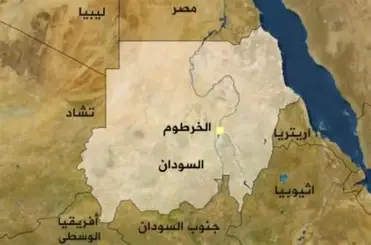
Sudan, neighboring countries… the conflict of borders, minerals and ambitions
Report: Badr al-Din Abd al-Rahman
The Sudanese borders with neighboring African countries (Chad, Central Africa, Ethiopia, Libya) appear to be one of the most important and prominent hotbeds of security tensions and inter-tribal and regional conflicts, which are fueled at other times by international and regional forces, with the aim of disrupting Sudanese national security, and with the aim of controlling the levers of power, in order to facilitate control of the national economy, which is replete with mineral (gold), agricultural (fashion), water and animal resources. And others.
There is no doubt, according to those interested in regional economic affairs, that multiple wealth and its various classifications are considered the greatest aspiration and the most influential goal for Western entities that plan to reach power in Sudan.
In this context, the skirmishes that took place between Russian forces that mostly follow Wagner, and between Sudanese merchants, and between them and the Rapid Rebellion militia last January, are considered one of the tools of the existential conflict, based on the great ambitions of “Russia” in the border region between “Sudan” and “Central Africa.”It is a region – according to documented strategic and economic reports – rich in psychological and precious metals, the most prominent of which is “gold”, which is the most important financial resource for countries of global political and economic dominance after oil.
Specialists have pointed out that the conflict in the above-mentioned border region is not entirely separate from the ongoing international and regional tension, rivalry, race, and competition over the mineral, agricultural, and water economic resources in the Middle East and Africa, which carry within them – in particular – many promising and huge, perhaps even undiscovered and unused, riches.This is not considered a strategic goal that must be achieved, no matter the cost, by countries searching for a foothold in Africa, or seeking to preserve their immediate gains, such as (Russia, France, and China).
Meanwhile, the Sudanese border with African countries, especially (Chad and Central Africa), continues to witness worrying and almost continuous security tensions, in that it is a long, vast and sprawling border, and in general requires a large and huge effort from the Sudanese government to secure, control and control, which will not be achieved, and will not be available at the present time, due to the almost complete preoccupation with the issue and repercussions of the war of the rebel Rapid Support militia, which aims to weaken and exhaust the state. Sudanese, it is a devastating war, which took the largest part of government attention.
Based on the course of events, which were based on correct intelligence analyses, the conflicts and security tensions on the Sudanese borders, and with various countries, will not stop in the near future, for various reasons, the most important of which are:
- There is heavy overlap on the borders between Sudan and neighboring countries, which is due to complex historical, demographic, security and political factors.
- Cross-border tribal interference.
- The old colonial concept, which planned and drew “scattered and distant” borders, does not take into account the social components of settled life, and does not take into account political and strategic assessments.
- Political, tribal, and regional armed conflicts, which make the borders “fragile,” easily porous, and an ever-heating arena.
- The spread of arms smuggling.
- The existence of a spiral of conflicts of varying causes between countries (“civil wars”).
- Using the borders as rear bases for the armed opposition against the governments of the border countries.
- Smuggling goods such as “gum arabic, sugar, and livestock” through unofficial crossings.
- The possession of common border tribes on agricultural and pastoral lands on both sides, which creates an overlap in economic interests.
- Weakness of the central authority of states in border areas.
In fact, and as a result of a series of violations and transgressions, border disputes and tensions remain the dilemma of constant anxiety and the most painful headache in the body of successive and current Sudanese governments, as they are an incurable disease that is subject to painkiller treatment, far from a proper diagnosis of the underlying cause and causes of the disease.