
Ethiopia’s Role in Supporting the RSF —
Dissecting Complicity from Denial to Damning Evidence
The False Neutrality
Since the opening hours of the Sudanese war in April 2023, Addis Ababa took pains to present itself as a neutral mediator and advocate for peace, hosting negotiation rounds and goodwill conferences. Yet this diplomatic façade began to crack under the weight of mounting field evidence, collapsing entirely in early 2026 when multiple internationally sourced and verified reports exposed a direct and systematic Ethiopian involvement in supporting the Rapid Support Forces — extending from training and armament to providing territory as an operational base for military strikes against a neighbouring state.
Asosa Base: From a Remote Regional Facility to an Operations Hub
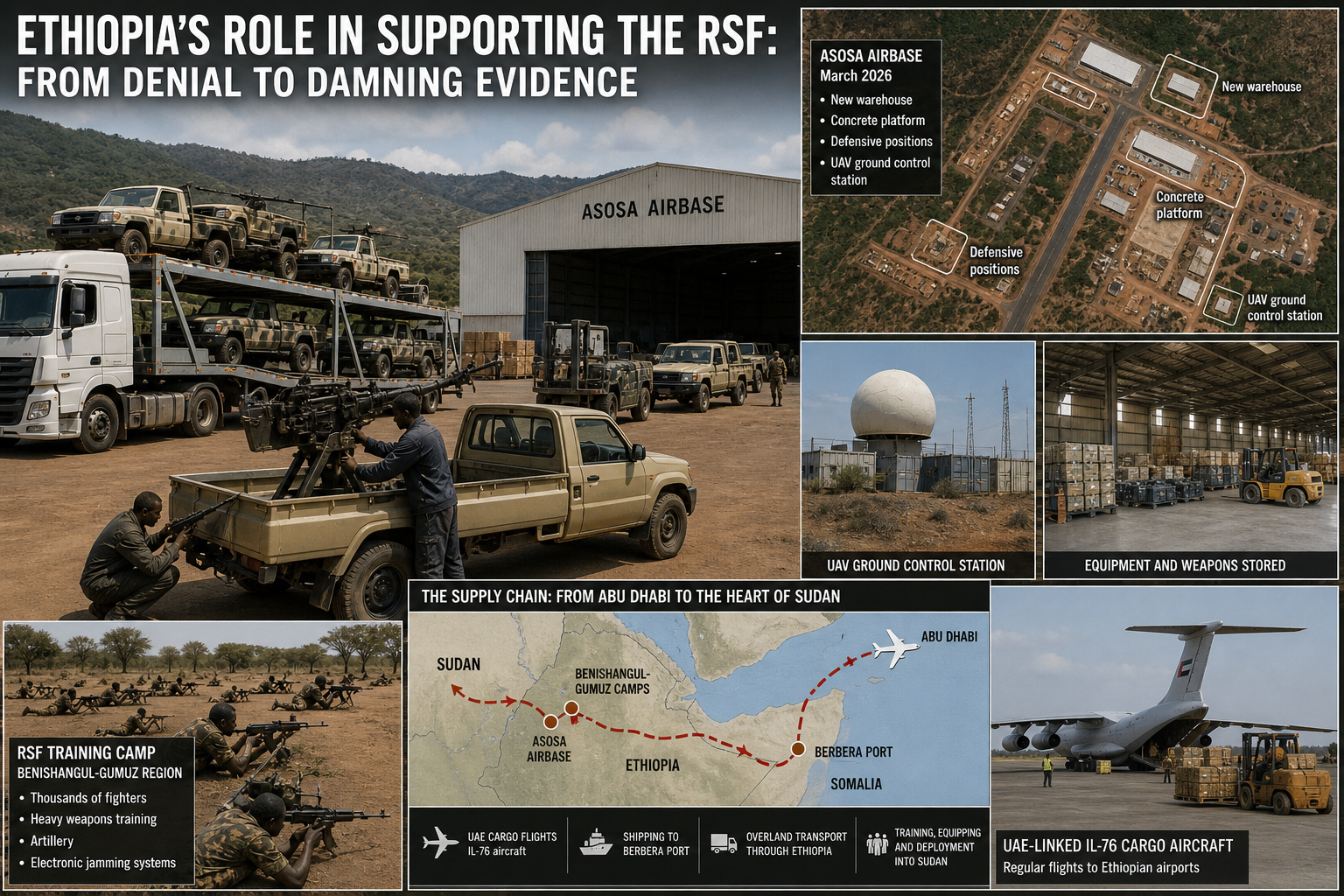
Asosa base lies deep within the western reaches of the Benishangul-Gumuz region, a semi-isolated area that had previously attracted little international scrutiny. However, satellite imagery analysed by the Humanitarian Research Laboratory at Yale School of Public Health between December 2025 and March 2026 revealed a radical transformation in the nature of activity inside the base. In its report published in April 2026, the Laboratory concluded with “high confidence” that systematic activity consistent with the direct provision of military assistance to the RSF was taking place, supported by five months of continuously documented visual evidence.
Among the most significant findings: non-military commercial car transporters making conspicuously regular visits to the base to offload light tactical vehicles; civilian vehicles on which technicians were installing gun mounts capable of accommodating heavy .50-calibre machine guns — meaning the conversion of civilian vehicles into combat platforms was taking place inside Ethiopian territory, with either the knowledge or the cover of the authorities. The Laboratory also documented steady expansion of Asosa airport’s facilities, including the construction of a new warehouse, a concrete platform, defensive fighting positions, and — critically — a ground control station for unmanned aerial vehicles, directly linking the base to strike operations against Sudanese territory.
The Secret Camp That Is No Longer Secret
In February 2026, Reuters published an extensive investigative report it described as representing “the first direct evidence” of Addis Ababa’s active involvement in the Sudanese war. The investigation exposed a clandestine military camp in the remote western reaches of Benishangul-Gumuz, housing thousands of fighters undergoing intensive training in heavy weapons, artillery, and electronic jamming systems — all on behalf of the Sudanese RSF.
The investigation drew on fifteen sources across multiple levels, including Ethiopian government officials, diplomats, and military officers, underpinned by detailed satellite imagery analysis that revealed newly constructed facilities and a drone ground control station at a nearby airport. Military technology expert Wim Zwijnenburg of the Dutch peace organisation PAX provided a comparative technical assessment confirming that the drone-support infrastructure observed in Benishangul-Gumuz matched the equipment at two other drone bases inside Ethiopia — strongly suggesting a coordinated and deliberate military system rather than an isolated incident.
The Hidden Threads of a Support Network
Middle East Eye added a further dimension to this composite picture through an exclusive investigation drawing on an exceptionally diverse and significant set of sources, including serving and former Ethiopian Army officers, Sudanese intelligence analysts, a senior European diplomat, and a former adviser at the Ethiopian Ministry of Foreign Affairs — all of whom confirmed the existence of an RSF operational base in the Benishangul-Gumuz region. The investigation further exposed the UAE’s pivotal coordinating role in the relationship between Addis Ababa and the RSF. Flight-tracking data revealed UAE-linked IL-76 cargo aircraft flying on a regular basis from Abu Dhabi to multiple Ethiopian airports, pointing to an organised air bridge for the transfer of military equipment.
The Supply Chain: From Abu Dhabi to the Heart of Sudan The cross-referenced findings of Yale, Reuters, and Middle East Eye reveal a carefully conceived and comprehensive logistical supply network. It begins with Emirati cargo aircraft transporting equipment and weapons to regional ports — most notably the port of Berbera in Somalia, which has become a strategic transit point. Shipments then travel overland through Ethiopian territory to reach Asosa base and the Benishangul-Gumuz camps, where vehicles are fitted out and units are trained before infiltrating into Sudanese territory. This logistical corridor explains the RSF’s ability to sustain its supply lines despite mounting military pressure from the Sudanese Armed Forces on its internal routes.