Human Trafficking and Smuggling of Sudanese Victims: Trafficking Networks from Darfur to Niger and Cameroon
Brownland — Investigative Research Team
Overview
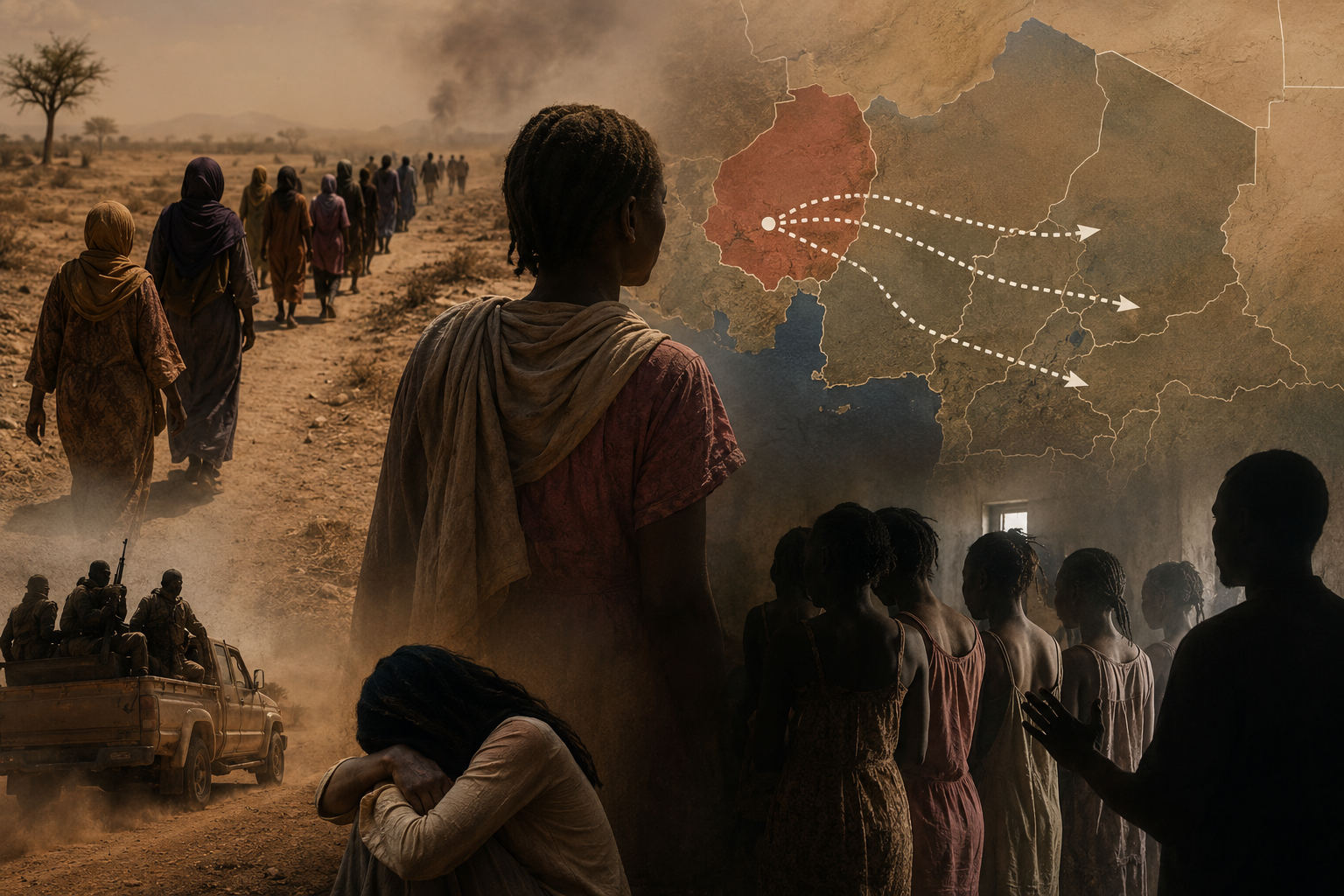
The Brownland Investigative Research Team monitored, during the period spanning late 2025 through May 2026, a systematic and escalating pattern of human trafficking operations stemming from the armed conflict in Sudan. These operations center on the abduction of women and girls from conflict zones in Darfur, Al-Jazirah state, and the Khartoum region, followed by their transfer through sprawling and methodically organized smuggling routes that cross Sudan’s borders into Chad, then branch outward into Niger and Cameroon.
This report draws on documentary materials gathered by the Brownland Research Team, including testimonies from survivors and Chadian and Nigerien citizens, statements by the Secretary-General of the Sudanese National Council for Childhood, and data from the United Nations High Commissioner for Refugees (UNHCR) and the International Organization for Migration (IOM), as well as reports from local human rights organizations in Niger, Chad, and Cameroon.
The Brownland Investigative Research Team has documented cases involving the sale of no fewer than 350 Sudanese girls in Niger, Cameroon, and border areas between Sudan and Chad, according to a statement by the Secretary-General of the Sudanese National Council for Childhood.
Awareness Among Authorities and International Organizations in Niger
1. The Nigerien Government and Security Apparatus
Niger’s National Agency for Combating Trafficking in Persons (ANLTP) maintains documented files relating to the activities of cross-border smuggling networks operating along the Chad frontier. Security agencies in the Diffa and Agadez regions have recorded a regular flow of sealed trucks arriving from Libya and Chad carrying migrants and trafficking victims; several networks comprising individuals of Sudanese and Chadian nationality were apprehended during this period.
At the regional level, Niger — as a member of the Sahel Alliance — exchanges intelligence on cross-border militia movements. However, formal action remains constrained by the political sensitivities surrounding the Rapid Support Forces (RSF) and their deep tribal ties across the region.
2. International Organizations (IOM & UNHCR)
- International Organization for Migration (IOM): Operates transit centers in Agadez and Diffa, and has documented cases of Sudanese female victims rescued from smugglers’ warehouses or found in the desert following exploitation.
- UNHCR: Monitors the transfer of abducted girls under the cover of refugee status as a means of concealment, and works to distinguish trafficking victims from ordinary asylum seekers through specialized protection interviews.
The Brownland Investigative Research Team has documented cases of girls who went missing in Khartoum and Al-Jazirah state and subsequently appeared in Niger, where they were registered at the Niamey refugee reception center.
3. Nigerien Civil Society Organizations
Women’s initiatives in Niamey have received reports revealing the presence of Sudanese girls employed under conditions of domestic forced labor within the households of wealthy individuals or persons with militia affiliations — confirming that victims are reaching the capital and major urban centers. The Association Nigérienne pour la Défense des Droits de l’Homme (ANDDH) maintains files on missing persons and victims of enforced detention in border areas.
Smuggling Routes and Operational Geography
The Brownland Investigative Research Team has mapped in detail the routes used by smuggling networks — routes that originally served as corridors for arms and narcotics trafficking and have since been adapted for the transfer of human victims:
Route 1: From Sudan to Chad
- Wadi Kajja: The primary artery from the city of Al-Junaynah toward the Chadian border.
- Wadi Bari: A rugged track used to bypass official checkpoints.
- Adikong Area: A Sudanese border village functioning as a primary assembly point prior to crossing.
Route 2: Within Chad (Transit Corridor)
- Bida and Hiriba Areas: Chadian border villages used to conceal victims in traditional storage facilities.
- Wadi Umm Shaluba: A desert track used for northward movement toward Niger or westward toward Lake Chad.
- Amdjeras Village: Its surrounding valleys serve as transit corridors for trucks carrying abductees.
- Baga Sola and Bol Areas: Contain clandestine holding facilities for victims prior to onward transfer to Niger.
Route 3: Toward Niger
- Diffa Area: A Nigerien border hub on the edge of Lake Chad, used to sort victims before their transfer to Agadez.
- Wadi Talmès: A desert track between northern Chad and northern Niger, far from paved roads.
- N’Guigmi Village: The first point of entry into Niger for victims; its dry valleys serve as truck assembly areas.
Route 4: Toward Cameroon via Lake Chad
- Doua Passage: A narrow waterway between Chadian and Nigerien islands, used at night to transport victims by small boats.
- Bultrem Area: A tri-border junction (Chad, Niger, Cameroon) known among criminal networks and militias as a “free trade zone.”
- Kaïga Village: The Cameroonian gateway for incoming victims, where they are concealed amid rice fields and marshland.
- Mayo Louti Valleys: Natural overland routes used to reach the Cameroonian cities of Maroua and Garoua.
Lake Chad — The Critical Security Vacuum
Lake Chad, with its more than 2,000 islands, constitutes what the report describes as the “black hole” in which the traces of hundreds of victims disappear. The Brownland Investigative Research Team has documented the smuggling mechanisms operating within and around the lake:
- The Isolated Island System: Victims are moved from island to island by small fishing boats; on each island, an agent from local tribal groups (Fulani or Buduma) provides protection and logistical support.
- Papyrus Forests and Marshlands: Narrow passages cut through dense vegetation known only to local tribes, rendering aerial surveillance ineffective.
- Concealment Under Fish Cargo: Victims are transported in boats loaded with dried fish and forced to hide beneath fishing nets when passing near monitoring points.
- Khor Yobé: A waterway marking the border between Niger and Nigeria that feeds into the lake, serving as a primary route beyond the reach of official oversight.
The overlapping influence of Boko Haram on the Nigerian and Cameroonian sides, combined with RSF militia networks operating through allied tribal proxies, produces what the report terms “organized chaos” — a condition that facilitates the passage of smuggling convoys in exchange for the payment of levies.
Along these routes operate cross-border tribal components with deep geographical knowledge of the region and extensive social networks spanning the Sahel states. They perform complementary roles: providing armed security and field protection on one hand, and logistical guidance with expert knowledge of desert and waterway routes on the other. This integration gives rise to a cohesive smuggling network that crosses borders seamlessly, exploiting both social cover and geographical advantage simultaneously.
Documented Forms of Exploitation
- Sexual Exploitation (Enslavement): The most prevalent pattern, in which abductees are treated as “spoils of war” or “property” and trafficked within and beyond Sudan’s borders.
- Forced Labor (Domestic Servitude): Victims are compelled to perform arduous domestic work without remuneration and under armed threat in neighboring countries.
- Labor in Gold Mines: The Brownland Investigative Research Team has documented cases of victims forced to work in artisanal and informal gold mining areas in northern Niger and Chad, generating revenue streams for militia groups.
- Open Sale Markets: Abductees are held in camps or enclosures, then subjected to negotiation: either the payment of a substantial ransom, outright sale, or cross-border transfer.
The Trafficking Risk in Refugee Camps — Aftit Camp, Ethiopia
The dangers are not confined to smuggling routes through Chad and Niger. The Brownland Investigative Research Team has monitored a series of increasingly serious incidents within Aftit Camp in Ethiopia’s Amhara Region, which shelters approximately 2,500 Sudanese refugees:
- Three Sudanese female refugees were subjected to an attempted abduction inside the camp while gathering firewood; armed individuals intercepted them and attempted to take them by force.
- The attackers fired gunshots into the air, issued threats to return, and then withdrew. No arrests were made.
- This incident was preceded by a bladed-weapon attack on a woman inside her shelter within the camp — the sixth such attack of its kind within the recent period.
- Ethiopian authorities detained a member of the camp’s Central Refugee Committee in connection with security tensions.
A delegation presumed to represent UNHCR arrived in the nearby town of Shahidi to assess the security situation; no official statement had been issued at the time of this report’s publication.
Obstacles to Prosecution and Official Intervention
| Obstacle | Description |
|---|---|
| Terrain Difficulty | The vast desert between Chad and Niger (Wadi Talmès) renders comprehensive surveillance virtually impossible. |
| Tribal Entrenchment | Smugglers’ membership in tribes with significant standing in Niger provides social protection and enables victims to be concealed within local communities. |
| Border Corruption | Substantial payments made to local intermediaries to facilitate the passage of trucks under the guise of ordinary commerce. |
| Vegetation Cover | Papyrus thickets and marshlands obstruct aerial surveillance by drones and satellites. |
| Overlapping Armed Influence | Boko Haram levies must be paid to guarantee passage of convoys through its controlled corridors in the Lake Chad basin. |
Conclusions
The Brownland Investigative Research Team has concluded that human trafficking operations originating in Sudan’s conflict zones are characterized by a high degree of organization and methodical planning, and rely on a well-established logistical infrastructure encompassing cross-border tribal networks, defined geographic corridors, and sophisticated concealment mechanisms.
Recommendations
- Urge international organizations (IOM and UNHCR) to intensify victim identification and screening protocols at transit centers in Agadez, Diffa, and across Niger.
- Press Nigerien authorities to activate the National Agency for Combating Trafficking in Persons (ANLTP) and to publish transparent data on documented cases.
- Pursue urgent international coordination among Niger, Chad, Cameroon, and Ethiopia to monitor border routes and establish effective information-sharing mechanisms.
- Submit the geographic routes documented in this report to the International Criminal Court as evidentiary support for the ongoing file on crimes against humanity in Sudan.
- Strengthen security protection in Sudanese refugee camps, with particular urgency at Aftit Camp in Ethiopia and border camps in Chad.
Legal and Editorial Notice
This report was prepared by the Brownland Investigative Research Team on the basis of field data, documented testimonies, and statements by relevant officials. It seeks to document the described crimes through evidentiary field findings, and is submitted to the relevant human rights and international bodies for appropriate action. Brownland retains full publication rights over the content of this report.