From Tonkin to Hormuz: The Anatomy of an American War Pretext
Part One: From the Communist Threat to the Nuclear Specter
By Sabah Al-Makki

The Script Outlives the Battlefield
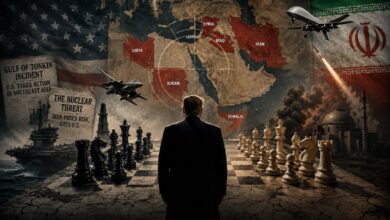
The comparison between the Gulf of Tonkin and the Strait of Hormuz is not geographic. Nor is it merely a resemblance between two strategic maritime passages drawn into moments of military escalation. The deeper significance lies elsewhere. Both reveal a recurring pattern in American strategic thinking: invent or inflate a danger, turn it into a global threat, mobilize public opinion around it, and then use it as the political, moral, and legal gateway to expand war.
In Vietnam, the Gulf of Tonkin incident provided the moment Washington needed to move from indirect support and intervention to full-scale military engagement. On August 2, 1964, the United States claimed that North Vietnamese patrol boats had attacked the American destroyer USS Maddox in the Gulf of Tonkin. Two days later, on August 4, Washington announced that a second attack had taken place against American vessels in the same waters.
Both incidents were presented to the American public and to Congress as direct acts of aggression requiring a response. Yet the second account, in particular, would later become the subject of widespread doubt, and ultimately one of the most famous examples of how ambiguous events can be used to widen wars.
The naval incident, then, was not the essence of the war. It was the instrument that made war marketable. It quickly became the justification for granting the president sweeping authority and moving the United States from indirect intervention to direct military involvement in Southeast Asia.
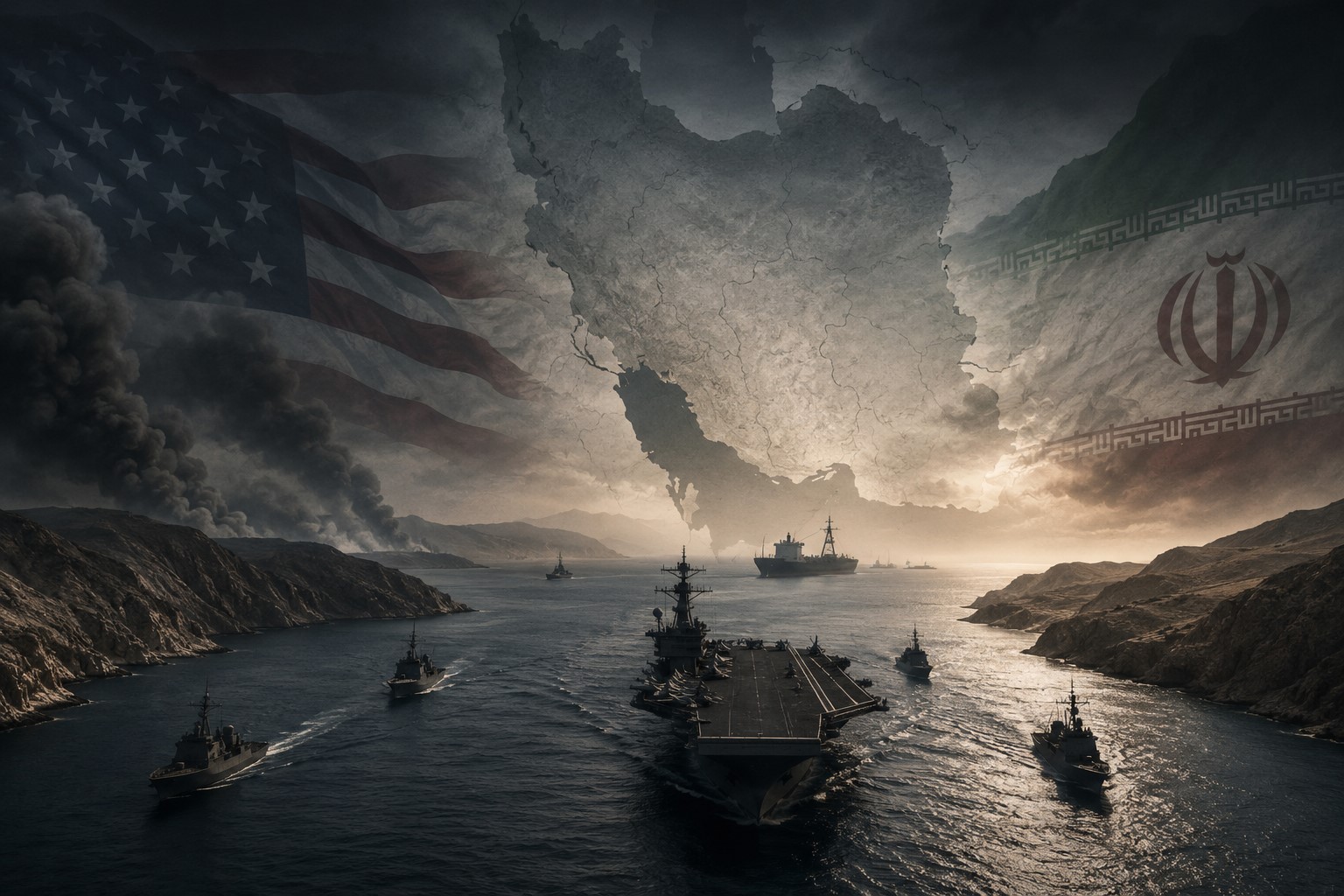
In the Iranian case, the Strait of Hormuz cannot be viewed merely as a waterway or a passing point of tension. Given its global strategic and economic weight, the strait is uniquely suited to serve as a theater for escalation. Any naval incident, threat to shipping, or disruption of maritime traffic can be presented as a threat to the global economy, rather than simply one episode in the American-Israeli confrontation with Iran.
Tonkin and the Politics of Manufactured Urgency
What lay behind the Gulf of Tonkin was far deeper than a naval incident. It was the great ideological fear of the Cold War: communism.
Vietnam was not presented as a country engaged in a complex national and historical struggle against colonialism and foreign intervention. It was reduced to one link in a broader Soviet-Chinese project. In that framing, the war was no longer a Vietnamese conflict within its own local and historical context. It became a global battle between the “free world” and communism.
The United States did not fear Vietnam alone. It feared what Vietnam represented inside the logic of the Cold War. Washington feared that a Vietnamese victory would damage American prestige before the Soviet Union and China, and that a small country would become a political symbol far larger than its geography. That is why Washington entered the war not merely as a war against Vietnam, but as a battle over the image of American power itself.
In this sense, the Gulf of Tonkin was the perfect instrument: a naval incident, an urgent narrative, a direct threat, domestic outrage, and then sweeping authorization. This is how a state moves from hesitation to war, from debate to alignment, from caution to the logic of “there is no choice but to respond.”
Hormuz as Theater, Not Merely Geography
Here, the resemblance to Iran becomes clear. The Strait of Hormuz, like the Gulf of Tonkin, is not the conflict’s core. It can, however, become the ideal stage for dramatizing escalation. Hormuz is not merely a waterway. It is a global artery of energy and trade. For that reason, any tension there can be converted into a global issue: a threat to navigation, oil markets, the international economy, and what is commonly called “freedom of navigation.”
In this way, the danger in Hormuz is not presented to public opinion as a limited military detail. It is framed as an opening through which the confrontation with Iran can be removed from its regional context and inserted into a broader language: protecting navigation, protecting the global economy, and protecting international stability.
Through this framing, Washington attempts to detach the confrontation with Iran from its specific political and regional context and recast it as a defense of the entire international order. Just as the Gulf of Tonkin gave Washington a moment of mobilization in Vietnam, the American administration today seeks to make the Strait of Hormuz perform a similar function against Iran.
Yet that effort has not, so far, produced a new Tonkin. Hormuz remains a stage on which escalation can be marketed, but not yet a full political and psychological authorization for war.
That distinction matters. The Strait becomes more than geography. It becomes political language. Whoever controls the narrative around Hormuz can decide whether what is taking place is a “conflict with Iran” or a “defense of the world.” That is precisely the function of maritime passages in moments of war: they do not only carry ships. They carry pretexts.
When Possibility Becomes a War Pretext
Just as the Gulf of Tonkin was only the surface, the Strait of Hormuz is also only part of the surface. The deeper instrument in the Iranian case is the manufacture of fear around the nuclear file.
In Vietnam, the central fear was that Vietnam would join the Soviet camp and open the door to the spread of communism. In Iran, the central fear is that Iran will become a nuclear power, even when there is no conclusive evidence that it possesses an actual nuclear weapon or has made a final decision to produce a ready bomb.
Here lies the danger: the conversion of possibility into certainty. The existence of an enrichment program, scientific and technological capability, or disputes with the International Atomic Energy Agency does not automatically mean the existence of a ready nuclear bomb or a confirmed decision to use one. Yet in political and media discourse, all of this is compressed into one frightening phrase: “Iran is nearing a nuclear weapon.”
That phrase now performs the same political function that “communist expansion” performed in Vietnam. It does not explain reality as much as it mobilizes fear.
More dangerously, this phrase shifts from a debatable security assessment into a final political verdict. Once the image of the “coming nuclear Iran” takes hold in public consciousness, escalation against Iran is justified before the evidence is settled. The debate is no longer about whether the alleged threat has been proven. It is redirected toward a more politically useful anxiety: what must be done before it is “too late”?
This is the intellectual machinery of preventive war. Possibility becomes inevitability. Suspicion becomes proof. Incomplete evidence becomes a reason for urgency rather than caution.
In each case, a single fear is elevated into a grand justification for a wider war. In Vietnam, it was the containment of communism. In Iraq, it was the elimination of weapons of mass destruction. In Iran, it is the prevention of a nuclear threat.
But the real question is not whether danger exists. The question is whether a limited or potential danger is being used to justify a broader project that existed before the pretext.
In Vietnam, Washington did not fear Vietnam alone. It feared what Vietnam represented within the struggle with the Soviet Union and China. In Iran, Washington and Tel Aviv do not fear the nuclear file alone. They fear what Iran represents as a major regional state that refuses full submission to the American-Israeli order in the region. The nuclear file, therefore, becomes the headline; the deeper objective is to break a balance of power that neither Washington nor Tel Aviv is willing to accept.
This is the essence of fear manufacturing: the public is not asked to understand the details, but to fear the headline. Danger is not measured only by what exists. It is measured by what can be imagined, amplified, and sold. Once fear is written in existential language, politics shortens the distance between possibility and war. It becomes enough to build around the adversary the image of a coming threat until targeting that adversary appears acceptable, even necessary.
Hormuz and Energy: When Nuclear Fear Expands into the Global Economy
The Strait of Hormuz enters here as an additional element in the manufacture of fear. If the nuclear file speaks to the world’s fear of weapons, Hormuz speaks to the world’s fear over energy, markets, and trade.
In this way, the circles of fear around Iran expand: a nuclear threat, a maritime threat, an economic threat, and a threat to the regional order.
The nuclear file gives war the language of security. Hormuz gives it the language of economics. The alliance with Israel gives it the language of strategy. Across these three levels, Iran is recast as a comprehensive danger that can only be dealt with through force.
This is how major wars are prepared. Rarely is one argument enough. Instead, several arguments are layered together until escalation appears to be the only possible outcome.
From here, the central question becomes unavoidable: Does danger create war, or does the decision for war search for the right danger through which to sell itself?
In Vietnam, the Gulf of Tonkin became the bridge between the fear of communism and the expansion of war. In Iran, the nuclear file, Hormuz, and energy may become that same bridge between fear of Iran and a wider project aimed at breaking it.
The Manufacture of Fear Is Only the First Chapter
Wars of this kind do not erupt suddenly from nothing. They are constructed.
First, an image of danger is created. Then it is enlarged. Then it is given a moral language. Then it is tied to global security. Finally, escalation is made to appear not as a choice, but as a necessity.
This is what happened in Vietnam, when communism became the specter through which war was justified. The same logic now shadows the confrontation with Iran, where the nuclear file, Hormuz, and energy are turned into accumulating circles of fear that justify escalation.
But the manufacture of fear is only the first chapter of the story. The deeper question is not only how war is justified, but what happens after it begins.
Here, history is unforgiving. Washington does not merely misjudge the pretexts it manufactures. It often misjudges the wars it ignites. In Vietnam, it entered the war under the illusion of a swift victory, only to sink into a long quagmire. With Iran, the same danger returns: a war presented as a short operation may become a strategic nightmare with no clear exit for those who launch it.
That is where Part Two begins: with Wesley Clark’s testimony about the seven countries, the map of fragmentation, the illusion of the short war, and the deeper question behind the confrontation with Iran.
Is this truly a confrontation with a nuclear danger, or another chapter in a wider project to dismantle states that refuse to bend?
Read Part Two here➡️: Wesley Clark’s List, Iran, and the Illusion of the Short War
About the Author
Sabah Al-Makki is a Sudanese researcher, writer, and journalist who writes in Arabic and English for Sudanese and regional platforms. She is Deputy Editor-in-Chief at Brown Land News. Her work examines geopolitics, political violence, international law, statehood, sovereignty, war, and the role of media in shaping public discourse, with particular attention to Sudan within its regional and global contexts. She is especially interested in hate speech, dehumanization, social fragmentation, and the rebuilding of national legitimacy. Her writing challenges dominant narratives, foregrounds voices often excluded from global discourse, and approaches journalism as a form of cultural and intellectual resistance. In this sense, she writes from within the storm.
𝑬𝒙𝒄𝒍𝒖𝒔𝒊𝒗𝒆𝒍𝒚 𝒑𝒖𝒃𝒍𝒊𝒔𝒉𝒆𝒅 𝒃𝒚 𝑩𝒓𝒐𝒘𝒏 𝑳𝒂𝒏𝒅 𝑵𝒆𝒘𝒔.
Where sovereignty is not negotiable, and truth defies revision.
Our Land. Our Voice. Our News.