
Reports
Ethiopia-Sudan: Proxy War and the Intersection of Regional and International Interests
Report by: Badr al-Deen Abdal Rahman
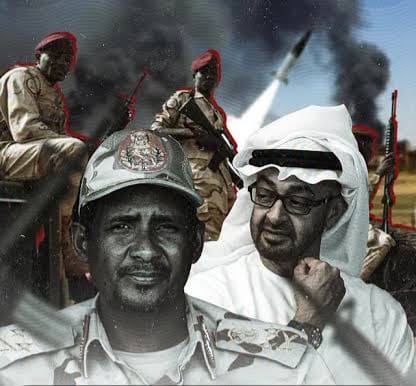
- Sudan has faced, and continues to face, a complex war with internal, regional, and international dimensions. In this conflict, the Rapid Support Forces (RSF) militia has served as a “cat’s paw” used to achieve external agendas anchored in political, strategic, and economic ambitions.
Amidst this raging conflict, Ethiopian support for the rebel RSF militia has surfaced in various forms. Most notable is the use of Ethiopian territory as a “launchpad for unmanned aerial vehicles (drones)” aimed at striking civilian targets within Sudan.
According to analysts, Ethiopia seeks to achieve several strategic objectives in the Horn of Africa, most importantly: - Weakening the Sudanese Army, which Ethiopia views as a historical adversary and an ally of Egypt and Eritrea.
- Securing its western borders.
- Leveraging regional alliances to control conflict zones.
- Gaining control over the fertile “Al-Fashaga” agricultural region.
- Depleting the Sudanese Army and entangling it in a long-term war of attrition.
- Serving Ethiopian objectives regarding the Grand Ethiopian Renaissance Dam (GERD) file.
- Securing the economic and logistical interests that Ethiopia requires.
”Using the Territory of Others for Hostile Acts is a Flagrant Violation of State Sovereignty”
- Journalist and writer “Ibrahim Shaqlaqi” stated that the use of Ethiopian territory to launch drones against Sudan is an extremely dangerous development in the regional security equation. This is because it does not merely fall within the framework of traditional border tensions, but rather rises to the level of a direct threat to the principle of state sovereignty and the prohibition of using one’s territory for hostile acts against others.
According to the Sudanese Army and regional and international condemnations regarding the drone bombing of Khartoum Airport—reportedly originating from “Bahir Dar” in Ethiopia—such behavior opens the door to reclassifying the nature of the conflict from a bilateral tension to a regional crisis.
“Shaqlaqi” explained that, politically, this signifies the transition of the relationship between Khartoum and Addis Ababa into a more complex phase where national security considerations overlap with calculations of deterrence and diplomacy. This could also impact current or future negotiation tracks regarding files such as (borders, security, and Nile waters) and increases sensitivity toward any regional or international mediation. In such cases, the language of dialogue often retreats in favor of the logic of security measures and mutual accusations.
“Shaqlaqi” noted that it is essential, within a responsible professional context, to distinguish between “reports” and “proofs,” as building positions on incomplete information may exacerbate tension rather than contain it. Therefore, there remains a need for additional technical investigations and intelligence and diplomatic scrutiny before establishing any final conclusion. While such issues are serious in their implications, managing them with the “mind of the state” rather than emotional impulsivity is what preserves regional stability and prevents a slide into uncalculated paths.
”The Ethiopian Conduct Aims to Distract the Sudanese Army’s Efforts”
- ”Dr. Adel Mahjoub Al-Aqib”, a professor of journalism at Sudanese universities, confirmed that the Ethiopian conduct aims to scatter the efforts of the Armed Forces and supporting forces by opening several fronts (Chad, Eastern Libya, South Sudan), and finally Ethiopia—especiallyع since Ethiopian terrain is elevated while Sudanese land is flat, which facilitates the movement of rebels on the ground.
“Al-Aqib” warned that the drones launched from “Bahir Dar” are merely a natural result of Emirati pressure on Ethiopia, which has fully mortgaged its decision-making to the UAE. The UAE, in turn, controls the economy, investments, and foreign aid. This is, of course, a short-sighted view by the Ethiopian government, which Sudan could treat in kind if it so desired.
”Ethiopia Has Shifted the Conflict from a Domestic Scope to Regional and International Spheres”
- Journalist “Dr. “Maymouna Saeed Adam Aburqab” argued that the use of Ethiopian territory to launch drones against Sudan represents a dangerous shift in the course of the current war, as it moves the conflict from its internal scope to a more complex regional dimension. This complexity leads to various repercussions, most notably an escalation of tension between the two countries, as Khartoum considers this a violation of its sovereignty and a direct threat to its national security, which may lead to a diplomatic crisis or increased border tensions.
In the same context, “Dr. Maymouna” clarified that the use of drones raises the level of military danger due to their ability to target vital facilities and infrastructure from long distances, potentially expanding the scope of the war and increasing casualties.
From a legal standpoint, “Dr. Maymouna” emphasized that using a state’s territory to launch military operations against another state is contrary to the principles of international law and the UN Charter, particularly regarding respect for state sovereignty and non-interference in their affairs. Furthermore, this development could lead to the internationalization of the Sudanese crisis and increased regional interventions, threatening the stability of the Horn of Africa and further complicating opportunities for a political solution to end the war.
”Sudanese Army Evidence Puts Ethiopia in an Embarrassing Position”
- Political researcher and analyst “Ahmed Qasim Al-Badawi” considered that the Sudanese Army’s possession of evidence proving Ethiopia’s involvement in using its territory as drone platforms to strike Sudanese lands puts the latter in an embarrassing position before the international community—an act that violates UN charters and international law.
“Al-Badawi” pointed out that Sudan had previously submitted an official protest stating that it had monitored Ethiopia sheltering camps belonging to the RSF militia.
“Al-Badawi” believes the issue has now surpassed the language of protests and requires Sudan to take urgent diplomatic action using its evidence to condemn Ethiopia. He warned that Ethiopian intervention in the Sudanese crisis could expand the conflict into a regional war, especially since there are many international and regional intersections that prompt some neighboring countries to enter the arena, particularly regarding the water file. Collectively, these intersections could lead to a larger explosion, warning against Sudan turning into a regional battlefield for settling international scores.
The final word remains that Ethiopia has become deeply embroiled in the RSF militia’s war against Sudan by providing logistical, military, and training facilities documented by numerous regional and international reports. According to specialists, this will cost Ethiopia dearly in both the near and long term.