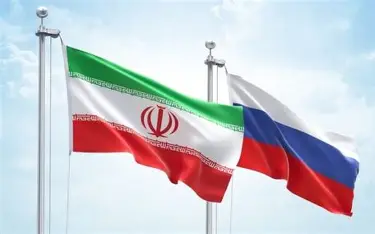
According to Brown land, even during the days of the US-Iran War, cooperation between Russia and Iran continues not only politically and economically, but also militarily. This aspect of mutual cooperation is conducted exclusively across the Caspian Sea.
The Importance of the Caspian Sea for Cooperation Between Russia and Iran
The Caspian Sea has emerged as an increasingly important strategic artery connecting Russia and Iran. It has gained particular significance in light of the wars and escalating Western sanctions imposed on both countries. This maritime corridor has become a vital means of transporting military and commercial goods. This bolsters Tehran’s ability to withstand US and Israeli pressure.
The Iranian port of Bandar Anzali on the Caspian Sea was the target of an Israeli attack last March. It targeted the Iranian naval command center. Israel claimed at the time that it had destroyed several Iranian naval vessels. It also described the operation as among its “most important strikes” against Iran. What is striking about the operation is that it did not take place in the Arabian Gulf or the Strait of Hormuz, but rather in the Caspian Sea. This has become a new strategic axis for trade and military support between Moscow and Tehran.
It should be noted that Russia strongly condemned the attack and summoned the Israeli ambassador. It lodged a stern protest and declared that the Caspian Sea “must not be violated”. Remarkably, the sea has not witnessed any further attacks since then.
Russia is supplying Iran with drone components and goods via the sea
According to recent press reports, Russia is transporting drone components to Iran via the Caspian Sea. This activity aims to support the rebuilding of Iran’s offensive capabilities after the loss of part of its drone arsenal during recent clashes. Moscow is also continuing to supply Iran with goods that previously passed through the Strait of Hormuz, which is currently under strict restrictions.
For their part, Iranian officials have confirmed that work is proceeding at an accelerated pace to develop alternative trade routes. In this context, four Iranian ports on the Caspian Sea are operating around the clock to receive various Russian shipments. These include, for example, wheat, corn, animal feed, sunflower oil, and other essential commodities. Mohammad Reza Mortazavi, head of the Iranian Food Industries Association, stated that his country is actively working to reroute its food imports through this sea route.
Russian trade data and port statistics also indicate a rapid increase in shipping traffic through the Caspian Sea. Vitaly Chernov, head of analytics at the Russian Port News Group, stated that “two million tons of Russian wheat, which were previously transported annually to Iran via the Black Sea, are now being shipped through the Caspian Sea due to security risks stemming from Ukrainian attacks in the Black Sea.”
Area characteristics
Alexander Sharov, head of the RusIranExpo Foundation, predicted that shipping traffic through the Caspian Sea would double this year. He noted that the Strait of Hormuz crisis has prompted many companies to reconsider the importance of this trade route.
The Caspian Sea, larger than Japan, is the world’s largest and deepest enclosed lake. It also provides an ideal environment for clandestine trade. Especially since ships operating between Russian and Iranian ports often switch off their tracking devices to evade international monitoring. Unlike the Persian Gulf, the USA cannot intercept ships in the Caspian Sea because access is restricted to the five littoral states.

In this context, Nicole Graevsky, a researcher specializing in Russian and Iranian affairs, stated that the Caspian Sea represents “the ideal place to circumvent sanctions and transport military equipment.”
The Depth of Cooperation Between the Two Countries
It must be said that the drone shipments reveal the depth of military cooperation between Moscow and Tehran. While Russian support may not fundamentally alter the balance of power in the ongoing conflict between Iran on one side and the United States and Israel on the other, according to some experts. But it undoubtedly contributes to strengthening Iran’s ability to rapidly rebuild its air arsenal.
Over the past few years, military cooperation has been bidirectional. Iran supplied Russia with Shahed drones for use in the war against Ukraine. While Russia continued to send military components and technology to Iran. However, Moscow’s need for Iranian drones diminished after 2023, when Russia began manufacturing its own version of the Shahed drone domestically under Iranian license. Nevertheless, active cooperation between the two countries continues, and is even acquiring new dimensions, the details of which remain unknown to the public.
Last August, Ukraine announced that it had targeted a Russian ship in the port of Olya on the Caspian Sea. At the time, it claimed that the ship was transporting Shahed drone components from Iran to Russia. The US Treasury Department has previously imposed sanctions on the ship and its Russian operator for allegedly transporting short-range ballistic missiles.
Russia and Iran have also been working for years on a massive trade corridor stretching from the Baltic Sea to the Indian Ocean, passing through Russian territory and the Caspian Sea basin. This project aims to reduce reliance on Western trade routes.
Conclusion
In conclusion, the Caspian Sea presents a geopolitical challenge for the United States. Some experts consider it a “blind zone” in US foreign policy.
Given the ongoing confrontation between Iran and the United States and the possibility of another round of conflict, the following can be expected. Cooperation between Moscow and Tehran will continue in general, and specifically regarding the Caspian. Russia will undoubtedly provide further military support to its ally through this corridor.
This support may be limited to drones. Iran needs to strengthen its air defense systems, and Russia is a world leader in this field, not to mention its expertise in aviation technology and military aircraft. This will likely be another form of cooperation and support from the Kremlin to the Iranian state. Or, more accurately, the two sides – Russia and Iran – will continue to cooperate within its framework.
Prepared by: Brown land