A legal-political analysis of why states may absorb former adversaries after war, and how reintegration can shift from a tool of conflict termination into a risk if detached from legal vetting, accountability, and victims’ rights.
By Sabah Al-Makki

Editor’s Note
This three-part series examines one of the most sensitive questions facing Sudan in the aftermath of war: how should the state deal with former fighters, commanders, and armed actors who surrender or return to state authority?
Reintegration may serve a legitimate military purpose in dismantling the Rapid Support Forces (RSF) militia and restoring state control. Yet it must not become a substitute for legal vetting, victims’ rights, or accountability.
Drawing on comparative post-conflict experiences, the series argues that reintegration may help end a war, but only justice can prevent the next one.
Military Necessity, Former Fighters, and the Limits of Legal Accountability
In war, the battlefield is rarely the final frontier of conflict. A military victory, the fall of strategic positions, the surrender of commanders, or a shift in loyalties may mark the end of one phase of fighting. Still, it often opens a more difficult question: how should a state deal with those who once fought against it and now seek to return to its authority?
Should all former fighters be treated the same? Can some be brought into military or security arrangements as part of dismantling an armed movement? And how can the state ensure that reintegration, when used as a tool of stabilization, does not become a pathway to impunity?
This question arises whenever commanders or armed elements of the RSF militia surrender to the army and are later incorporated into security or state institutional arrangements. It should not be read as an accusation against the army, a challenge to its national role, or a dismissal of its sacrifices in restoring the state. Rather, it is a question faced by any country emerging from war: how can a state move from military necessity to institutional justice? And how can it distinguish between those whose return may help dismantle an armed structure and those who may be implicated in crimes against civilians, including killing, looting, rape, forced displacement, torture, or humiliation?
In wartime, the state does not act solely through the logic of the courtroom, nor solely through the logic of the battlefield. It operates in a difficult space between the two. The surrender of commanders and fighters may accelerate the collapse of a militia, fracture its ranks, remove experienced personnel, generate intelligence, and weaken its operational capacity. Yet military necessity must never become an undeclared amnesty, an unconditional recycling of armed actors, or a signal to victims that responsibility can be avoided by changing sides or surrendering weapons.
The central distinction is clear: not every act of reintegration is complicity, and not every amnesty is wisdom. The difference lies in the mechanism: legal vetting, transparent criteria, institutional oversight, and an accountability framework that protects victims’ rights and does not equate the ordinary fighter with the perpetrator.
Why States Absorb Former Adversaries?
The absorption of former adversaries is not unusual in modern post-conflict settings. Many states emerging from civil war or internal conflict have relied on disarmament, demobilization, and reintegration programs (DDR). At their best, these programs are not rewards for former fighters. They are tools for dismantling armed threats, recovering weapons, reducing the risk of renewed violence, and bringing previously uncontrolled forces under state supervision.
Reintegration can also serve immediate security objectives. It may encourage defections, weaken cohesion within an armed movement, disrupt command structures, expose supply networks, identify funding channels, and remove experienced fighters from the battlefield. In this sense, reintegration can form part of conflict management through political and security means, rather than evidence of leniency or collusion.
A state may absorb certain surrendering elements because each commander who leaves a militia can carry with him field knowledge, communication networks, subordinate fighters, information on weapons stockpiles, supply routes, financing channels, or internal vulnerabilities. If properly managed, this process can deprive an armed group of the capacity to reorganize.
Yet this logic is defensible only if reintegration remains conditional. It must not become a laundering of records, an undeclared pardon, or a form of de facto immunity for those implicated in serious violations. A fighter who returns to the state does not become innocent by virtue of return. A commander who surrenders does not shed responsibility if credible complaints, testimony, or evidence exist against him.
The relevant question, therefore, is not whether a state may absorb some surrendering fighters. It is under what conditions, through what legal process, under whose supervision, and with what safeguards for victims.
Surrender Is a Military Act; Exoneration Is a Legal Judgment
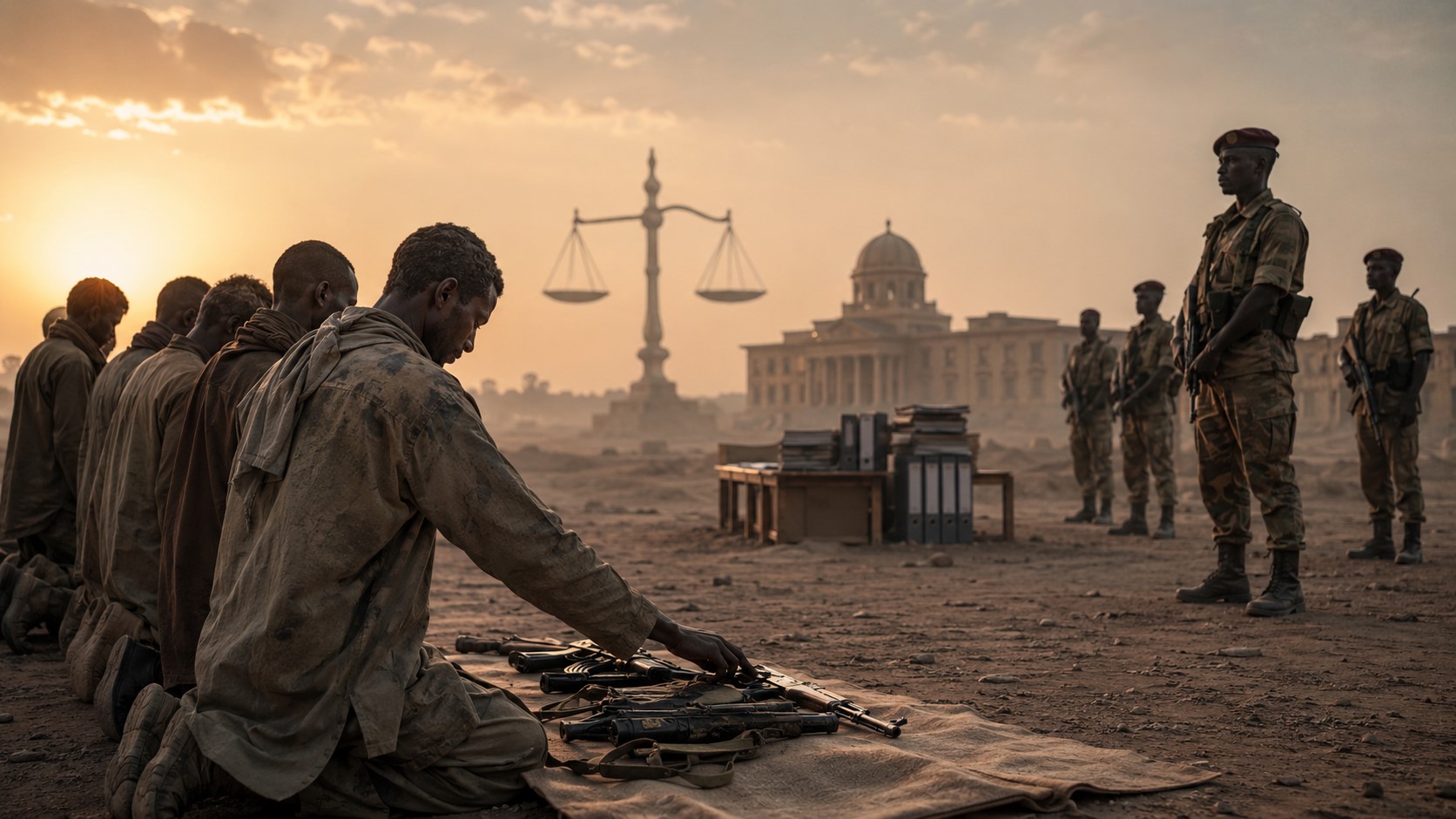
One of the most dangerous errors in the aftermath of war is to treat surrender as proof of innocence. Surrender is a military act; exoneration is a legal judgment. A person who surrenders to the state may have left the field of direct armed confrontation, but he does not automatically exit legal responsibility.
It is therefore essential to distinguish between different levels of responsibility: the ordinary fighter, the field commander, the person who issued orders, the person who participated in abuses, the person who incited, financed, or planned violations, and the person who exploited chaos to loot, retaliate, humiliate, or attack civilians.
A rational state does not equate these categories. Nor should it blur them in a way that wrongs victims or creates a loophole for impunity. A fighter against whom no crime against civilians has been established may be dealt with through security, rehabilitation, or legal pathways. But anyone who committed killing, rape, looting, abduction, forced displacement, or torture, or who ordered, knowingly tolerated, approved, concealed, or provided command cover for such crimes, should not escape accountability merely because he has joined the state’s side or surrendered his weapon.
The governing principle should be explicit: reintegration must not launder a record; it must remain a provisional status subject to legal vetting.
Surrender may remove an immediate military threat, but it does not erase the memory of a crime. It may help dismantle a militia, but it must not close the door to justice. Between these imperatives, the state needs institutional discipline: the capacity to distinguish between those who may enter a regulated security pathway and those who must remain within a criminal accountability process.
Comparative Experiences: Reintegration Does Not Abolish Accountability
The question of absorbing former fighters is not unique to Sudan. Many states emerging from civil war, armed rebellion, or mass violence have faced a similar dilemma: how to dismantle an armed force, restore the state’s monopoly over weapons, and prevent reintegration from becoming an open amnesty or a pathway to impunity.
No comparative experience can be transplanted wholesale from one country to another. Each conflict has its own history, social composition, political constraints, and scale of violations. Yet comparative experience offers a consistent lesson: reintegration may contribute to postwar stabilization, but it becomes dangerous when separated from legal vetting, accountability, and institutional oversight.
South Africa: Rebuilding the State’s Security Architecture
After the end of apartheid, South Africa’s new order was not built on the total exclusion of all previously armed formations. A unified national defense force was created by integrating former statutory forces with armed formations that had fought the apartheid system, including the African National Congress’s military wing, as well as other groups linked to different political actors.
The principal lesson is not that integration was unconditional. It is that the new state sought to rebuild its security architecture so that former armies and armed formations would not remain outside state authority. Integration formed part of a founding institutional project, not a reward for former fighters or a transactional exchange of loyalties.
South Africa, therefore, shows that the absorption of former adversaries can contribute to post-conflict state-building, but only when it takes place within a clear institutional framework, under state authority, and within a national vision that prevents armed power from re-emerging outside the state.
Nepal: Limited Integration After Screening
In Nepal, following the end of the civil war between the state and the Maoists, not all Maoist combatants were integrated into the army. Fighters underwent verification and screening and were offered options including integration, voluntary retirement, or rehabilitation. Ultimately, only a limited number entered the army after a process of evaluation and classification.
The lesson is clear: disciplined integration is not an open door to everyone who once carried a weapon. It is a selective process involving verification, classification, training, rank determination, and clear entry conditions into the military structure.
In Nepal, reintegration was not treated as an automatic political concession. It remained subject to institutional screening. Not all former Maoist combatants entered the army, and the end of the conflict did not erase the need to examine their prior roles. This is precisely what any state emerging from war requires: return to the military institution must never replace legal and security vetting, and surrender must never be treated as exoneration.
Colombia: Reintegration Under Transitional Justice
In Colombia, after the 2016 peace agreement with the FARC rebel movement, the state adopted a more complex model. It opened a path for the reintegration of former fighters into civilian and political life, while linking that process to a transitional justice framework based on truth, acknowledgment, reparations, and guarantees of non-repetition.
The importance of the Colombian experience lies in the fact that peace was not framed as forgetting. Those who sought to benefit from the peace process were expected to participate in truth-telling, acknowledgment, and reparative measures, rather than hide behind a political settlement.
The lesson is that return cannot be separated from truth. Opening the door to former fighters is insufficient if that return is not connected to disclosure, compensation, and accountability for grave crimes. Reconciliation that does not establish the truth may silence weapons temporarily, but it leaves the wound open in the memory of victims.
Rwanda: Distinguishing the Former Fighter From the Perpetrator of Genocide
Rwanda’s experience, despite its specificity and horror, offers a stark lesson. After the 1994 genocide, the state did not treat everyone associated with the opposing side in the same way. It distinguished between levels of responsibility: those who could enter disarmament and reintegration pathways, and those who had to remain subject to accountability as leaders, inciters, or perpetrators of genocide and serious crimes.
Multiple tracks were created, including an international tribunal for senior figures, broad local justice mechanisms to address the enormous number of accused persons, and programs to reintegrate some former combatants.
The lesson is severe but clear: a state cannot rebuild itself after a mass atrocity merely by absorbing those who once carried weapons. Nor can victims be honored through declarations of reconciliation alone. Reintegration cannot substitute for accountability. Reconciliation cannot become a cover for erasing responsibility. A state seeking to rebuild itself cannot equate the former fighter with the person implicated in mass crimes.
Comparative Conclusion
These experiences point to one central lesson: reintegration is not inherently wrong; the danger lies in reintegration without a mechanism in place.
In South Africa, integration formed part of rebuilding a unified national military institution. In Nepal, it was limited and subject to verification. In Colombia, it was tied to truth, reparations, and guarantees of non-repetition. In Rwanda, a clear distinction was drawn between those who could be reintegrated and those who had to face accountability for grave crimes.
For Sudan, the lesson is direct. The absorption of some surrendering fighters may be militarily useful in dismantling the RSF militia and accelerating the end of the war. But it cannot be legitimate unless it is tied to legal vetting, documentation, investigation, and accountability.
Comparative experience does not suggest that a state must close the door to every surrendering fighter. It does suggest that opening the door without conditions can turn reintegration from a tool for dismantling war into a means of recycling violence within state institutions.
Conclusion: From Reintegration to Justice
The reintegration of surrendering fighters cannot be separated from the conditions of war. It may serve a military purpose: weakening the militia, drawing away weapons, reducing operational capacity, and accelerating the restoration of state authority. But necessity must not become immunity. Surrender must not become innocence. Reintegration must not launder the record.
The question, therefore, is not whether the state may absorb some surrendering fighters. It is how that absorption takes place: under what conditions, through which legal safeguards, under whose supervision, and with what distinction between the fighter and the perpetrator.
This is where the second part begins. If the state says that victims’ private rights have not been waived, is that declaration enough? Or do those rights require a clear mechanism that protects victims, documents violations, preserves testimony, and prevents reintegration from becoming de facto immunity for those implicated in serious abuses against civilians?
About the Author
Sabah Al-Makki is a Sudanese researcher, writer, and journalist who writes in Arabic and English for Sudanese and regional platforms. She is Deputy Editor-in-Chief at Brown Land News. Her work examines geopolitics, political violence, international law, statehood, sovereignty, war, and the role of media in shaping public discourse, with particular attention to Sudan within its regional and global contexts. She is especially interested in hate speech, dehumanization, social fragmentation, and the rebuilding of national legitimacy. Her writing challenges dominant narratives, foregrounds voices often excluded from global discourse, and approaches journalism as a form of cultural and intellectual resistance. In this sense, she writes from within the storm.
𝑬𝒙𝒄𝒍𝒖𝒔𝒊𝒗𝒆𝒍𝒚 𝒑𝒖𝒃𝒍𝒊𝒔𝒉𝒆𝒅 𝒃𝒚 𝑩𝒓𝒐𝒘𝒏 𝑳𝒂𝒏𝒅 𝑵𝒆𝒘𝒔.
Where sovereignty is not negotiable, and truth defies revision.
Our Land. Our Voice. Our News.