
When the Guns Fall Silent
Part Two: Private Rights Cannot Be Preserved by Declaration Alone
A legal-political analysis of why postwar reintegration must be anchored in prosecutorial review, victim documentation, witness protection, reparations, and institutional accountability.
By Sabah Al-Makki

Where Is the Mechanism, and Where Is the Public Prosecution?
The first part of this series examined reintegration as one of the most delicate questions facing a state emerging from war. In certain circumstances, the absorption of surrendering fighters may serve a legitimate military purpose: dismantling an armed movement, fracturing its command structure, recovering weapons, extracting intelligence, weakening operational capacity, and accelerating the restoration of state authority.
Yet the governing principle remains unchanged: reintegration may serve military necessity, but it must never become exoneration.
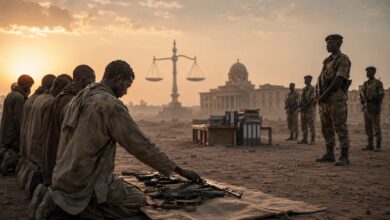
This distinction is particularly important in Sudan, where the surrender of commanders or elements affiliated with the Rapid Support Forces (RSF) militia may carry immediate security value. Such surrender can weaken the militia from within and assist the state in restoring its monopoly over force. But military utility does not confer legal absolution. A surrendering fighter does not become innocent by surrendering. A commander does not shed responsibility by changing sides. A weapon handed to the state does not erase the memory of a crime.
This is where the second question begins.
If the state says that victims’ private rights have not been waived, is that declaration enough? Can victims’ rights be protected through reassurance alone? Or must they be given institutional form through prosecutors, complaint mechanisms, witness protection, documentation, reparations, and a legal process capable of linking surrendering fighters to existing or future allegations?
At this point, the issue moves from military stabilization to the architecture of justice.
The state may decide that absorbing certain surrendering fighters is necessary to weaken the RSF militia and bring the war closer to an end. But it cannot leave victims alone to carry the burden of accountability. A citizen who has lost a child, a home, a livelihood, safety, or dignity does not need reassurance alone. That citizen needs a legal path.
A right without an institutional pathway is not preserved. It is merely deferred.
Public Right and Private Right Are Not the Same
The distinction between public right and private right is not merely legal. It lies at the heart of any credible postwar settlement.
The public right belongs to the state and society. It concerns violations of public order, national security, constitutional authority, and the institutional integrity of the state. It applies to those who carried weapons against lawful authority, threatened public security, rebelled against the state, or participated in dismantling its institutions.
In exceptional circumstances, the state may manage the public right with a degree of political or military flexibility. It may do so to end fighting, collect weapons, divide an armed movement, or accelerate the restoration of national stability. Such decisions may fall within sovereign judgment, provided they remain bound by law, public interest, and accountability.
Private rights belong elsewhere.
It belongs to the individual, the family, and the directly harmed community. It is the right of the mother whose son was killed, the father whose child disappeared, the woman who was violated, the family whose house was looted, the citizen whose home was burned, the community expelled from its land, and the person whose dignity was crushed before relatives and neighbors.
The state may exercise discretion over the public right. It cannot dispose of the private right on behalf of the victims.
It cannot pardon blood that was not shed from its own body. It cannot forgive property that was not stolen from its own treasury. It cannot waive the violation of a woman’s dignity, the burning of a family’s home, the disappearance of a loved one, or the destruction of a civilian life as though these injuries belonged to the state alone.
This is why the phrase “private rights are preserved” matters, but does not suffice. It does not close the question. It deepens it.
If private rights are preserved, where is the mechanism that preserves them? Who receives complaints? Who protects witnesses? Who links surrendered fighters to alleged violations? Who prevents military reintegration from becoming practical immunity, even where no formal immunity has been granted?
Without answers, the right remains acknowledged in language but suspended in reality.
When a Right Exists in Theory but Fails in Practice
A right without access to enforcement is a suspended right.
Victims of war are not ordinary claimants in ordinary times. Many have lost documents, homes, witnesses, livelihoods, and access to state institutions. Many have been displaced inside Sudan or forced to seek refuge abroad. Some do not know the perpetrator’s legal name. They know only a battlefield nickname, a face, a vehicle, a checkpoint, a unit, or the commander under whom he operated.
Others fear retaliation, especially when the person who harmed them has surrendered, been reintegrated, returned to arms, or entered an official structure.
In such conditions, it is not enough to tell citizens that their rights are preserved and that they may pursue whoever harmed them. The statement may be legally sound. In practice, it can become cruelly unrealistic.
How does a displaced person who has lost all their documents pursue an armed commander? How does a woman report sexual violence without confidentiality and protection? How does a grieving family prove responsibility when the perpetrator is known only by a nickname? How does an ordinary citizen confront a person who now wears an official uniform or benefits from tribal, political, or military cover?
This is where the responsibility of the state becomes greater, not smaller.
It is not enough to refrain from waiving private rights. The state must make those rights reachable.
Private rights do not survive through declaratory language alone. They require institutions capable of receiving claims, protecting evidence, preserving testimony, and converting injury into a justiciable record.
The Mechanism Required to Preserve Private Rights
If the state wants the phrase “private rights are preserved” to mean more than political reassurance, it must establish a clear, public, and institutional mechanism. Such a mechanism should rest on several connected pillars.
1. Specialized prosecution units for war crimes and grave violations
Cases involving killing, rape, looting, enforced disappearance, forced displacement, torture, abduction, humiliation, and the burning of homes should not be treated as isolated criminal complaints detached from the context of war.
Many of these crimes may form part of wider patterns of violence, territorial control, command responsibility, or systematic coercion. They require specialized prosecution units capable of collecting evidence, preserving testimony, mapping patterns, identifying chains of command, and distinguishing among direct perpetrators, field commanders, organizers, facilitators, and beneficiaries of the crimes.
Not every killing is isolated. Not every act of looting stands apart from the authority that controlled the area at the time. Not every violation can be understood without examining the structure of power that enabled it.
A serious justice process must be able to place individual complaints within the broader architecture of war.
2. A national register of victims and violations
Sudan needs a national register to document victims, missing persons, killings, looting, sexual violence, destroyed homes, stolen property, forced displacement, suspected perpetrators, and identifying details where full names are unavailable.
Such a register should also record the commanders, units, and armed formations that controlled specific areas at the time of the violations. It must be accessible to displaced persons, refugees, and those who have lost formal documents. It must also guarantee strict confidentiality, especially in cases of sexual violence.
Memory that is not documented can be erased. A right that is not recorded can later be denied.
Such a register would not be merely administrative. It would be historical, legal, and moral. It would prevent the destruction of evidence from becoming the destruction of truth.
3. Legal and security screening before reintegration
No surrendering fighter should enter a state institution as though his past began on the day he surrendered.
Every reintegration process must include legal and security screening. That screening should examine the individual’s previous rank, unit, area of operation, command role, known affiliations, and participation in military operations. It should also determine whether his name, nickname, description, unit, or commander appears in complaints, testimonies, field reports, or records of violations.
If serious allegations emerge, the individual’s status should be suspended. At a minimum, he should be barred from promotion, command responsibility, or authority over civilians until the matter is investigated.
Reintegration must not become a back door into authority for those who still have unresolved files with victims.
4. A clear exclusion of crimes against civilians from any settlement
The state must state, clearly and publicly, that no military settlement, political compromise, reintegration process, or amnesty can cover crimes against civilians.
Killing, rape, looting, torture, abduction, enforced disappearance, forced displacement, the burning of homes, and attacks on civilians cannot be erased by changing allegiance or handing over weapons.
Surrender may end an immediate military threat. It does not erase the victim’s memory. It does not extinguish the victim’s claim. It does not transform the perpetrator into a clean political actor.
A weapon can be surrendered in a day. Responsibility cannot.
5. Witness and complainant protection
A justice mechanism will fail if victims and witnesses are afraid to speak.
How can a citizen testify if his family remains exposed? How can a survivor of sexual violence come forward if her identity may be revealed? How can a displaced person submit a complaint if the accused or his associates can still reach him?
Sudan needs confidential reporting channels, witness protection procedures, secure mechanisms for testimony from inside and outside the country, and restrictions preventing accused individuals from returning to areas where victims live before screening and investigation are complete.
Without protection, the law exists on paper while fear governs reality.
6. A reparations and compensation fund
Justice is not achieved through prosecution alone. It also requires reparation.
Homes must be rebuilt. Looted property must be compensated. Families of the dead and missing need support. Survivors of sexual violence need medical, psychological, and social care. Children need rehabilitation. Communities need official recognition of the crimes committed against them.
A national reparations fund should be established and financed through confiscated assets, recovered militia funds, assets recovered from supporters, court-ordered compensation, fines, and international assistance, all conditioned on transparency and oversight.
A state that asks victims to trust the postwar order must show that justice is not abstract. It must be visible in their lives.
7. The right of victims to object to the reintegration of accused individuals
Victims and their families should have the right to object if a person accused of serious violations is absorbed into the army or any official institution.
Such an objection should trigger a formal review. If the complaint is serious, the person’s status should be suspended, and he should be barred from promotion, command responsibility, or civilian-facing authority until the investigation is completed.
Without this safeguard, reintegration may become an administrative shield around individuals whom victims recognize but fear to confront.
Only through such a mechanism can private rights become real rights, not elegant legal language.
The Missing Role of the Public Prosecution
At the center of this question stands the Public Prosecution.
Private rights are not protected by slogans. They require legal form, and it is the prosecution that must provide the pathway from complaint to accountability: receiving complaints, directing investigations, preserving evidence, classifying crimes, identifying suspects, and linking facts to perpetrators.
This raises a question as important as reintegration itself: where is the Attorney General in this process? Where are the specialized prosecution offices? Where is the public mechanism through which victims can file complaints related to wartime violations?
A state that says private rights are preserved must translate that statement into an announced legal pathway. It must tell victims where to go, how to report, how their testimony will be protected, and what happens when the accused person has surrendered or entered an official institution.
Citizens must not be left alone to confront individuals who may still be armed, socially protected, politically connected, or newly absorbed into formal structures.
The responsibility of the Public Prosecution in this phase is not administrative. It is foundational.
It is the institution capable of preventing the loss of evidence, preserving victims’ testimony, opening files on major violations, identifying patterns of organized violence, and ensuring that military reintegration does not become practical immunity for individuals named in serious complaints.
The absence of a clear prosecutorial mechanism creates a dangerous vacuum.
Victims do not need general promises. They need a known address. Where do they file complaints? Who receives their statements? How is evidence secured? How is confidentiality protected in cases of sexual violence? How are the names of surrendered or reintegrated fighters compared with records of violations? What happens if the accused is already inside a state institution?
The Attorney General should be at the center of this stage, not at its margins.
Private rights cannot be preserved without an active prosecution service, specialized offices, published procedures, instructions to prosecutors in war-affected states, and accessible channels for displaced persons, refugees, and those who have lost documents or witnesses.
Justice does not begin only when a court convenes. It begins when a victim knows where to go, whom to trust, how to speak, and who will ensure that fear, poverty, displacement, or the absence of documents will not bury the claim.
Conclusion: From Declaration to Enforcement
Saying that the state has not waived private rights is important. But it is only the beginning.
The real question is not whether private rights are preserved, but how.
Who documents the crimes? Who investigates them? Who protects witnesses? Who screens surrendering fighters? Who compensates victims? Who prevents an accused person from gaining command, authority, or promotion before his file is resolved? Who guarantees that murder, rape, looting, torture, forced displacement, and attacks on civilians will not disappear inside a military or political settlement?
Private rights cannot remain suspended in legal formulas. They must be accessible, protected, and enforceable.
That requires a visible Public Prosecution, clear complaint procedures, a national victims’ register, witness protection, legal screening of surrendering fighters, and a direct link between reintegration and accountability.
A state that says private rights are preserved must make those rights visible in its institutions, not merely present in its rhetoric.
The necessities of war may explain why a state negotiates surrender, absorbs defectors, or reintegrates certain fighters. But the foundations of peace cannot be built by silencing guns alone. Peace begins when victims know that justice has not been postponed indefinitely.
This is where Part Three begins: how have other postwar societies dealt with victims’ rights? And how can Sudan build a justice pathway that does not abandon victims, does not turn reintegration into immunity, and does not recycle the violence of war into the institutions of peace?
Read Part One here➡️: Reintegration Is Not Exoneration
About the Author
Sabah Al-Makki is a Sudanese researcher, writer, and journalist who writes in Arabic and English for Sudanese and regional platforms. She is Deputy Editor-in-Chief at Brown Land News. Her work examines geopolitics, political violence, international law, statehood, sovereignty, war, and the role of media in shaping public discourse, with particular attention to Sudan within its regional and global contexts. She is especially interested in hate speech, dehumanization, social fragmentation, and the rebuilding of national legitimacy. Her writing challenges dominant narratives, foregrounds voices often excluded from global discourse, and approaches journalism as a form of cultural and intellectual resistance. In this sense, she writes from within the storm.
𝑬𝒙𝒄𝒍𝒖𝒔𝒊𝒗𝒆𝒍𝒚 𝒑𝒖𝒃𝒍𝒊𝒔𝒉𝒆𝒅 𝒃𝒚 𝑩𝒓𝒐𝒘𝒏 𝑳𝒂𝒏𝒅 𝑵𝒆𝒘𝒔.
Where sovereignty is not negotiable, and truth defies revision.
Our Land. Our Voice. Our News.