
⭕️From Bosaso to Bangui… How the UAE’s War in Sudan Became an International Criminal File
✒️Ammar Al-Araki
UAE support for the Rapid Support Forces militia is no longer merely a rumor or a media leak. It has become clearly visible to regional and international public opinion as a fully structured project, its interconnected threads unraveling one by one — from Bosaso in Somalia to Bangui in the Central African Republic, from Red Sea ports to the airports of Darfur.
Every time the world believes it has uncovered one thread of this war, a new knot emerges, confirming that what is happening in Sudan is not merely an internal conflict but a complex regional operation managed through networks of mercenaries, logistical corridors, and fragile states that have been converted into transit platforms for Abu Dhabi’s project across Africa.
Today, new information regarding the transfer of Colombian mercenaries through the Central African Republic to Nyala in Darfur confirms that the “UAE Puntland Project” was only the beginning of a far larger network — one now extending westward toward Bangui, where the Central African Republic is gradually being transformed into a rear base for sustaining the war in Sudan and revitalizing the militia, particularly following the internal splits, fragmentation, accusations of treachery, and heavy battlefield losses in Darfur and Kordofan.
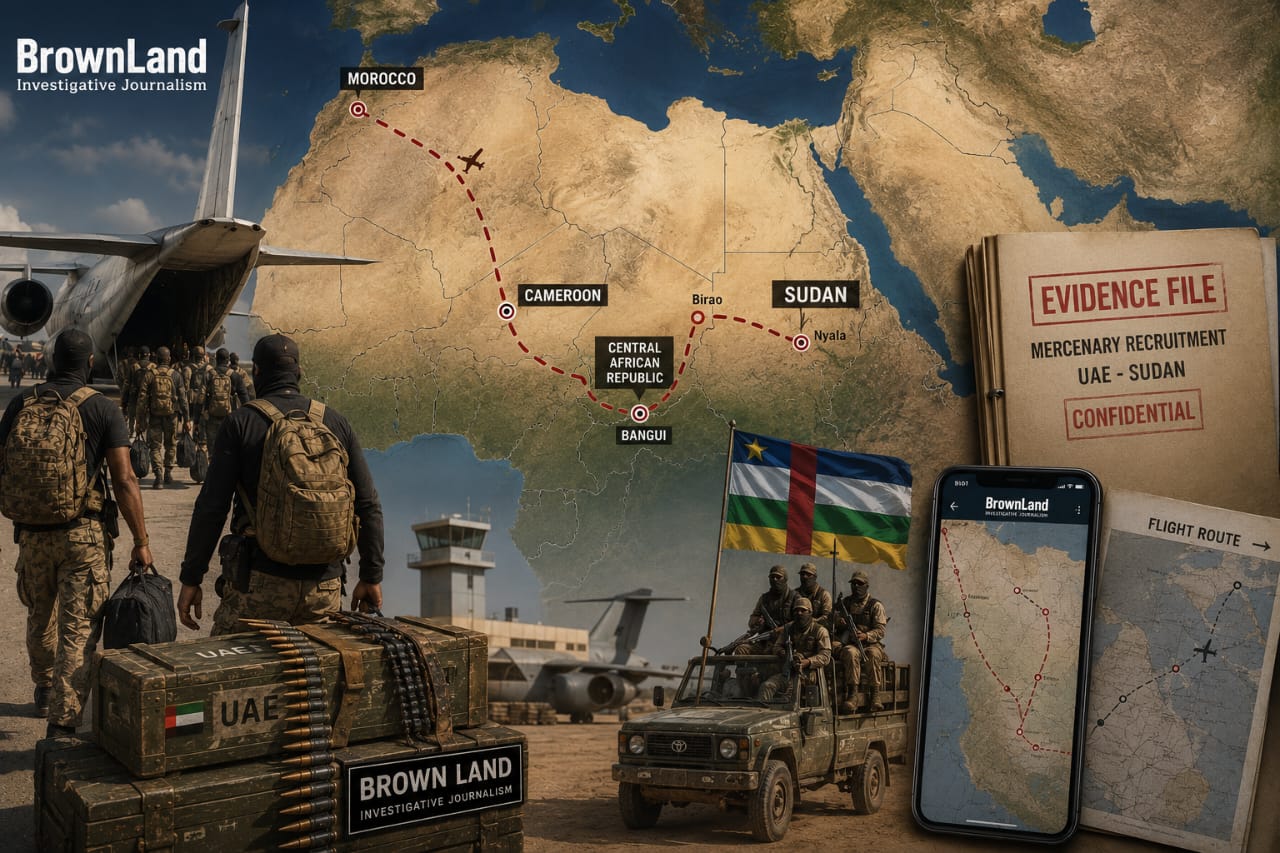
The report revealed by Africa Intelligence represents a profoundly significant development in the very nature of the war. We are now confronted with a systematically organized operation to transport foreign combat elements of high military expertise — moved via a complex air route beginning in Morocco, passing through Cameroon, then Bangui, then Birao, finally arriving in Nyala — an operation bearing all the hallmarks of professional intelligence and logistical coordination.
More critically, the report linked the financing of these mercenaries to a private company headquartered in the UAE, with documented ties to senior officials in Abu Dhabi. This re-establishes a truth that the UAE has long sought to obscure: that the Rapid Support Forces did not operate alone, but rather within a massive regional support network managed by Abu Dhabi — politically, financially, and logistically.
In this context, the investigative reports published by Brownland newspaper played an important role in exposing the logistical structure of this project, particularly regarding the movement of ships and aircraft between Dubai and Bosaso, the routes of suspicious container transfers, and the repeated presence of Colombian mercenaries inside Bosaso airport. The newspaper also revealed — through maritime tracking data, field photographs, and local testimonies — how the port of Bosaso had been transformed into a regional supply platform directly linked to networks of UAE influence in Sudan and the Horn of Africa.
What is happening today in Bangui closely mirrors what previously occurred in Bosaso: the same methods, the same tools, and the same underlying concept of converting fragile regions and weak states into rear platforms for proxy wars. In Bosaso, the UAE used ports, airports, and local influence in Puntland to build a supply corridor toward Darfur. Today, it appears to be replicating the exact same model in the Central African Republic, this time through the gateways of Bangui and Birao.
The complete picture is now coming into sharper focus: the UAE is not merely supporting a militia — it is constructing an entire geography of war surrounding Sudan. To the east, through Bosaso and the Gulf of Aden. To the west, through Bangui, Chad, and Niger. And from within, through the Rapid Support Forces and mercenary networks. This is a transparent effort to encircle and besiege Sudan with a logistical and military belt designed to ensure the militia’s survival even as it suffers battlefield setbacks. Accordingly, the recruitment of Colombian mercenaries at this precise juncture cannot be seen in isolation from the recent military developments in Darfur and Kordofan, where the militia has absorbed severe blows that have compelled Abu Dhabi to seek urgent measures to reconstitute its fighting capacity.
Given that Colombian mercenaries are well known for their expertise in guerrilla warfare and irregular combat, their deployment signals that the conflict has escalated to a more complex and dangerous level — particularly as mounting indicators suggest the existence of external operations rooms overseeing the militia’s field reorganization.
Most alarming of all is that the Central African Republic itself appears to be gradually drawn into the heart of the Sudanese conflict. The deepening relationship between Bangui and Abu Dhabi is no longer limited to economic or political cooperation; it has begun to take on clear security and military dimensions. President Touadéra’s repeated visits to the UAE, and the country’s growing financial dependence on Abu Dhabi, have opened the door to extensive UAE penetration of decision-making structures in the Central African Republic — making it an ideal corridor for covert operations far removed from international oversight.
This raises the most important question: Has Bangui become the western equivalent of Bosaso? All indicators say yes. What was being managed east of Sudan through the Red Sea is now being expanded westward through the African Sahel. Between these two corridors flow weapons, mercenaries, and money, while civilians in Darfur and Kordofan pay the price in blood, displacement, and genocide.
What has occurred and continues to occur in Darfur in recent days cannot be separated from these networks. The militia committing massacres is not an isolated local entity — it is the field arm of a cross-border regional project. Every mercenary who arrives in Nyala, and every arms shipment that passes through Bangui or Bosaso, ultimately becomes a bullet in the chest of a Sudanese child, or a shell falling on a home in Darfur or a hospital in Kordofan.
Yet the most dangerous recent development is that this project is no longer solely under political siege — it has begun to enter the arena of international legal prosecution. The proceedings initiated in Colombia and the United States reveal that the Colombian mercenary file is no longer being viewed as “private security contracting” but rather as activity falling within the crimes of human trafficking and the financing of unlawful warfare.
Bogotá has moved from political condemnation to open legal warfare, after Colombian President Gustavo Petro ratified a law officially criminalizing the recruitment of Colombians for participation in international conflicts — granting authorities broad powers to pursue the companies and intermediaries involved in recruitment operations.
Crucially, the Colombian investigations are no longer targeting the fighters themselves, but rather “the masterminds” — the companies, brokers, and financiers who manage recruitment operations from Abu Dhabi and Dubai under the cover of private security firms.
American sanctions targeting recruitment networks linked to the UAE, alongside UN reports on mercenary transfer routes through Libya and Chad, have for the first time begun to place the UAE’s project under mounting international legal and financial pressure.
Most gravely, Colombian and American courts have begun using WhatsApp recordings and the GPS data of fighters to establish that they were transferred from Dubai to Libya and then to Sudan without genuine knowledge of the true nature of their mission — a development that transforms the case from “mercenary activity” to “human trafficking and modern slavery.”
The full picture is now coming into unprecedented clarity: what was once presented as political support or security cooperation has gradually become an internationally documented criminal file — recorded with names, companies, financial transfers, and flight paths. Bosaso, Bangui, Libya, and Chad are no longer mere transit points; they are potential pieces of evidence in the largest irregular military supply network the region has witnessed in recent years.
This is precisely what grants Sudan a rare strategic opportunity. The battle is no longer confined to the battlefield — it has moved to courts, sanctions, and international public opinion.
Khartoum today holds a genuine opportunity to transform the mercenary file from a media controversy into a fully constituted international legal case, by directly linking UAE support to war crimes and mass violations in Darfur and El Fasher.
Furthermore, these developments open the door to building new regional alliances with countries adversely affected by the expansion of UAE influence — chief among them Turkey, which views with growing alarm Abu Dhabi’s attempts to encircle its influence in the Horn of Africa and the Sahel.
In Conclusion
Gradually and unmistakably, the picture is becoming clear as never before. Bosaso was not an isolated stop. Bangui is not a passing footnote. And the Colombian mercenaries are not mere hired fighters. This is a fully integrated war network. For this reason, the real battle is no longer only in Darfur or Kordofan — it is in the routes that lead there, and in the capitals from which this war is silently managed, while Darfur is left to bleed alone.