When the Masks Fall: The “Sumoud” Alliance and the Crisis of Public Trust in Sudan
A Scene from the Heart of the Tragedy
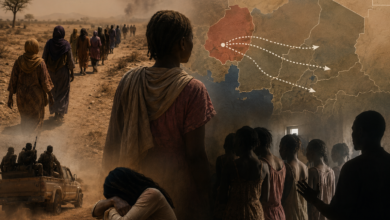
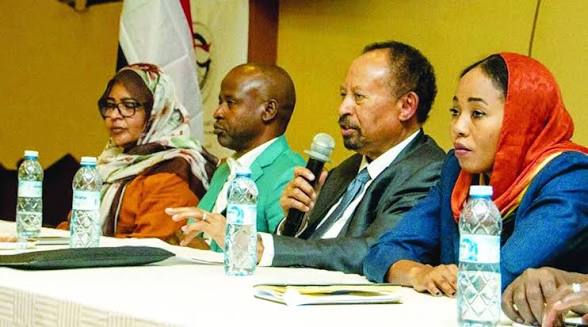
In the displacement camps scattered on the outskirts of Sudan’s besieged cities, where survivors of the war’s inferno crowd together, one question is repeated with bitter persistence on the lips of the displaced: “Where is Sumoud?” This is no innocent question — it is a silent indictment of a political alliance that claimed to represent the voices of Sudanese civilians, only to find itself in voluntary exile, holding meetings in Addis Ababa, London, and Nairobi while the homeland burns.
Since the founding of the Democratic Civil Alliance of Revolutionary Forces — “Sumoud” — on the eleventh of February 2025, following the collapse of the “Taqaddum” coordination body and its self-dissolution amid bitter disputes over a parallel government, the alliance led by former Prime Minister Abdallah Hamdok has faced an existential challenge that goes far beyond political disagreements: a deep crisis of public trust that, given current realities, appears nearly impossible to resolve.
I. The Alliance Born in a Moment of Fracture
Sumoud did not come into being under favorable circumstances. It emerged in the aftermath of the Taqaddum phase, which had stirred widespread controversy over what many Sudanese perceived as an implicit alignment with the Rapid Support Forces — a phase that ended in internal rupture when several constituent factions refused to be drawn into forming a parallel government in militia-controlled territories. Yet the faction that preserved itself to form Sumoud could not escape the weight of that legacy; the Sudanese street does not easily distinguish between one phase and another, but judges the entire trajectory as one.
According to Sudanese political observers, the public carries what might be called a “transitional memory” — one that bundles together, in a single indictment, all the failures of the Forces of Freedom and Change since 2019, through the October 2021 coup, and on to the Addis Ababa agreement and the catastrophic war that erupted in April 2023. This renders any attempt by Sumoud to present itself as a clean civilian force a collision with a solid wall of suspicion and rejection.
II. The Absence of a Symbol and the Erosion of the Base
Abdallah Hamdok played a pivotal role in lending Sumoud some measure of credibility, carrying a technocratic record and a civilian biography that conferred upon the alliance a degree of international acceptance. Yet the problem lies in the fact that Hamdok himself has become a controversial figure within Sudan; he is the man who signed the framework agreement that, in the view of many, paved the way for events that ultimately led to the military confrontation. Critics argue that the man who was once a “symbol of civilian rule” has become a political liability that is not easily shed.
Added to this is what multiple reports have noted: the declining role of the Resistance Committees — the grassroots network that had been the backbone of the December 2018 revolution — in supporting the alliance. These committees have fractured sharply, with a wide segment refusing to engage with Sumoud over its entangled positions on the RSF file, while some young cadres have abandoned the political scene altogether, despairing of parties and alliances alike.
III. The “Rational Solution” and the Problem of Timing
When the Sumoud alliance published its political vision in June 2025 under the title “A Political Vision for Ending Wars, Restoring the Revolution, and Founding the State,” some analysts described it as “a lengthy essay in which opinion, analysis, and roadmap are intertwined.” Perhaps the deeper problem lies in the fact that the document proposed two transitional phases spanning ten years — something critics viewed as an entrenchment of the transitional disorder that Sudan had suffered since independence.
Critics also pointed to a striking contradiction within the document: while it mentions the military establishment eight times, it refers to the Rapid Support Forces only twice, and indirectly at that. In a Sudanese climate living through a moment of anguish and anger over the militia’s atrocities, this linguistic choice appears to be a deliberate avoidance of provoking an implicit ally, rather than a vindication of the victims of war.
IV. The Detached Elite and the Bitterness of the Street
Perhaps the single phrase that captures all of these problems is what Sudanese citizens repeat across digital spaces and displacement camps alike: “ivory towers.” Most of Sumoud’s leadership resides in regional and Western capitals — Addis Ababa, Cairo, London, Dubai — far removed from the groans of the wounded in Omdurman’s hospitals and the cries of the hungry in Khartoum’s neighborhoods. This physical geographic distance is seen by many as reflecting a deeper moral and political estrangement.
In October 2025, the alliance held a consultative meeting with the mediation team composed of the United Nations, the African Union, the Arab League, and IGAD, in an attempt to present its vision for ending the war. Yet this international engagement, rather than bolstering the alliance’s standing among the public, deepened the suspicions of a broad segment of Sudanese who view international intervention not as an instrument of rescue, but as a threat to national sovereignty.
Is There a Path Back?
The crisis of trust between Sumoud and the Sudanese street remains hostage to interlocking factors that cannot be untangled by statements and political documents alone. Trust, as political scientists tell us, is built in moments of difficulty and cannot be recovered through white papers. The Sudanese people — living through the brutal experience of war — possess a sharp collective memory that does not forget those who abandoned them in moments of trial. Unless there is a fundamental change in positions, and not merely in rhetoric, Sumoud will remain bound by this crisis for the foreseeable future.