Sudanese National Security: Between Existential Challenges and Regional Stakes
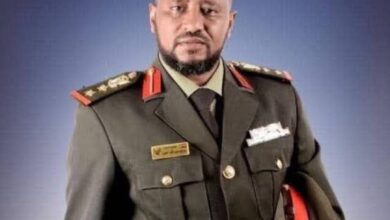
An Interview with Brigadier General Dr. Al-Sawarmi Khalid Saad, Former Official Spokesperson of the Sudanese Armed Forces
Conducted by: Badreldin Abdulrahman
Sudanese national security is considered one of the most prominent and vital pillars of the state, requiring the concerted efforts of all those who care about the country’s supreme interests in the coming period. Sudan is going through a difficult, critical, and complex situation that demands the building of a strong internal front capable of helping the country escape its current predicament.
“Brawn Land” conducted an interview with Brigadier General Dr. Al-Sawarmi Khalid Saad, Former Official Spokesperson of the Sudanese Armed Forces, covering political and security issues with regional and international dimensions.
● Sudanese national security faces complex existential challenges, most notably the war launched by the rebel Rapid Support Forces militia. Can it be said that Sudan has passed this critical historical turning point?
Sudanese security still requires considerably more effort to reach a state of balance. Yes, the RSF has withdrawn from the areas it controlled in Khartoum and Al-Jazirah, but its threat remains present in Darfur and Kordofan. Therefore, we say that security still requires a great deal of effort. In truth, as long as there are forces other than the regular armed forces carrying weapons, this represents the greatest national threat. A state cannot achieve security balance unless there is truly one army, not multiple armies. Accordingly, all forces outside the army’s umbrella, and all civilians carrying weapons, represent a deduction from state security. Weapons must be confined to the regular forces only, and heavy combat weapons must be restricted to the army alone — meaning that even regular forces are armed according to their specific combat specialization.
● Regional and international interventions have played a major role in prolonging the current war. In your view, what decisive measures can curb such interference both now and in the future?
Resolving foreign interventions in states is among the most difficult things to achieve, because countries that interfere in internal affairs are always powerful — financially, militarily, or politically. It is therefore extremely difficult to restrain countries that target you with interference. We know that the most influential country on the political and military course of events in Sudan is the United States, through the numerous sanctions it imposes on the government — making it the sole country responsible for punishing Sudan in ways that hinder its ability to fight the rebels. There are also accusations, as we know, against other countries, but restraining them is extremely arduous and requires smart diplomacy and state strength in terms of both political activity and military power. Sudan currently suffers from severe weakness due to the American sanctions imposed on it, as well as American policies that play a very significant role in perpetuating this global political suppression directed against the Sudanese government.
● The internal political response has not been commensurate with the magnitude of the threats facing Sudanese national security. How do you view this important aspect?
In truth, we see that the internal political activity of the various political groups is negative across all fronts, because internal conflicts are the real fuel of this war. Sudan suffers greatly from the divisions and internal problems adopted by its political groups — whether traditional parties, entities, armed movements, or religious and Islamist movements. There is currently no consensus among them, no common ground or bond linking these competing currents. Political consensus, despite its importance, is given no weight by these warring factions. It is therefore extremely difficult to deal with these currents, which never converge on any issue, however minor — there are always differing views and conflicts, and sometimes they descend into physical altercations in conference halls, throwing chairs, as we have witnessed when they convene. The divide between these competing currents is vast.
● One of the key objectives of the current war, according to foreign ambitions, is to destabilize the state and its institutions and work toward their collapse, making it easier to control Sudan and exploit its abundant economic resources. To what extent has this been achieved, and how can Sudan protect its internal framework in relation to this issue?
There is no doubt that Sudan’s many enemies work around the clock to achieve their hostile objectives. Sudan is a targeted state, but this targeting has reasons on the part of those who target it. They indeed want it weak, divided, and unable to protect itself against their economic, commercial, and political ambitions. The only solution — the correct course of action — to confront these global ambitions is our unity and the unification of our goals. The people of Sudan must awaken and stand as one front against this raging assault, which has set us far behind other nations. Without our unity, solidarity, and collective action, we cannot achieve any security or stability for our beloved homeland.
● The greatest threat to Sudanese national security is the direct support of neighboring countries for the RSF militia. How can this be interpreted?
Some neighboring countries directly support the RSF militia, and this poses a clear and present danger. But more dangerous still is the indirect support, which is not visible to the naked eye yet erodes the state’s strength and affects its security and stability. Neighboring countries’ interference in any security matter constitutes an act undermining national security and often leads to invisible, unseen conflicts. As a result, security personnel inside Sudan cannot perform their duties as required when there is a hidden enemy operating indirectly.
● Could the current war be a cause for the proliferation of weapons and organized crime, particularly human trafficking, drug trade, and illegal migration — all of which are also major threats to national security?
In truth, we can see now that this war has indeed led to the widespread proliferation of weapons illegally and on a massive scale, and has led to a horrifying spread of crime. Sudan could, because of this, even be classified as the worst country in the world for human rights violations. The current war has produced numerous negative consequences now playing out before the eyes of the world, all stemming from the security breakdown, which is responsible for many of the negative phenomena Sudan is experiencing today. National security can never be set right unless an end is put to these security breakdowns, these ongoing battles, and this raging war in Sudan. Without the war stopping, crime will never stop.
● Transitional governance institutions lacked clear vision in supporting the war effort, particularly on the political and media fronts — which were the weakest points in the course of the war. How do you see this?
It is well known that transitional governments focus entirely on maintaining the status quo, without attempting to develop long-term strategic plans, since they are not mandated to do anything beyond preserving the current situation. Any genuine creativity or achievement is never of concern to transitional governments. Prolonging the transitional period is therefore fundamentally a setback for the state and for the citizen, leading to stagnation and an inability to move forward — while nations around you advance and you remain waiting. This must be remedied so that the Sudanese people can keep pace with other nations and develop and progress. A rapid transition to a stable, permanent government is indispensable. The proof, as you noted, is the weakness in political and media infrastructure, which has been fundamentally affected by the absence of a stable government and the prolonged transitional period.
● The Quartet has failed to achieve the required breakthrough. Why?
First, the Quartet’s failure stems from its very composition — it is made up of countries that everyone knows have played negative roles in Sudan. The Quartet includes the United States, which is the world’s foremost country in imposing sanctions on Sudan, and thus the principal country obstructing the Sudanese army through sanctions that prevent it from fulfilling its duties or resolving anything. Regrettably, they proclaim that the RSF is committing crimes amounting to genocide and war crimes and so forth, yet there is no actual reaction from the Quartet. It will continue to fail in the future because it has no genuine performance in combating or confronting what is happening in Sudan — there are only theories, assumptions, and talk, and talk neither feeds nor satisfies. Sudan has consequently begun to view the UAE and the United States with suspicion and doubt, and continues to view Egypt’s role with skepticism as well, knowing that Egypt alone cannot achieve anything, nor can Saudi Arabia. The reason the Quartet has failed thus far is that it has no practical steps to confront and combat the security breakdowns inside Sudan — nothing but theories, assumptions, and words that accomplish nothing.
● Can Saudi–American joint efforts succeed in reaching a just peace?
I do not believe that joint Saudi–American efforts will lead to a decisive solution that stops the war in Sudan. Yes, Saudi Arabia has very good intentions, but America — with the numerous sanctions it imposes on us and insists upon so adamantly — makes it impossible for any joint efforts to bear fruit. America fundamentally does not support the Sudanese government and considers it, as a central part of its agenda, a government under sanctions — and sanctions are only directed at criminals. This is a contradiction between word and deed in what America declares about wanting to reform Sudan’s affairs while imposing such harsh and devastating sanctions upon it.
● The rebel RSF militia has committed unprecedented crimes sufficient for it to be internationally classified as a terrorist militia. Why has this not happened?
Indeed, the RSF militia has not been classified as a terrorist militia to date. The reason is that those responsible for making such designations are themselves opposed to the Sudanese government and classify it as an unstable transitional government, and thus hesitate even to engage with it. The African Union, for example, continues to suspend Sudan’s government membership on the grounds that it is a transitional government that overthrew Hamdok’s government and so forth. There are therefore residual issues that cause international bodies and organizations to delay classifying this militia as a terrorist organization — because they want, in short, to remain neutral. We know that the majority of Arab and world countries stand neutral on Sudan’s conflict, and this is what delays the classification of the militia as a terrorist one.
● How can the recent visits by the Chairman and Deputy Chairman of the Sovereignty Council and the Prime Minister to international institutions and influential foreign countries be read in light of the external factors affecting national security?
There is no doubt that these visits represent excellent and strong diplomatic work, and the government must move diplomatically in a clear and very forceful manner. However, these efforts have so far yielded no tangible results, because many of the countries visited view Sudan and the Sudanese government with suspicion — sometimes classifying it as an Islamist movement government or Islamist groups — and consequently the results have been weak. Regardless, diplomatic engagement is absolutely essential, and without it we can never succeed at anything.