
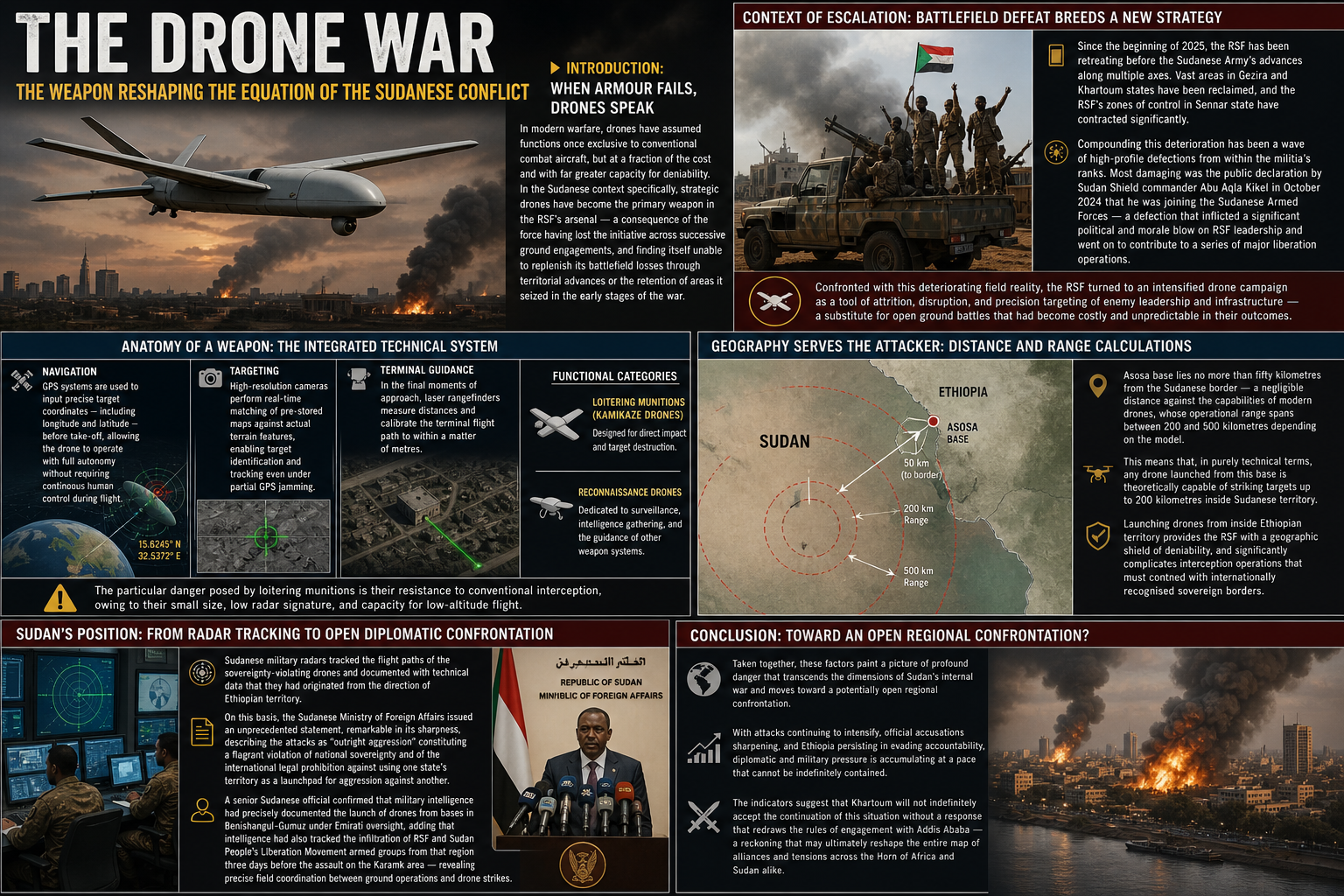
The Drone War —The Drone War — The Weapon Reshaping the Equation of the Sudanese Conflict
Exclusive_ Brown Land
When Armour Fails, Drones Speak
In modern warfare, drones have assumed functions once exclusive to conventional combat aircraft, but at a fraction of the cost and with far greater capacity for deniability. In the Sudanese context specifically, strategic drones have become the primary weapon in the RSF’s arsenal — a consequence of the force having lost the initiative across successive ground engagements, and finding itself unable to replenish its battlefield losses through territorial advances or the retention of areas it seized in the early stages of the war.
Context of Escalation: Battlefield Defeat Breeds a New Strategy
Since the beginning of 2025, the RSF has been retreating before the Sudanese Army’s advances along multiple axes. Vast areas in Gezira and Khartoum states have been reclaimed, and the RSF’s zones of control in Sennar state have contracted significantly. Compounding this deterioration has been a wave of high-profile defections from within the militia’s ranks. Most damaging was the public declaration by Sudan Shield commander Abu Aqla Kikel in October 2024 that he was joining the Sudanese Armed Forces — a defection that inflicted a significant political and morale blow on RSF leadership and went on to contribute to a series of major liberation operations.
Confronted with this deteriorating field reality, the RSF turned to an intensified drone campaign as a tool of attrition, disruption, and precision targeting of enemy leadership and infrastructure — a substitute for open ground battles that had become costly and unpredictable in their outcomes.
Anatomy of a Weapon: The Integrated Technical System
The strategic drones deployed operate on a sophisticated, multi-layered technical architecture. In terms of navigation, GPS systems are used to input precise target coordinates — including longitude and latitude — before take-off, allowing the drone to operate with full autonomy without requiring continuous human control during flight. For targeting, high-resolution cameras perform real-time matching of pre-stored maps against actual terrain features, enabling target identification and tracking even under partial GPS jamming. In the final moments of approach, laser rangefinders measure distances and calibrate the terminal flight path to within a matter of metres.
Functionally, these drones fall into two principal categories: loitering munitions — commonly known as kamikaze or suicide drones — designed for direct impact and target destruction; and reconnaissance drones dedicated to surveillance, intelligence gathering, and the guidance of other weapon systems. The particular danger posed by loitering munitions is their resistance to conventional interception, owing to their small size, low radar signature, and capacity for low-altitude flight.
Geography Serves the Attacker: Distance and Range Calculations
Asosa base lies no more than fifty kilometres from the Sudanese border — a negligible distance against the capabilities of modern drones, whose operational range spans between 200 and 500 kilometres depending on the model. This means that, in purely technical terms, any drone launched from this base is theoretically capable of striking targets up to 200 kilometres inside Sudanese territory — areas previously considered well beyond the reach of RSF strikes. Beyond this, launching drones from inside Ethiopian territory provides the RSF with a geographic shield of deniability, and significantly complicates interception operations that must contend with internationally recognised sovereign borders.
Sudan’s Position: From Radar Tracking to Open Diplomatic Confrontation
Sudan did not limit its response to field monitoring and verbal condemnation — it moved toward an open diplomatic confrontation with its Ethiopian neighbour. Sudanese military radars tracked the flight paths of the sovereignty-violating drones and documented with technical data that they had originated from the direction of Ethiopian territory. On this basis, the Sudanese Ministry of Foreign Affairs issued an unprecedented statement, remarkable in its sharpness, describing the attacks as “outright aggression” constituting a flagrant violation of national sovereignty and of the international legal prohibition against using one state’s territory as a launchpad for aggression against another.
A senior Sudanese official confirmed that military intelligence had precisely documented the launch of drones from bases in Benishangul-Gumuz under Emirati oversight, adding that intelligence had also tracked the infiltration of RSF and Sudan People’s Liberation Movement armed groups from that region three days before the assault on the Karamk area — revealing precise field coordination between ground operations and drone strikes.
Toward an Open Regional Confrontation?
Taken together, these factors paint a picture of profound danger that transcends the dimensions of Sudan’s internal war and moves toward a potentially open regional confrontation. With attacks continuing to intensify, official accusations sharpening, and Ethiopia persisting in evading accountability, diplomatic and military pressure is accumulating at a pace that cannot be indefinitely contained. The indicators suggest that Khartoum will not indefinitely accept the continuation of this situation without a response that redraws the rules of engagement with Addis Ababa — a reckoning that may ultimately reshape the entire map of alliances and tensions across the Horn of Africa and Sudan alike.