
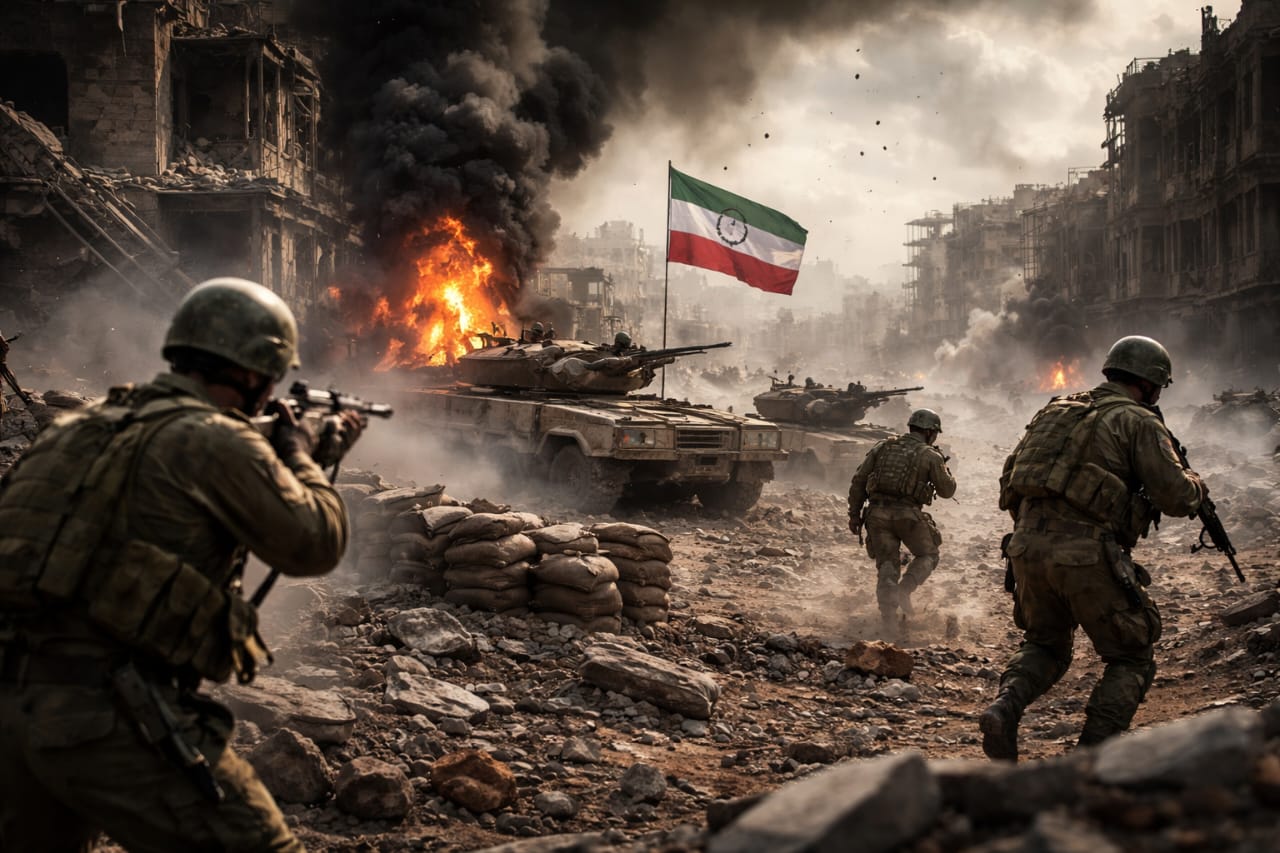
The Iranian-American-Israeli War in the Gulf: Some Military Consequences
Brown land
Following the end of the Third Gulf War (or at least its cessation during negotiations and diplomatic efforts to resolve the crisis), several military consequences emerged that warrant attention.
In this context, it should be noted that the airstrikes and downing of American fighter jets constituted a strategic turning point, striking at the very core of the concept of absolute air superiority. As a result, airspace is no longer a safe environment, even for the most advanced platforms. This forces the United States to reassess its risk criteria and the scope of its involvement, sending a clear deterrent message: the price of intervention is no longer cheap. This development directly impacts decisions regarding escalation and participation in the war, as well as the United States’ image as a leading air power and its global reputation. It also serves as a valuable lesson for Washington’s global strategic rivals, Russia and China.
For the first time in Israel’s history, its territory was subjected to such a volume and type of missile and drone strikes that reached sensitive sovereign, military, and security targets. This represents a direct collapse of one of the cornerstones of Israeli security doctrine: the transfer of the war to enemy territory and its prevention from spilling over into Israel. This is not merely a tactical development, but a destruction of previous rules of engagement and a fundamental reassessment of the limits of deterrence.
Furthermore, the war demonstrated that the notion of absolute Israeli superiority is largely an illusion. This advantage, despite its relative reality, is susceptible to erosion under the pressure of a protracted war of attrition, especially when the adversary is willing to bear the costs and acts according to the logic of troop buildup rather than launching a swift and decisive strike. Reports also indicated that the vast majority of Israel’s arsenal of surface-to-air missiles and rockets has been depleted, further complicating its military position should the conflict resume.
There is a clear shift in the nature of deterrence: from a model of total prevention to one of managing strikes and their consequences. This signifies a transition to a situation where attacks are no longer entirely prevented, but rather accepted as a constant factor to be lived with.
Moreover, air defense systems, despite their multi-layered defense capabilities, have demonstrated their limitations. Saturation tactics, mass attacks, and electronic jamming not only overwhelm these systems but also force them to operate under constant pressure, creating vulnerabilities that cannot be fully closed.
A rigid attrition model is emerging as a result of this war: the cost of defense far exceeds the cost of offense. Every interception operation requires enormous resources, while offense relies on cheaper and more effective means. In the long run, this disparity becomes unsustainable.
In the same vein, the war reaffirmed that Israel operates with structural support from the United States—military, intelligence, and political. At the same time, it became clear that even the scale of this support has its limits and cannot prevent all breaches. Based on this, many experts declared that if Israel were to confront Iran directly without American assistance, it would not be able to withstand a prolonged conflict.
The Gulf conflict also demonstrated that Israel is unprepared for asymmetric warfare, where the weaker party avoids direct confrontation and relies on flexibility, force distribution, a variety of tools, and a protracted war of attrition.
In conclusion, it must be said that Iran effectively exploited this technological uncertainty. By not revealing its full capabilities, Iran has managed to mislead Israeli and American assessments of its missile and drone capabilities, a key factor in conflicts of this type.
On the diplomatic front, the negotiations held in Pakistan have yielded no results so far, after approximately 21 hours of talks between the Iranian and American delegations. Therefore, a return to war remains a possibility.