Donald Trumps election win means Africa taking back seat to U.S. foreign policy?
By Jehron Muhammad
@JehronMuhammad
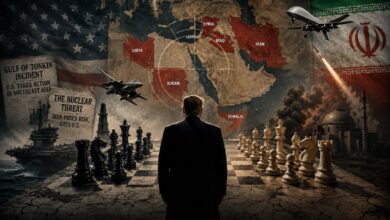
America’s just ended November 5 presidential race with a win for Donald Trump matters for just about every region on earth. But the fact that unintended consequences, including Israel’s expanding genocidal war in the Middle East, including Gaza, the West Bank and now Lebanon, and Russia’s war with Ukraine has relegated Africa to taking a back seat.
In fact, according to the recently released report by the Washington D.C. based Center For Strategic & International Studies (CSIS), U.S. presidential elections “have mattered less in Africa.” The report titled: “What U.S. Elections Could Mean for Africa,” explains, “a bipartisan policy consensus in Washington has largely prevailed. Washington’s fundamental approach to the continent has not varied substantially from one administration to the next.”
Applying this question about the influence of the election on Africa to the South African based researcher at the Southern and East African Trade Institute (SEATI), Riaz Tayob. An attorney and an economist Tayob said during a phone interview, “All I can say is that, yeah, it’s a uni-party buddy on issues that affect Africa or Gaza, or anything important internationally. It doesn’t really matter who (Democrat or Republican) comes on board.”
Add to that he said, “A good way of looking at how the deep state (corporate interest or lobbying groups like the American Israel Public Affairs Committee) deals with the Republicans, and the Democrats.” He explained, “It’s like you’re having a coalition government. You (may) come from different positions and ideologies (but) you work a synthesis that somehow makes it work.”
The CSIS report notes the U.S. governments development plans and security issues for Africa remain pretty much in tack whether under a Democrat or Republican administration. “Washington’s fundamental approach to the continent has not varied substantially from one administration to the next. Indeed, since the Clinton administration, the U.S. approach to Africa has followed a similar formula involving signature development programs, aspirational talk around democracy and human rights, and ever-expanding security partnerships that have kept ties to the continent on a steady trajectory, but not much more.”
African’s the report suggests had hope that Barack Obama, a president with African roots, would have the continents interest. “However, the notion that a U.S. president with African roots would somehow fundamentally elevate the continent’s importance in Washington was quickly dispelled by an Obama administration that did not stray far from traditional orthodoxy toward Africa: braying about democracy and human rights while also pursuing national security interests that often ran contrary to its stated values. The U.S.-led overthrow of Libyan leader Muammar el- Qaddafi in 2011, the pernicious effects of which are still reverberating across the continent today, remains a contemporary reminder of the ongoing gap between the promotion of U.S. values and the aggressive pursuit of Washington’s fundamental interests in Africa.”
Then last year there was the Black American U.S. ambassador to South Africa, Reuben Brigety, holding a press conference in South Africa accusing, without proof, that the Cyril Ramaphosa government “had loaded weapons and ammunition on to a Russian vessel, which is under sanctions, at the Simon’s Town naval base near Cape Town, reported the UK based Guardian.
Add to that the Biden administration, through its Ambassador to the United Nations Linda Thomas Greenfield, promising to use its weight as a permanent member of the UN Security Council, to somehow get Africa permanent membership status. Thomas Greenfield later added, the permanent seat would come without veto power. The equivalent of giving Africa a gun without bullets. The permanent seat has yet to materialize.
Despite promises, including an unfulfilled visit to Africa, many say the outgoing President Biden has not prioritized Africa enough, compared with the Trump administration whose most notable position on the continent came with referring some African countries as “sh—t-hole.” Add to that, the never materializing normalization with Israel Trump brokered through the Abraham Accords with Sudan. This all happening “as Russia and China make inroads into the continent,” noted Al Jazeera.
Promises made by the outgoing administration “to elevate the collective voices of Africans in global decision making and institutions, the White House has continued to fall short of its rhetoric. Africans still hold no seat at the UNSC two years after Biden first agreed to it, while the U.S.-led response to climate change, development finance, and great power competition all seem to continue to favor the Global North. This overpromising and underdelivering has only further reinforced the well-established reputation that Washington is an inherently unreliable, even hypocritical, partner. Neither Donald Trump nor Kamala Harris, who have ignored Africa over the course of their campaigns, have done anything to give Africans the impression that their administrations would be appreciably different from the past, noted the CSIS report.
Making reference to whoever the winner of the presidential race, Riaz responded, “Our goose (Africa) is cooked,
right. It’s just with different spices.”
End