The American Giant at the Moment of Decline
Summary of an article by Mazen al-Najjar, researcher in history and sociology, writer, translator, and academic researcher in thought, history, and American studies
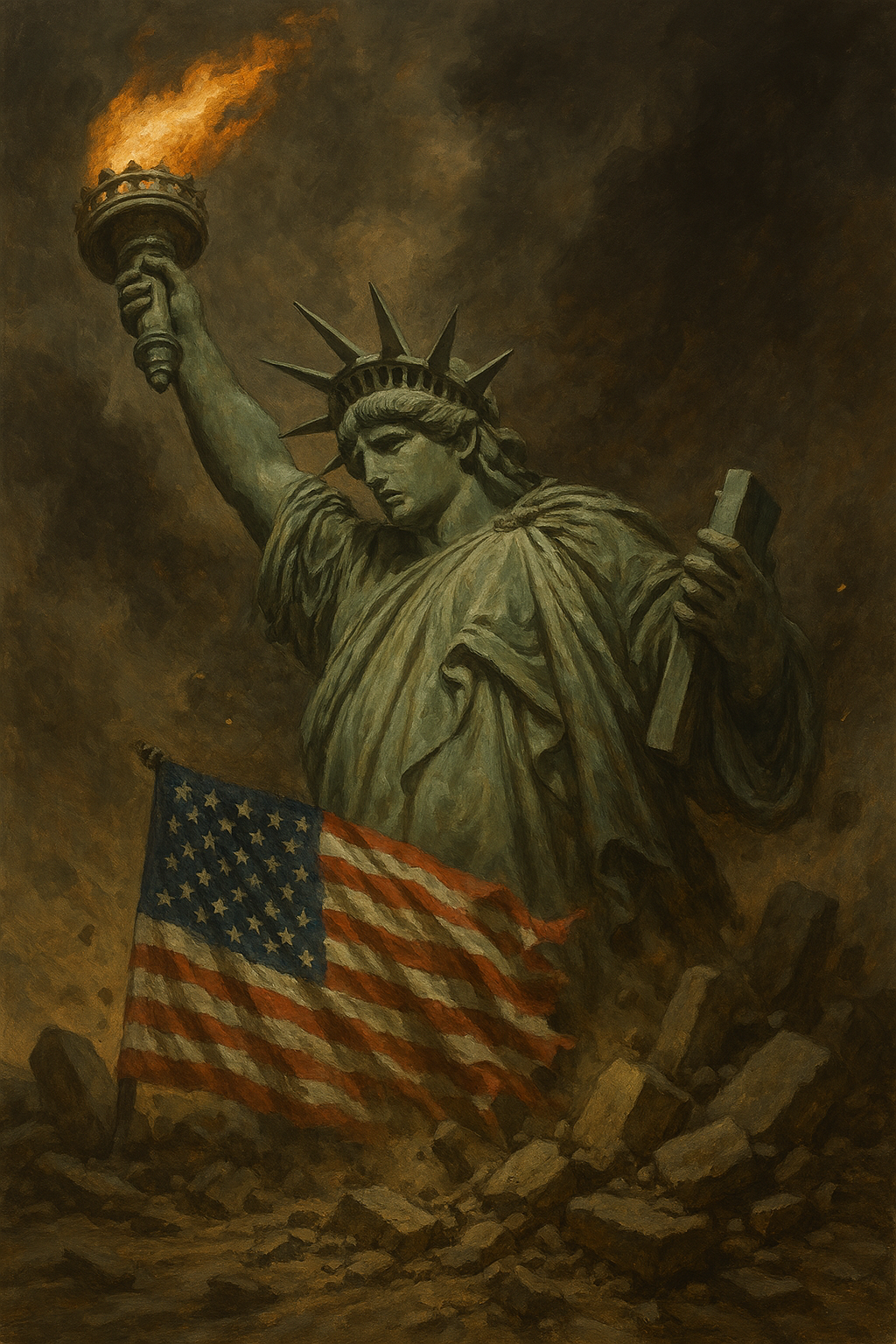
Mazen al-Najjar argues that the United States is undergoing a long-term structural decline, resulting from the convergence of excessive imperial expansion, resource depletion, and the erosion of internal foundations of legitimacy and cohesion. This aligns with the concepts of the structural realist school in international relations, which explains state behavior based on the structure of the international system and the distribution of power within it, rather than intentions or rhetoric.
The author begins with an extended intellectual debate on the decline of great powers, starting with Oswald Spengler’s thesis in his book *The Decline of the West*, then moves to contemporary structural theorization crystallized by Kenneth Waltz. Waltz argues that the accumulation of power beyond defense requirements drives the hegemonic state to use power as an end in itself, leading to accumulating costs, expanding circles of resistance, internal erosion, and the beginning of gradual rather than shocking decline.
This analytical trajectory is reinforced by Paul Kennedy’s argument in his book *The Rise and Fall of the Great Powers* regarding “imperial overstretch,” when military commitments become broader than the economic base can bear, transforming military power into a strategic burden rather than a source of superiority.
According to this logic, the author explains that American hegemony does not primarily face a moral crisis, but rather a structural crisis resulting from an imbalance of power that pushes weaker states to band together against the hegemonic state. He points out that the experiences of Vietnam, Iraq, Libya, and Afghanistan reveal a consistent pattern of achieving overwhelming military superiority that fails to produce sustainable political outcomes.
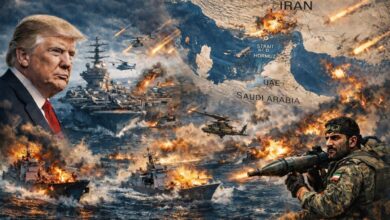
He considers that the current phase represents a more dangerous shift in American behavior, from managing influence to openly seeking acquisition and direct control, as evident in the political discourse of Donald Trump’s administration and in repeated threats against sovereign states inside and outside the Western Hemisphere. This reflects an ideological transformation in the conception of sovereignty, linking it to the will of the United States.
The author analyzes what he calls the “Donro Doctrine” as a more explicit reformulation of the Monroe Doctrine, where the Western Hemisphere is treated as an exclusive sphere closed to competing major powers, primarily Russia and China. He emphasizes that this behavior does not express the confidence of a hegemonic power so much as it reflects an attempt to fortify the nearest sphere at a moment of declining global influence.
In contrast, he notes that the United States, despite continuing to possess the world’s largest military structure in terms of bases, budgets, and technology, is increasingly unable to convert this capacity into strategic gains. Practical experience, from Vietnam and Korea to Afghanistan, Yemen, and Iraq, shows the widening gap between military superiority and political outcomes.
The author devotes central space to the wars in Iraq and Afghanistan, which depleted more than six trillion dollars and ended in strategic failure, despite field control and the rapid collapse of targeted regimes in the initial stages. He concludes that the absence of knowledge about the social and political context, weak legitimacy, and the lack of achievable objectives made “operational victory” an achievement without political translation.
He also links the chaotic withdrawal from Kabul in 2021 to a state of imperial exhaustion, considering it a symbolic indication of the limitations of coercive power when disconnected from local legitimacy and the ability to build viable political systems.
The author concludes that wars fought by the weaker party for survival differ fundamentally from wars to achieve gains, and that history shows that social patience, internal cohesion, and societies’ willingness to bear costs often surpass technological superiority when conflict becomes existential.
In this context, he recalls George Kennan’s warnings about the consequences of ignoring the vital security interests of major powers, as well as Andrew Bacevich’s criticism of America’s increasing reliance on military power as a substitute for strategy, confusing motion with direction, depleting resources, and undermining legitimacy both domestically and internationally.
Overall, the article’s thesis indicates that American military hegemony remains massive in terms of size and capabilities, but is steadily declining in its ability to influence major political and strategic outcomes, against an increasing accumulation of economic, political, and legitimacy costs. This trajectory does not reflect a moment of sudden collapse, but rather a slow process of disintegration of the pillars of power, according to a logic of structural decline similar to what previous empires witnessed in their final stages.