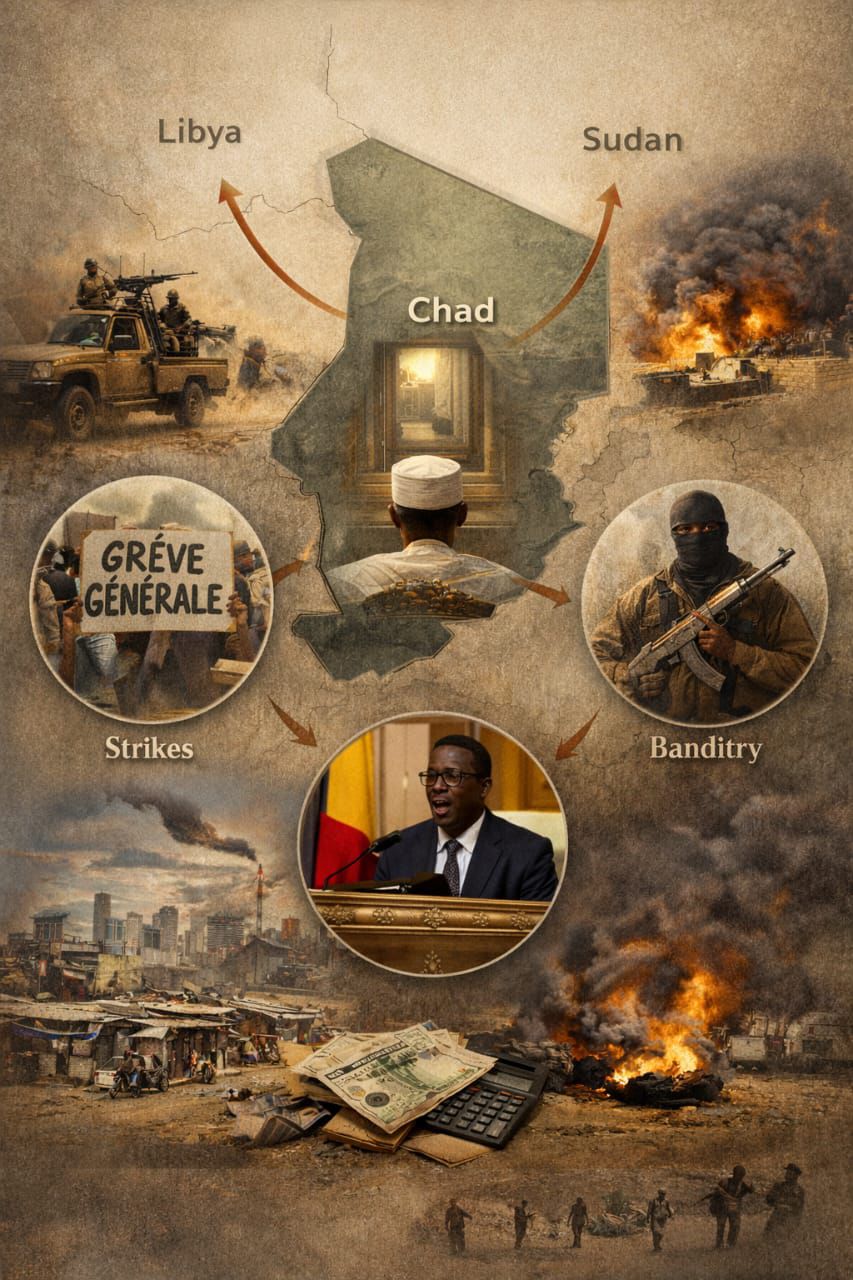
Chad: An Absent President, A Frozen State — What Our Sources Reveal from Within the Palace
Reality: The Chadian state is in a difficult situation and the Chadian system is deteriorating in an unprecedented manner…!
This is evident across multiple fronts:
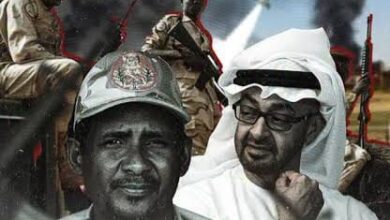
– The regime’s involvement in the Sudanese crisis and its painful repercussions.
– The regime’s involvement in Libyan state affairs and the formation of joint forces with Haftar’s faction — which is illegitimate — in confrontation with the Liberation Front of Southern Libya.
– The reactivation of Chadian opposition movements against the regime, both in the north and south.
– A return once again to the camp of the French colonizer, dismissing the national public opinion that raised the slogan “Chad is free and France is out”.
– A deadly social crisis resulting from the absence of security, the spread of highway bandits, and armed looting across the country.
– A general strike carried out by the teachers’ union and the doctors’ union — with more to follow.
– A suffocating economic crisis, manifested in:
– Accumulation of external debt on top of internal debt.
– Rampant chaos in economic management and the dominance of administrative and financial corruption.
– A president incapable of solving even the smallest problem.
– In sum: a failed state is at the doorstep — if not already there.
This report reveals a large part of this bleak picture:
Chad: An Absent President, A Frozen State — What Our Sources Reveal from Within the Palace
Six days after our first disclosure regarding the president’s repeated diplomatic absences, a new and troubling chapter has unfolded at the very top of the state. For the first time since assuming power, Mahamat Idriss Déby, known as “Mohamed Kaka,” did not deliver any message to the faithful on the occasion of the holy month of Ramadan. For four years, Chadians had grown accustomed to seeing him inside a mosque addressing those observing the fast. In a country where the head of state has traditionally addressed the people on every major religious occasion, this silence represents a striking political rupture.
On the same day, three corroborating sources from within the General Secretariat of the Government and the Civil Cabinet reported that the Council of Ministers, scheduled for Thursday, February 19, was cancelled at the last minute. A senior official stated: “The files were ready, and ministers had been notified of the agenda. The cancellation order came less than two hours before.”
Our investigations — covering administrative officials, members of the first security circle, and informal advisors — describe a president who has withdrawn inside the palace, reducing his meetings to a bare minimum and tightening procedures for selecting who he agrees to see. A security source familiar with internal arrangements noted: “Since the Paris episode, he has barely wanted to appear in public.”
A source close to the Military Cabinet pointed to fluctuating morale, punctuated by prolonged periods of withdrawal.
In a notable precedent, several guests invited to a collective Iftar dinner at the presidential residence confirmed that they did not see the head of state. One of them said: (We were received and we waited, but he never appeared) According to a government source, Prime Minister Allamaye Halina was the only person who met with him privately two days prior. In a highly centralized system — where even the most minute strategic decisions depend on presidential approval — this shrinking of meetings is creating a bottleneck at the very top.
One source from the first institutional circle went even further, saying:At this rate, some are wondering whether he will actually be able to travel to Umm Jarras before continuing on to Umrah as planned.
This internal doubt reflects a growing anxiety within the governing apparatus itself. The physical absence of the president is not a neutral matter within a system built on delicate balances; it redistributes centers of power, fuels competition, and opens the door to factional maneuvering.
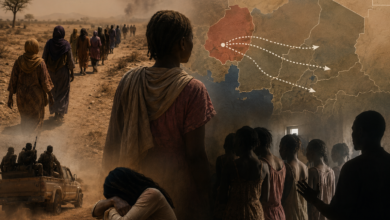
Meanwhile, the national context is deteriorating. In the east, the fallout from the Sudanese war is spreading in a dangerous manner following the Rapid Support Forces’ takeover of the Sudanese region of Tina, which is increasing pressure on the border. Domestically, highway bandit attacks are multiplying, even along strategic routes. On the social front, the teachers’ strike continues to paralyze Chad’s schools in an already financially strained climate.
Fragile security, an ongoing social crisis, and a diplomacy in retreat: the convergence of these factors, combined with an isolated president, raises a weighty question within power circles:
Is the state still functioning normally, or is the country experiencing a phase of silent paralysis at the top?
Special Correspondent — Tchadiens Ndjamena