
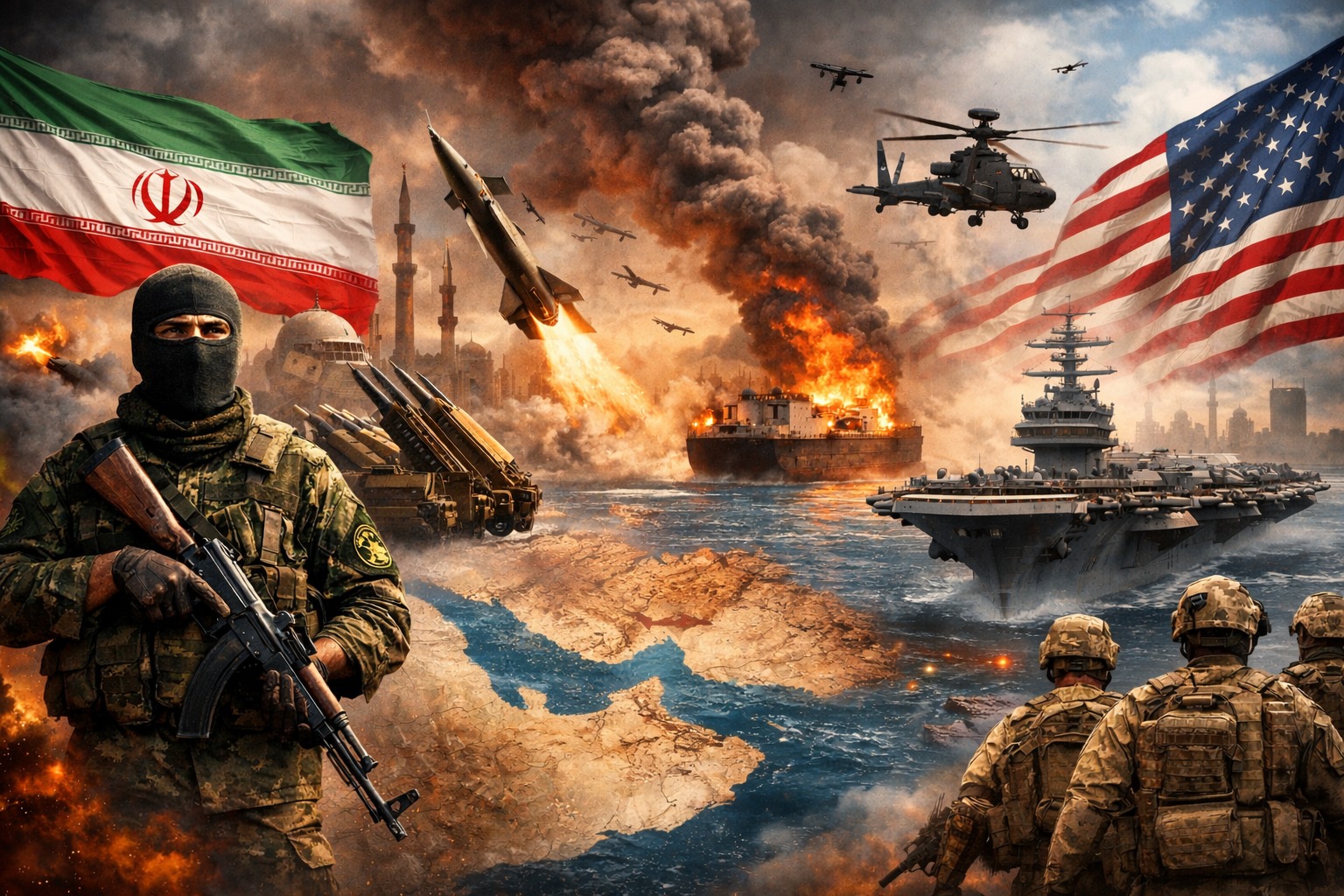
The Third Gulf War Looms on the Horizon
Brown Land
Talk of a third Gulf war resurfaces whenever tensions escalate between Washington and Tehran. The entire region is attuned to this possibility: U.S. military bases dispersed across multiple locations, aircraft carriers operating nearby in the Gulf and the Arabian Sea, and the Strait of Hormuz and Bab al-Mandeb perpetually on the brink of paralysis with any minor escalation.
The question that persistently arises is this: how does Iran project such confidence when the opposing side—at least on paper—enjoys a substantial technological and military advantage?
The answer lies neither in slogans nor in emotive rhetoric. Over the past two decades, the Islamic Republic of Iran has constructed a sizable missile arsenal, much of it precise and long-range, theoretically capable of reaching U.S. bases in the Gulf, Iraq, and Syria, as well as threatening major naval assets in the Arabian Sea and the Indian Ocean. Aircraft carriers—long emblematic of American power—are no longer as distant from risk as they once were. A single successful missile strike, or a coordinated swarm of drones penetrating air defenses, could instantaneously alter the political message conveyed by the balance of power.
Missiles are not the sole factor. Persistent reporting points to significant advances in Iran’s military capabilities, to technologies not yet fully disclosed, and to a potential capacity to reach the nuclear threshold should a political decision be taken. Whether this capability is realized in practice or remains an instrument of leverage, it nonetheless enters the calculus of deterrence and reinforces Tehran’s perception that it is neither exposed nor helpless.
From this perspective, any initial strike against Iran would not be contained or neatly concluded. The concern is not limited to a brief exchange of fire, but to a cascading sequence of events that could rapidly escape control. Multiple fronts could ignite simultaneously: southern Lebanon, the Red Sea, Iraq, and potentially Gaza. At that point, the central question would no longer be who initiated the strike, but who could endure prolonged attrition. Such an escalation could also trigger a broad wave of popular mobilization across the region, transcending governmental calculations and imposing a new political reality.
In Washington, the calculations differ, but they are no less complex. A large-scale war with Iran would entail immediate disruption to global energy markets, sharp increases in oil prices, threats to navigation through Hormuz and Bab al-Mandeb, and the risk of direct losses at U.S. military bases. The experiences of Iraq and Afghanistan remain vivid in institutional memory, and the lesson is clear: entering Middle Eastern wars may appear relatively straightforward on paper; exiting them is profoundly difficult.
If a confrontation were to occur, discussions frequently return to plausible Iranian scenarios: targeting aircraft carriers with long-range drones flying at high altitudes to evade radar detection; deploying attack drones equipped with penetrative munitions against warships and the fuel tankers that accompany carrier strike groups; or laying naval mines in the Strait of Hormuz, Bab al-Mandeb, and narrow passages in the Red Sea—actions that alone could severely disrupt global trade.
The debate extends to even more distant contingencies: strikes on energy infrastructure beyond the immediate region, or hints at extreme options such as the use of small tactical nuclear warheads mounted on hypersonic ballistic missiles against remote bases like Diego Garcia or against strategic naval assets. The mere contemplation of such scenarios underscores the magnitude of the risks that could unfold should a decision to escalate be taken.
Ultimately, the issue is not simply one of technological superiority on one side and political resolve on the other. It is a dense web of mutual deterrence, economic calculations, and the legacy of past wars. Both parties recognize that the initial spark may not remain controllable. Consequently, the rhetoric of threat intensifies even as caution governs concrete decisions. The confidence projected in Tehran is met by palpable hesitation in Washington, while the region as a whole stands at the edge—acutely aware of how crises begin, and far less certain about how they end.
For context, the First Gulf War was fought between Iraq and Iran from 1980 to 1988. It began in September 1980 with Iraq’s invasion of Iranian territory and lasted eight years of intense ground and air combat. The conflict ended with massive human losses—killed and wounded—as well as severe economic damage on both sides, without significant changes to international borders.
The Second Gulf War took place in 1990–1991 between Iraq under Saddam Hussein and an international coalition led by the United States, following Iraq’s invasion of Kuwait. It concluded with Iraq’s withdrawal from Kuwaiti territory, the imposition of severe sanctions, and extensive destruction of Kuwait’s infrastructure. It also served as a pretext for a substantial expansion of the U.S. military presence in the region.