Exclusive Conversations
Ibrahim Al-Houri to Brown Land: Militia Not Designated as Terrorist Due to Overlapping Regional and International Interests
Interview by: Badreldeen Abdulrahman
The war launched by the Rapid Support Forces (RSF) militia against Sudan in April 2023 was nothing short of a fierce conflict. Numerous countries have participated—and continue to do so—with the aim of seizing the reins of power and controlling the nation’s resources, which represent the primary target for regional and international agendas.
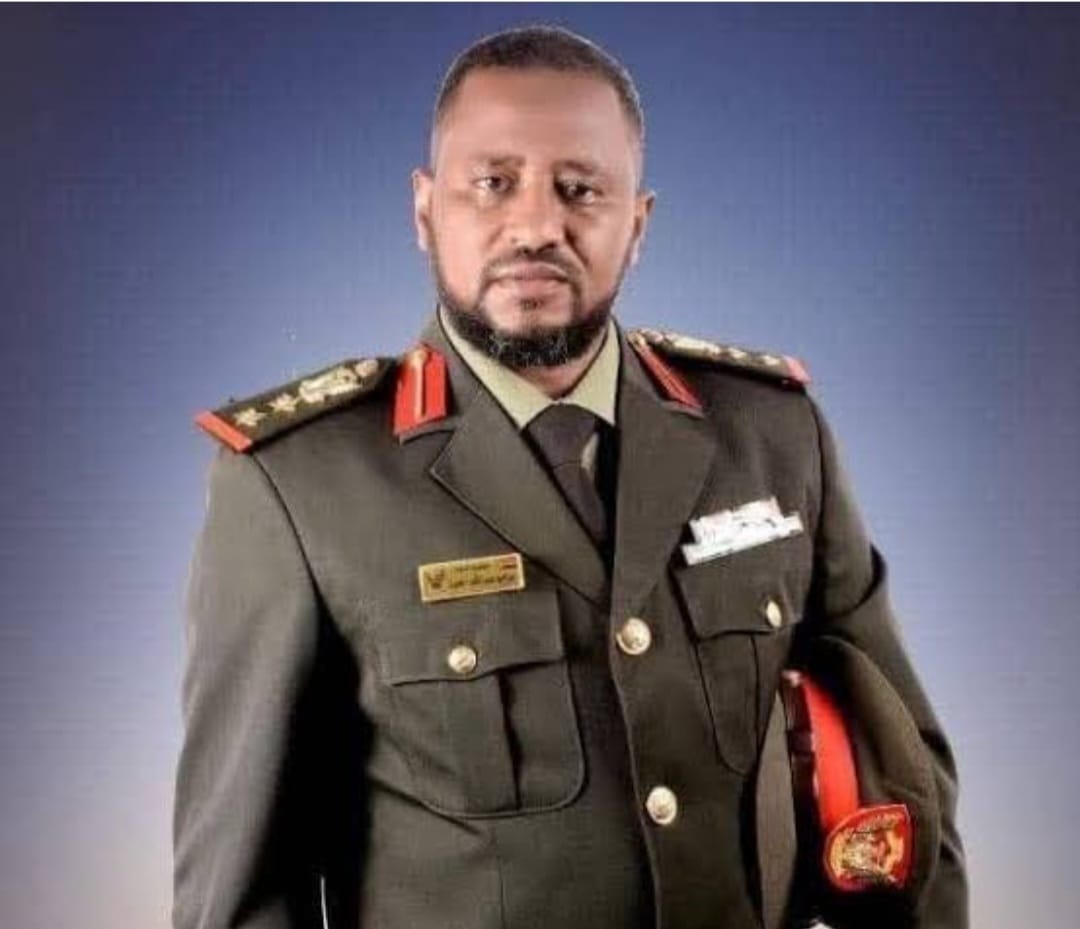
Brown Land discussed several files and key issues with retired Colonel Ibrahim Al-Houri, who shed light on various matters concerning the Sudanese Army and the “War of Dignity.”
= The Sudanese Armed Forces (SAF) have faced a relentless war now entering its fourth year. How was the army able to abort such a massive plot?.
- The Sudanese Armed Forces are deeply rooted in history, possessing a vast heritage of combat and training expertise passed down through generations. This is based on the principles of modernization, adherence to laws, regulations, and hierarchy, which allowed the SAF to remain a stable, organized, and cohesive institution.
It is well known that from the moment an individual joins the Armed Forces, they are saturated with the doctrine of belonging and defending faith and homeland. After receiving the required physical and moral training, a fierce soldier emerges who knows how to defend Sudan.
Overall, the Military College works professionally to prepare officers, making them highly qualified to perform their duties. They gain sufficient experience to understand the terrain and the psychology of the population.
Regarding the gravity of this war, I say: the militia began the war with 165,000 soldiers and 12,000 combat vehicles, in addition to their presence in strategic areas within Khartoum State. Their high level of preparation allowed them to set the “zero hour” with great confidence.
However, the cohesion of the Armed Forces—due to the rigorous training of soldiers and officers, the strategic planning of leaders, and the presence of commanders on the front lines—enabled the army to absorb the initial blow with great intelligence and skill. Initially, the SAF focused on defending military headquarters and vital strategic sites to maintain state stability.
The steadfastness of the General Command and the areas of Bahri and Omdurman at that time played a major role in foiling the militia’s plan. The SAF activated what is known as “offensive defense,” and we also witnessed the birth of “Special Action” units that carried out lightning strikes in the heart of the enemy before withdrawing.
In short, “offensive defense” enabled the Armed Forces to achieve strong victories at that time—victories that struck terror into the hearts of alarmists and traitors.
=For a long time, the Sudanese Army and its supporters were in a defensive posture. How did the Armed Forces shift to the offensive, and what is the primary reason for the victories achieved?. - There are many reasons for the SAF’s victories, including the “offensive defense” principle mentioned earlier, and the activation of “raiding and infiltration” tactics, which exhausted the enemy and gave the SAF a chance to catch its breath and reorganize.
The most crucial factor, however, was the availability of intelligence regarding the enemy’s strength, weaponry, and leadership details, as well as their fighting style. Furthermore, full coordination between different army units, facilitated by a robust communications system, played a major role in the victories achieved on the ground. All of this allowed the army to shift from defense to offense and subsequently expel the enemy from strategic areas in the capital.
=The Armed Forces have received unprecedented popular support in the current war. How do you view this?. - The Armed Forces found unprecedented support because their cause is just. Under the constitution, the SAF is the primary protector of the people; this is its sacred duty.
Another reason for the people rallying around the army is the grave violations—killing, lynching, looting, and displacing citizens from their properties—committed by the militia. The militia destroyed the country’s infrastructure, creating deep resentment among citizens and driving them toward their army. This is the cornerstone of the victories achieved.
Popular support also provided the army with a massive social cover and accurate intelligence. Human resources became readily available due to the unprecedented surge in mobilization (Mustanfareen). While the militia relied on foreign mercenaries to bolster its ranks, the army was, and remains, supported by the loyal sons of the nation.
=Influential defections have recently hit the militia. What are the causes, and how do they affect the current battle?. - The militia lacks military hierarchy and is rife with racist discourse. It constantly employs tribal divisions and lacks a qualified administrative cadre to manage its personnel. This created significant problems in logistics and medical treatment for the wounded among fighting groups, alongside financial disputes.
All of this created significant “indignation” among militia members, especially since their leadership lacks the administrative experience to lead a major war. It is a leadership that is not unified; each has their own goals and agendas.
These defections are a result of this fragile and suspicious situation within the militia. These will not be the last; defections will continue sequentially until they consume one another. This will inevitably affect the battlefield, cohesion, and morale.
=There has been much controversy regarding recent military retirements. What is the correct explanation for what happened?. - The Armed Forces have long-standing regulations and laws. The controversy over recent retirements arose because this war caused a “bloating” in senior ranks for nearly three years, making the number of officers in certain ranks exceed the permitted limit.
There is a specific organizational “budget” allowed for each rank. This war distorted the army’s organizational pyramid. Once the situation stabilized significantly, the army leadership decided to remove these distortions to restore organizational order and avoid creating redundant positions.
=The militia received significant support from the UAE, Chad, Ethiopia, and others. How did the army confront this unprecedented aggression?. - All these countries combined participated in theu aggression against Sudan and provided unprecedented support to this militia. This opens the door to a very big question: Why all this hostility toward Sudan?
The leaders of these countries prioritize their regimes’ interests over their people’s interests. It is well known that the interest of neighboring populations lies in preventing war in Sudan, as conflict affects them in various aspects. However, these leaders provided aid to the militia to gain economic support to stay in power. This support will, God willing, eventually bring disaster upon all these countries.
In reality, the Sudanese Army confronted this aggression with precise and well-crafted plans on political, diplomatic, and military levels, including striking supply lines.
=The United States has not yet designated the RSF as a “terrorist group” despite the horrific crimes committed. Why?. - The reason is the conflict and overlap of regional and international interests, especially those that see “benefit” in this war to achieve their goals of seizing Sudan and its wealth. The world today is not governed by right, but by might.
=The militia’s political wing, “Sumoud,” is considered one of the reasons for the continuation of the war. What is your take on this?. - Any political wing of a militia will work hard to gain support and legitimacy. This political wing seeks to build relationships with influential political entities abroad to attract support and attempt to restore some legitimacy.
Undoubtedly, “Sumoud” is the other face of the militia; no two people disagree on that. They have attempted to “wash” the militia’s crimes through media and by downplaying the violations. “Sumoud” played a major role in attempts to belittle the Sudanese Army, accusing it of crimes and attempting to fix condemnations against it.
=The battle of the Presidential Guard and the Guest House (Beit Al-Diyafa) is considered a pillar of the victory achieved. How did that happen?. - In my view, the battle of the Presidential Guard represented the symbolic targeting of sovereignty, the army, and the state. The Presidential Guard fought heroically because they knew that reaching the Commander-in-Chief meant the end of the army and, consequently, the end of Sudan.
Thus, there was a desperate and brave defense of the Commander-in-Chief, who is the symbol of the country. Thirty-five martyrs were sacrificed for faith and homeland—an act beyond description. It is an honorable model of the professional Sudanese soldier who believes in his right to a dignified life and that Sudan must not be handed over to enemies. The martyrs of the “Guest House” wrote history with their blood.
=The battles to liberate the remainder of Kordofan and all of Darfur are not over yet. What is the future of military operations in this regard?. - The war was concentrated in central Sudan and nearly covered the whole country, but the SAF fought strongly to reclaim those parts. Now, the army is working with the same strength to reclaim parts of Kordofan and all of Darfur.
It is worth noting that the army’s strategy here is clear: exhausting the human element first. Replacing manpower requires at least a full year, plus six months to gain combat experience. This strategy has been very successful in defeating the militia, despite its reliance on foreign mercenaries.
In truth, a “mercenary” fights only for money; he has no principles or ethics, so he will not sacrifice his life. The future of operations in Kordofan and Darfur depends specifically on monitoring the militia’s human supply levels. If the army succeeds in cutting supply lines, this battle will end, and the militia will scatter across the plains and valleys, leaving no trace behind.