A World Order in Progress:an Angles of Triangle Rearranging Priorities, Recognizing National Interests
The Harvest of Times

- From the Peace of Westphalia on word, through the era of the balance of power and the League of Nations, then its replacement by the United Nations, and up to the Cold War, whose tensions were partially eased by the SALT II agreements… and from the bipolarity of “America-Russia,” to the renewal of that bipolarity so that the West encompasses Western Europe and America, and the East encompasses Russia, China, and some Asian powers… throughout all of this, global systems have continued to move towards a precise definition of spheres of influence, recognized by the angles of a triangle to which the wall of definition has submitted as one of those angles.
- It goes without saying that the major powers of today are the United States, Russia, and China.
What is new in this description is that Western Europe has become less capable of confronting its position as an entity that once possessed history but has been overtaken by the present.
- It seems that the United States’ relationship with Western Europe is not sacrosanct for Uncle Sam, but rather a transaction, like the mating of spiders. America has been gradually strengthening itself for a long time, as the heir to European institutions, developing their colonial version in a way that makes their eventual absorption possible. This happened in the manner of a female spider needing a male for mating, and then feeding on him afterward.
- The dynamic between America and Europe is not a recent phenomenon; it manifested itself as early as 1919 during the Versailles Conference when Woodrow Wilson imposed American conditions on the Europeans. The weakening of the Old Continent continued until the end of World War II, when the prevailing feeling was that Europe was incapable of defending itself against Nazi domination, and that the victory, including the liberation of Europe, was attributed to both America and Russia. Then Trump entered the White House, and America revealed its true Republican face, as evidenced by its stance on the Russian-Ukrainian war. This exposed the vulnerability of the Old Continent, leaving it with little more than history and media presence. It is clear that America’s handling of the Ukrainian war, in all its dimensions, reflects, firstly, its recognition of the Eastern bloc’s right to manage its own affairs, including its neighbors, and secondly, its message to Europe that any global role it might play will only be possible through American obedience.
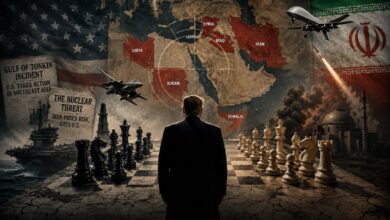
This tacit, mutual recognition has permeated the strategic concepts of the America-Russia-China triangle. The positions of the three parties—among themselves—regarding the Ukrainian war, Taiwan, and America’s neighbors (Canada, the North Atlantic, and Latin America) represent the emblem of a new world order taking shape under the motto “tit for tat.”
This means that each corner of the triangle will disregard the geopolitical sphere of the others, allowing the three major powers to settle their affairs without clashing. Trump’s handling of the Ukrainian issue, the Eastern bloc’s silence—aside from a few timid statements—regarding the events in Venezuela, and Trump’s softening of his tone toward Taiwan, all point to a tacit agreement among the three major powers to establish a system that excludes Europe from its global influence (as seen in the “Greenland crisis”), and reinforces the concept of a “dominion of obedience” to the major powers without dispute, and insulated from a new Cold War with all its potentially exorbitant costs for any of them.
As for other regions, represented by Africa and the Middle East, the “first come, first served” factor remains dominant, with these two characteristics giving America the advantage. The two Eastern blocs acknowledge that America’s presence in the region predates the colonial era, continuing through the discovery of oil and the commencement of other mining operations.