The Political Cover for the Carnage
How Did the Civilian Elite Legitimize the Militia?
In legal philosophy, there exists a concept known as “omission” as a form of liability — the one who witnesses a crime being committed before them and remains silent carries in their pocket a measure of legal and moral culpability. This is precisely the concept being applied in the Sudanese street and in the corridors of human rights organizations to the Sumoud alliance and its predecessor, Taqaddum: silence in the face of the RSF’s crimes, the softening of condemnation, and the signing of agreements during massacres — all of this is interpreted as “political cover” for a militia that a wide segment of Sudanese view as a criminal enterprise, not a partner in any civilian process.
I. The Origin and Substance of the Accusation
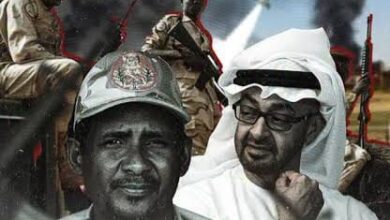
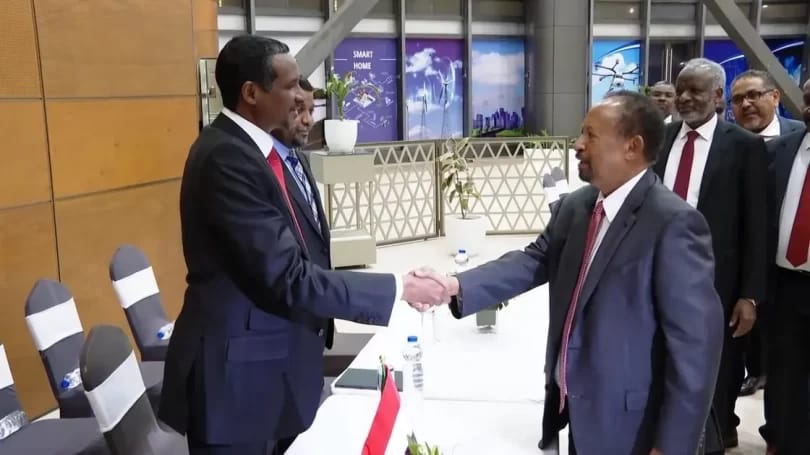
The great breaking point traces back to what is known as the “Addis Ababa Declaration,” signed by figures associated with the civilian current alongside the commander of the Rapid Support Forces. At a moment when the militia was expanding its presence across Khartoum, Gezira, and Darfur, and when international human rights organizations were documenting crimes of genocide and ethnic cleansing, the political handshake came to grant the RSF something that cannot be purchased with money: symbolic legitimacy. For the image of a civilian politician standing alongside a militia commander means, in the language of international politics, that the commander is an “acceptable interlocutor” — not a criminal to be isolated.
Sumoud officially adheres to the principle of “non-alignment with either party to the conflict,” insisting that its call for an end to the war encompasses both sides. Yet critics argue that actual practice reveals a glaring double standard: statements directed at the Sudanese Armed Forces are characterized by direct and unequivocal language, while those concerning the RSF’s crimes are marked by mitigation, vagueness, and a careful avoidance of explicit condemnation.
II. Democracy Is Not Built This Way
There is a fundamental philosophical contradiction within Sumoud’s political project that deserves careful examination. The alliance raises the banner of “democracy and civilian governance” as a non-negotiable goal, yet at the same time calls for dialogue with a militia that recognizes no legitimacy other than the legitimacy of the gun. Sudanese thinkers and constitutional scholars pose a difficult question: how can genuine democracy be founded while an armed force outside state authority remains in existence? And is the call to “integrate the RSF” into the national army a realistic solution, or a prescription for institutionalizing chaos?
Sumoud’s June 2025 document proposes a transitional horizon spanning ten years, part of which rests on forming a unified national army that would incorporate the RSF and armed movement factions. In the eyes of a wide segment of Sudanese — particularly those who lost family members in what has come to be described as a genocide in Darfur — this vision is not a solution but an additional insult to the blood of the victims.
III. The Civil Divide and the Shattering of Ranks
Perhaps the most precious thing Sumoud has lost in this battle is the unity of Sudanese civil space. Rather than civilian forces forming a cohesive bloc confronting the war and its advocates, they have fractured deeply. While Sumoud maintained what it describes as “positive neutrality,” other factions moved toward forming the “Sudan Founding Alliance,” which proceeded down the path of a parallel government. The Sudanese civilian scene now faces a spectrum of competing alliances in place of a unified front — weakening everyone and delighting the warring parties on both sides.
In this context, regional dimensions arrive to further complicate the picture. Sumoud finds itself in a position of rapprochement with regional actors who are sponsoring the Sudanese crisis for strategic and competitive calculations entirely removed from the interests of the Sudanese people. This makes the alliance an easy target for the accusation that it is “an instrument of regional agendas” — a charge that is difficult to refute through statements alone.
IV. Legitimacy and the Question of Its Source
The most pressing question facing Sumoud is this: from where do you derive your legitimacy? If it is derived from the street, that legitimacy has been eroded by detachment and ambiguous positions. If it is derived from the international community and external recognition, it is a fragile legitimacy with no roots in Sudanese soil. And if it is derived from a political program, the document the alliance issued was subjected to sharp discussion and criticism from allied quarters before it even reached opposing ones.
Legitimacy in politics is not a document written in a foreign capital — it is a living relationship between a leader and their people, tested in the darkest of moments. And the Sudanese people today are living through a dark moment that demands proximity, not distance; clear condemnation, not calculated ambiguity.
The Price of an Ambiguous Position
Sumoud remains trapped in what might be called the “ambiguity snare.” It cannot condemn the RSF in unequivocal terms without severing some of the threads of communication with the international actors who desire a comprehensive peace process. Nor can it continue its discourse of “neutrality” without losing the Sudanese street, which sees no possible neutrality in the face of documented massacres. This existential contradiction is the very core of the crisis — and unless it is resolved with courage and transparency, Sumoud will continue to mark time in place.