
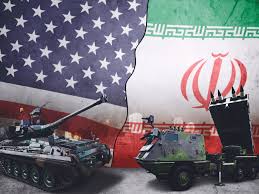
Joint Targeting of Iran.. “Winds of War” — The Region on the Brink of a Crumbling Cliff!
Exclusive: “Brown Land”
By: Badreddine Abdelrahman
In stark contrast to what transpired in recent days in Geneva and the Sultanate of Oman — regarding progress achieved in negotiations between the United States and Iran over the nuclear file and the uranium enrichment issue — America and Israel announced “this morning” the launch of a joint war against Iran, which the occupation described as a preemptive war with precise and specific objectives that would “break the back” of Iran’s domestic establishment.
The current war has targeted the presidential complex located south of Tehran, a massive compound known to house important government buildings.
Information that has emerged — according to various media outlets — clarified that the most significant targets in Iran include:
- President Pezeshkian, who was not present in the presidential complex at the time of the strike.
- Supreme Leader Khamenei.
- Leaders of the Revolutionary Guard.
- Leaders overseeing the nuclear file and uranium enrichment.
- Nuclear facilities.
Observers following the American-Israeli targeting campaign on Tehran pointed out that striking part of the Iranian Foreign Ministry headquarters in the capital represents an attack on the political thought within the Iranian system — particularly given that Israel and the United States, in all previous conflicts with Iran, had never committed such a blunder, one that could undermine all efforts aimed at a peaceful resolution through the Geneva and Oman negotiations.
Meanwhile, analysts noted that the previous 12-day war had begun as a military and security operation and had touched the Iranian political dimension only minimally. It is notable that the current military strike began as a joint attack rather than an Israeli strike backed by American support or vice versa — a development that carries many hidden implications regarding the dynamics of the current conflict.
International newspapers indicated that there is information — possibly unconfirmed — suggesting that Iran has deployed radar systems and military equipment and hardware in this region, potentially with assistance from Russia and China.
Other newspapers and satellite channels reported that what occurred was a wide-scale targeting of sites within Tehran, encompassing both political and military objectives.
In this context, specialists described what happened as “the earthquake that will reverberate enormously across the Middle East,” creating further repercussions — especially since these strikes this time have affected countries such as Saudi Arabia, the UAE, Qatar, Bahrain, Iraq, and Jordan.
“Reducing Iran’s Military and Nuclear Capabilities Is the Primary Goal of This War”
Political and strategic analyst Dr. Mahmoud Abdeljabbar, amid this scorching atmosphere, confirmed that there are three or four scenarios in this war, contingent on understanding its desired strategic objectives, chief among which are two primary goals:
First Goal: Reducing Iran’s military capabilities in general, and its missile and nuclear capabilities in particular, alongside ensuring Israel’s military superiority in the region.
Second Goal: Pulling Iran away from the Russian-Chinese alliance in the equation of international conflict.
As for the possible scenarios, they may be summarized as follows:
- Return to the negotiating table, giving Washington what it wants — most importantly, distancing Iran from the Russian-Chinese bloc — while allowing Iran to remain a force that intimidates Gulf states, thus ensuring their continued urgent need to seek American protection in the region, in addition to sustaining the normalization process with Arab states.
- America succeeding in replacing the Iranian regime with a Shah-style system, restoring Iran to secular governance allied with the United States, coupled with the necessity of neutralizing Iran’s allies in Lebanon, Yemen, Palestine, Syria, and Iraq.
Iran withstanding the operation and managing to draw America and the region into a prolonged war of attrition — until America becomes unable to bear the cost of such an exhausting war, particularly given America’s bitter experiences with wars of attrition.
“The Current War Is Different and Signals the Beginning of a Comprehensive Regional War”
Professor of Journalism at Sudanese Universities, Dr. Adel Mahjub Al-Aqib, concluded that the primary objective of this war is regime change in Iran — under the pretext of the regime’s suppression of the Iranian people (referencing recent internal protests that witnessed casualties and injuries) — in addition to curtailing Iran’s capabilities related to the development of nuclear weapons and ballistic missiles.
Dr. Mahjub warned that among the potential outcomes of this war is the emergence of a full-scale regional conflict, given that Iran will target all American interests in the region, as well as striking Israel with missiles.
America, in turn, will strike Iranian interests, including:
Hezbollah headquarters in Lebanon.
Popular Mobilization Forces (PMF) headquarters in Iraq.
Houthi headquarters in Yemen.
Dr. Adel predicted that this strike would be different from its predecessors, entailing catastrophic and far-reaching consequences for all countries in the region — particularly those hosting American military bases. He also noted that the current war could potentially drive global oil prices above $100 per barrel if mutual strikes continue for an extended period.
According to journalism professor Mahjub, Trump — with his arrogance and recklessness — has drawn the region into a military confrontation that exposes its nations to ever-increasing foreign intervention.
Despite this, there remains a glimmer of hope in the potential intervention of rational leaders — Turkish President Erdoğan and Saudi Crown Prince Mohammed bin Salman — to dissuade Trump from his excessive inclination toward his adversaries, particularly those nations that refuse to submit to his political, economic, and security goals.