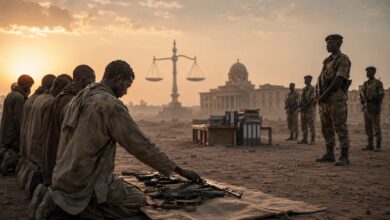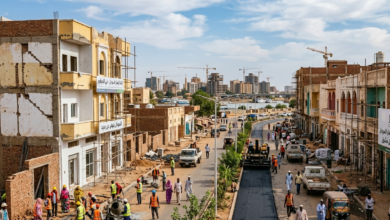

On the 26th of October 2025, the city of El Fasher, sometimes spelt as Al Fashir, in Sudan’s North Darfur state fell to the paramilitary Rapid Support Forces (RSF), after a years-long siege. In the immediate aftermath, I reached out to the Sudanese Embassy in Kenya to try and secure an interview with the ambassador and get the official government position on the unfolding crisis.
That decision led to me being invited for a press conference where Ambassador Mohamed Osman Akasha, the Charge’ d’Affaires, addressed the press on the atrocities being carried out in El Fasher.
Two months later, on the 14th of January 2026, I was back in the ambassador’s office, coffee in hand, discussing what had changed on the ground in the time since we had last spoken. Because while the world was focused on crises in Venezuela, Greenland, and Iran, the war in Sudan was continuing like it always did – intense, horrific, yet rarely ever in the news.
In El Fasher, home to about 250,000 people before the fall, the RSF had committed one of the greatest massacres in recent history. According to the UN, about 89,000 civilians managed to flee, which means that more than 160,000 were trapped with nowhere to go except into the genocidal arms of the paramilitaries. Nathaniel Raymond, executive director of Yale’s Humanitarian Research Lab (HRL), estimated that between 30,000 and 100,000 people may have been killed in six weeks, with 60,000 as a plausible midpoint. The last time the world witnessed killing at such a scale was during the Rwandan genocide in 1994.
Away from El Fasher, the RSF and the Sudanese Armed Forces (SAF) were clashing on the border between North Kordofan and Khartoum state. Drone strikes were targeting high level army meetings in Sinja. Outside El Obeid, the capital of North Kordofan, the RSF were making preparations for another siege, perhaps another El-Fasher.
The brutality seemed best summed up by Abu Lulu, an RSF commander who, before shooting an unarmed civilian, said, “I will never have mercy. Our job is only killing.”
Like a lot of journalists, I’d become grimly fascinated by these stories. When the UN went into El Fasher on the last Friday of December, they described it as a ghost town with few signs of life. That left some 60,000 people unaccounted for – neither among those who fled, nor among the likely total of the dead. How could a war that produced horrors like that remain missing from the headlines?
This was the backdrop against which the ambassador and I had our conversation on the 14th. One of intensifying war and vanishing interest. In the ambassador’s spacious office hidden in Nairobi’s upmarket Kilimani neighbourhood, I allowed myself – for once – to switch off from the chaos of the news, of Greenland, of Venezuela, and listen to the ambassador. Here’s what he had to say.
The Conversation
We started with El Fasher. I wanted to know what the government’s assessment was of the humanitarian situation, how many civilians remained, and what had happened to those who fled or disappeared. The ambassador didn’t mince words.
“The United Nations team that visited Al Fashir last month described the city as a ghost town,” he said. “That description is not rhetorical. It’s the direct result of systematic siege and a sustained campaign of terror waged by the RSF militia for nearly two years.”
He described a deliberate strategy of encirclement, where humanitarian corridors were blocked, civilian movement restricted, and communities subjected to violence and ethnic targeting. Then he dropped a figure that made me pause. “In only four hours more than 6,000 civilians were killed based on their ethnicity, including women, children and vulnerable patients receiving medical care.”
In order for the RSF to kill 6,000 people in 4 hours, they would have to kill 25 people per minute. Extremely grim figures, and in the ambassador’s view this met the legal threshold for genocide. For those lucky enough to survive, they fled to Tawila, a town in North Darfur, or Chad, often under direct attack from the RSF.
The ambassador pointed to external support that had enabled the RSF to sustain its siege. “The external logistics, financial and weapon support provided to the RSF, most notably by the United Arab Emirates, has enabled this militia to sustain siege and commit atrocities on a scale that would otherwise have been impossible.” This aligns with UN Panel of Experts documentation of Emirati support to the RSF, including weapons transfers and logistical assistance. It’s a point that we have mentioned multiple times in past videos but still bears repeating- without the UAE’s support, the RSF wouldn’t be able to carry out atrocities at the scale we’re witnessing today.
I shifted to military operations. There had been reports of renewed SAF offensives in Kordofan and Darfur, and I wanted to understand the government’s objectives.
“The Sudanese armed forces are conducting operations strictly within the framework of restoring constitutional order, protecting civilians and reopening vital supply roads,” he explained. “These are not offensive campaign of territorial gain. It’s rather security operations aimed at dismantling militia capabilities that threaten civilians life and natural cohesion.” He explained that the government expected progress in securing key transport corridors, enabling humanitarian access, and restoring state authority in liberated areas. The benchmarks, he insisted, were measured in civilian protection and service restoration rather than escalation.
Which brought us to reports of military cooperation between Pakistan and Sudan. I asked whether Saudi Arabia, given its close ties with both countries, had influenced any potential deal.
“Sudan enjoys long standing and valued relations with Pakistan,” he said. “So far, no military support deal has been announced by the General Command in Sudan. Nonetheless, Sudan is a sovereign state and retains the right under international law to procure goods, including military equipment for its legitimate defense.”
It’s important to note that even if the deal hasn’t officially been confirmed by the Sudanese government, it is all but guaranteed that this deal will go through. The SAF needs the weapons, and for Pakistan it provides vital income and real world data for its weapons systems. Reports indicate that the deal is likely to include light attack aircraft, drones, air defense systems, and potentially some JF-17s, Pakistan’s jets that gained global recognition after the skirmish with India last year.
On Saudi Arabia, he noted their relationship was deeply rooted in history, mutual respect and shared objectives. Comparing this relationship to the one between the UAE and the RSF, he said: “By contrast, the terrorist militia military strength does not drive from national institutions. It comes from foreign financing, weapons transfers and political coverage, particularly from the United Arab Emirates.”
I pushed back, highlighting concerns that acquiring new military capabilities could escalate the conflict. His response was firm, insisting that such an argument reversed cause and effect. “The war did not escalate because the Sudan government defended itself. It escalated because a militia attempted to overthrow the state using foreign backed force.” He insisted that legitimate defensive capabilities restored balance, adding, “Stability cannot be built on weakness. Negotiation requires deterrence.”
We moved to Khartoum and the government’s return after years in Port Sudan. “The government return to Khartoum reflects tangible security improvements.” he said. “It sends a clear message that the Sudanese state has not collapsed and will not be replaced by warlords.”
However, I had doubts, given the potential siege on El Obeid that would put the RSF at Khartoum’s doorstep. Still, I had limited time and more to cover.
So I turned to peace.
The ambassador insisted that the Sudanese government had spared no efforts, pointing to a December 22nd initiative when the Prime Minister presented the UN Security Council a roadmap for peace that was built on five pillars: a comprehensive, internationally supervised ceasefire, withdrawal of the militia from all states, disarmament of the RSF, followed by the safe return of displaced civilians to their homes, and unrestricted humanitarian access to the worst hit areas. And finally, accountability for the war crimes, and reconstruction of the nation. Once all this was achieved, it would culminate in a transitional government, and eventual free and fair elections.
“Sudan is fully committed to this roadmap,” he said. “The central obstacle remains the UAE’s insistence on continuing its war of destruction using this genocidal proxy.”
The obvious question was whether the RSF had indicated any acceptance. His answer was blunt. “This genocidal militia rejected this roadmap on the same day, even before going through it.”
Since peace seemed distant, we shifted to something more immediate, famine. The ambassador said there was no famine in government-controlled areas, citing sufficient reserves and normal supply chains. In his view, the areas encountering famine were RSF-controlled, due to the militia looting farmers’ crops and terrorizing civilians.
How would the government address this?
“It’s not in our hands to address obstacles in areas controlled by these genocidal militias,” he said. “But generally the government of Sudan is cooperating positively with all UN agencies and NGOs. We have renewed borders opening, we facilitate visas and the working of the NGOs inside Port Sudan, Khartoum and other states. I think it’s high time for the international community to put pressure on the RSF militia to give them access.”
For my final question, I returned to the UAE, particularly the collapse of the UAE-backed Southern Transitional Council’s influence in Yemen. Could this affect Sudan’s war?
“The collapse of UAE backed militia projects elsewhere, most notably in Yemen, has exposed a dangerous pattern of outsourcing influence through armed militias,” he said. “Sudan is not an exception. It is the latest and most tragic case. International scrutiny and regional pressure can make a difference if they translate into real consequences for those who arm, finance and politically shield the RSF militia and other militias in the region.”
Finally, I asked what consequences he wanted to see. He called for sanctions and urged superpowers to better protect the region, pointing to the Red Sea and Gulf of Aden as vital trade routes.
Final Thoughts
Leaving the ambassador’s office, I couldn’t help but wish that I had more time to ask more questions, specifically on claims about violence perpetuated by the SAF against civilians. While he would have probably given a standard diplomatic answer to try and absolve the government forces of any culpability, it would have been good to get a government official on record talking about these issues.
The reality is that wars are rarely as black and white as either side presents them. Both the RSF and SAF have been accused of atrocities, though the scale and systematic nature of the RSF’s actions in places like El Fasher stand in a category of their own. Still, the absence of these harder questions from our conversation felt like a gap that needed acknowledging.
I also couldn’t help but think about the Sudanese civilians who, through no fault of their own, are caught between two warring parties willing to do anything it takes to succeed. Those 60,000 missing in El-Fasher weren’t just a nice, round number in a UN report – they were individuals. People with families, pets, annoying habits. Dreams. People like my sister or friends, who’d just had the misfortune to be born somewhere that distant armies would one day fight for.
As the war rages on, these ordinary people are the ones who will continue to bear the worst of its impacts- death, famine, displacement- all the while the international community looks the other way. Too preoccupied with the latest Trump psychodrama to remember the victims of this century’s worst war.
The people of Sudan deserve better.
****
For those interested in seeing the ambassador’s responses in full, I have included the complete transcript of our conversation below. The transcript was automatically generated by Fireflies, and has been lightly edited to eliminate mistakes.
Transcript
Wilfred M. – 00:00
Good afternoon, this is Wilfred Maina. I am currently at the Sudanese Embassy with the ambassador and he’s going to introduce himself before we launch into a bunch of questions that I sent him in advance and take it from there. Hello, Mr. Ambassador. Please introduce yourself.
Ambassador – 00:16
Thank you, Wilfred, for having me on this show. My name is Ambassador Mohammad Osman Akasha. I am the chargé d’affaires of the Embassy of the Republic of Sudan in Nairobi.
Wilfred M. – 00:32
Thank you, Mr. Ambassador. We have a bunch of questions, so let’s get into them. Since our last meeting, a panel of experts from the UN has entered El Fasher and they described it as a ghost town. Do you have any updates on the information that the government has on the humanitarian situation there, the number of civilians remaining and the fate of those who fled or disappeared?
Ambassador – 00:58
Thank you so much for having me on this show. Once again, on El Fasher and the humanitarian situation, the United nations team that visited El Fasher last month described the city as a ghost town. That description is not rhetorical. It’s the direct result of systematic siege and a sustained campaign of terror waged by the RSF militia for nearly two years. In full view of the international community, El Fasher was deliberately encircled. Humanitarian corridors were blocked, civilian movement restricted, communities subjected to violence, intimidation and ethnic targeting. Do you believe that in only four hours more than 6,000 civilians were killed based on their ethnicity, including women, children and vulnerable patients receiving medical care. Also, all the hospitals were attacked and medical personnel deliberately targeted. These acts constitute grave international crimes and meet the legal threshold of genocide as far as the assessment is concerned.
Ambassador – 02:25
Our latest assessment indicates that thousands of civilians, predominantly women, children and elderly, were forced to flee towards Tawila and Chad and other borders area frequently under direct attack. For all that, the government of Sudan holds the RSF militia fully responsible for turning refashion into what the United nations now calls a ghost town. Moreover, the external logistics, financial and weapon support provided to the RSF, most notably by the United Arab Emirates, has enabled this militia to sustain siege and commit atrocities on a scale that would otherwise have been impossible. You know, without that support, the humanitarian catastrophe in El Fasher would not have reached its current magnitude.
Wilfred M. – 03:30
Thank you, Mr. Ambassador. That was a very extensive answer. The report by the United nations panel of experts was extremely troubling, especially considering we had more than 100,000 people at one point trapped in the city. So let’s move on to the next question. There are reports of renewed SAF military operations in Kordofan and Darfur. How would you characterize the government’s current objectives and what milestones do you expect within
the next few months?
Ambassador – 04:03
You know, Wilfred, this policy should be dismantled. To dismantle this policy, I would say the Sudanese armed forces are conducting operations strictly within the framework of restoring constitutional order, protecting civilians and reopening vital supply roads. These are not offensive campaign of territorial gain. It’s rather security operations aimed at dismantling militia capabilities that threaten civilians life and natural cohesion. As far as the expected outcome in the coming months is, we expect progress in security key transport corridors, enabling humanitarian access and restoring state authority in areas liberated from militia control. So our benchmarks are measured in civilian protection, service restoration and stability rather than escalation.
Wilfred M. – 05:17
Thank you, Mr. Ambassador. And speaking of those operations, one of the things from my research that I have seen is that renewed weapons shipments played a really important role in the SAF being able to take Khartoum. And speaking of new weapons shipments, there’s a report that came out pretty recently that Pakistan and Sudan so are discussing significant military cooperation package. And given Pakistan’s close security ties with Saudi Arabia and Saudi Arabia’s historical backing of the SAF one do you believe that Saudi Arabia influenced or contributed towards this deal? And what do you think of the deal in general?
Ambassador – 06:03
First and foremost, Sudan enjoys long standing and valued relations with Pakistan across multiple fields of cooperation. So far, no military support deal has been announced by the General command in Sudan. Nonetheless, Sudan is a sovereign state and retains the right under international law to procure goods, including military equipment. And that is definitely for its legitimate defense. Also, you mentioned the relation with Saudi Arabia. Our
relationship with Saudi Arabia is deeply rooted in history and mutual respect. Saudi Arabia has consistently supported Sudan unity and stability. Also, our regional cooperation with Saudi Arabia is guided by shared objectives. Just to mention countering terrorism, dismantling criminal militias and protecting the Red Sea region from instability. By contrast, the terrorist militia military strength does not drive from national institutions. It comes from foreign financing, weapons transfers and political coverage, particularly from the United Arab Emirates.
Ambassador – 07:31
So that is a real foreign interference in Sudan’s world.
Wilfred M. – 07:36
Thank you, Mr. Ambassador. So, for next question, I want to discuss something a little controversial. How does the Sudanese government respond to international concerns that acquiring new military capabilities could escalate the conflict rather than support stability or path towards negotiation?
Ambassador – 07:56
Now, you know this narrative or argument is made by the militia itself. So it is a militia made argument. This argument reverses cause and effect. The war did not escalate because the Sudan government defended itself. It has escalated because a militia attempted to overthrow the state using foreign backed force. So acquiring legitimate defensive capabilities is not escalation. It is the restoration of palace against this genocidal militia that
has killed civilians, looted cities, destroyed hospitals and universities and used siege as a weapon of starvation. Stability cannot be built on weaknesses. Negotiation require deterrence. And peace requires a clear understanding that armed militia will not be rewarded.
Wilfred M. – 09:04
Right, thank you. Thank you for clarifying that, Mr. Ambassador. I believe the concerns stem from a pure lack of understanding of what the objectives of the Sudanese armed forces are. And back to a question, a point I had raised earlier about the government returning to Khartoum. The government has returned to Khartoum after nearly three years in Port Sudan. What improvements made this possible? And what are the next steps for stabilizing the capital and restoring essential services given that it was under RSF control for a long time?
Ambassador – 09:43
Yes, you are absolutely right. The government retained to Khartoum reflects tangible security improvements. Also, it reflects successful clearance operations and the resilience of national institutions. Also, it sends a clear message that the Sudanese state has not collapsed and will not be replaced by warlords. Our next steps will include restoring electricity, water and telecommunication, reopening hospitals and schools, deploying civil
political judicial institutions and supporting the voluntary retain of displaced residents. I assure you that Khartoum will be rebuilt not as a militia stronghold, but as the capital of a sovereign state.
Wilfred M. – 10:39
Thank you, Mr. Ambassador. For our next question. Let’s talk about the peace process and efforts towards achieving a lasting peace in Sudan. How would you assess the current state of the peace process and what openings for negotiations do exist as well as the obstacles that are there? And what role do you see regional organizations such as IGAD, the Internet Government Intergovernmental Authority on Development, the African Union or the UN playing in a political settlement to this crisis?
Ambassador – 11:16
You know, as a matter of fact, the government of Sudan has saved no effort as to reach a peaceful resettlement of this conflict. Recently, on 22 December 2025, the Prime Minister of Sudan presented to the United Nations Security Council a roadmap of the peace initiative adopted by the Government of Sudan, which is built on five a comprehensive, nternationally supervised ceasefire, withdrawal of the militia from all states, cantonment of its militiamen and the disarmament. This will be followed by the safe restraint of displaced civilians and unrestricted humanitarian access. Also, accountability is one of the pillars and the reconstruction will be followed. After fulfilling all these steps, they will be culminated in Sudanese led political transition which will lead to free and transparent elections.
Ambassador – 12:23
The bottom of it is Sudan is fully committed to the to this roadmap, the central obstacle remains is the UAE’s insistence on continuing its war of destruction against the people of Sudan using this genocidal proxy. So there can be no sustainable peace while armed groups operate outside the state and are supported from abroad. Sudan is open towards any peace mediation that preserve and align with this roadmap which has been presented by the
Prime Minister.
Wilfred M. – 13:01
All right, Mr. Ambassador. So has the RSF indicated any acceptance of the roadmap or any willingness to negotiate.
Ambassador – 13:11
This genocide? This genocidal militia has rejected this roadmap on the same day even before going through it? Yeah.
Wilfred M. – 13:20
All right, it’s good to know. Famine and hunger remain severe in many regions of Sudan. What is the government doing to support food access in contested areas? And how is coordination with humanitarian organizations being strengthened?
Ambassador – 13:40
Generally there is no famine in all state under the control of Sudanese government. To be honest, there is type of living hardship at the war of the Janjaweed against the people of Sudan has affected the economic situation. But there is no famine. We have sufficient strategic reserves of sorghum amaz while the supply chain for imported wheat is operating normally. On the other hand, areas controlled by the infamous militia are encountering famine and hunger due to the malicious policies of looting farmers, crops and agricultural machines in addition to terrorizing farmers and local citizens. Despite these facts, the government has opened multiple humanitarian corridors, facilitated UN and NGOs access via security conditions permit and coordinated food deliveries with local administration and community leaders. Now the principal obstacle to food access remain the militia’s systematic looting of aid convoy, occupation of warehouses and diversion of humanitarian supplies.
Wilfred M. – 15:03
All right, thank you, Mr. Ambassador. A follow up question on that. How does the government plan to address those obstacles?
Ambassador – 15:16
It’s not in our hand to address the obstacles related to areas controlled by these genocidal militias. But generally the government of Sudan is cooperating positively with all UN agencies and NGOs. We have renewed borders opening, we facilitate visas and the working of the NGOs inside Port Sudan, Khartoum and other states. So I think it’s high time for the international community to put pressure on the RSF militia to give them access to areas under its control.
Wilfred M. – 16:03
Thank you, Mr. Ambassador. And for our final question, I want to go back to something we have spoken about at length within this conversation. The United Arab Emirates and the very clear facts, not just from your government’s statements, but also from expert testimony such as the UN and other international organizations that they are
backing the RSF and internationally. We’re seeing the collapse of the UAE backed Project in Yemen and the regional pressure that followed. So do you believe that this could affect the war in Sudan, Especially in light of allegations that, as we’ve said, the RSF does receive support from the uae?
Ambassador – 16:49
You know, the collapse of the UAE backed militia projects elsewhere in the region, most notably in Yemen, has exposed a dangerous pattern of the outsourcing of influence through armed militias. Sudan is not an exception. It is the latest and the most tragic case. I think by now the world should know that United Arab Emirates is the main source of destabilization in the region. International scrutiny and regional pressure can make a difference if they
translate into real consequences for those who are. For those who arm, finance and politically shield the RSF militia and other militia in the region as well. So our message is clear. Sudan will not be ruled by a militia and the era of proxy wars disguised as stability projects is coming to an end.
Wilfred M. – 17:49
All right, thank you, Mr. Ambassador. One final question. You’ve mentioned consequences. What consequences would you like to see for those who support, finance and offer political shielding to the rsf?
Ambassador – 18:05
I think that the international community, the UN Security Council, can do a lot of things. There could be sanctions. There could be a clear message to those who are supporting militias around the region. Countries and superpowers also. I think they have a job to do now. It is their duty to protect our region from falling in chaos. This is a very vulnerable and fragile region and it is a very important region for the entire world. It combasses a lot of
waterways, whether it is in the Red Sea or in the Gulf of Aden. So this area, if it falls in kayas, the entire trade will be affected negatively and will be impacted, definitely. So I think it’s high time for the international community to move from inaction to decay this country.
Ambassador – 19:11
I think now it is quite clear for the entire world that the United Arab Emirates is the main driver of instability in the region.
Wilfred M. – 19:21
All right, thank you, Mr. Ambassador. Do you have any final thoughts you’d like to share with our listeners?
Ambassador – 19:26
Thank you so much, Mr. Wilfred. You are most welcome and I have enjoyed this interview. Thank you so much.
Wilfred M. – 19:32
All right, thank you, Mr. Ambassador. Looking forward to speaking with you again very soon.