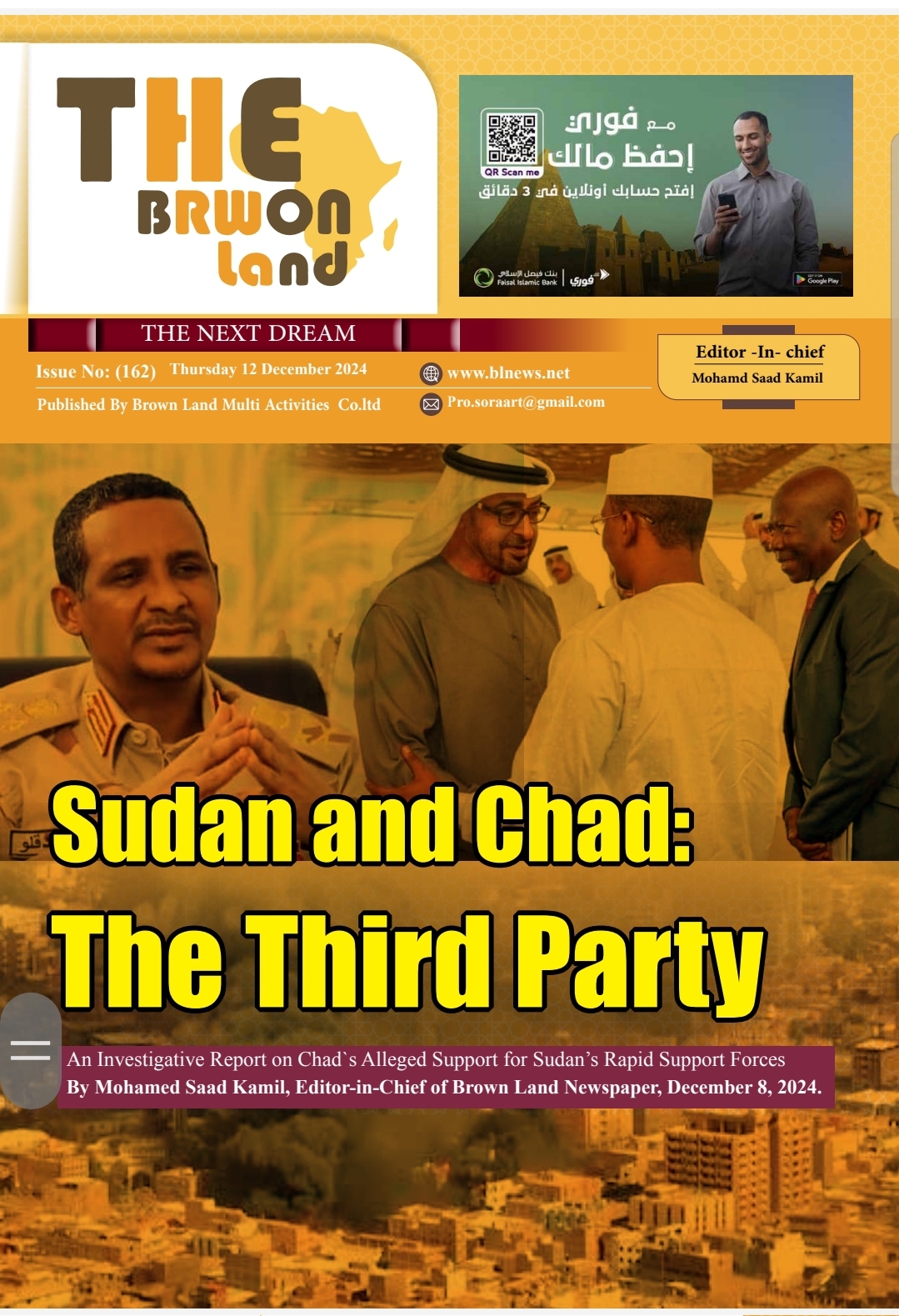
Sudan and Chad: The Third Party
An Investigative Report on Chad’s Alleged Support for Sudan’s Rapid Support Forces
By Mohammed Saad Kamel, Editor-in-Chief of Brown Land Newspaper, December 8, 2024.
The Genesis of the Conflict
The war between the Sudanese Armed Forces (SAF) and the paramilitary Rapid Support Forces (RSF) erupted on April 13, 2023. Preceding the outbreak, tensions had been brewing with warning signs that the country was on the brink of war. Just two days before the RSF launched a coordinated attack on the presidential palace, military headquarters, and strategic facilities in Sudan, approximately 100 RSF vehicles besieged Merowe Airport in northern Sudan, refusing to withdraw. This prompted the SAF to declare the RSF’s mobilization as a significant threat of confrontation. For months, the RSF had been steadily moving forces from Darfur to the capital, Khartoum.
On the political front, a contentious debate on the integration of the RSF into the national army added fuel to the fire. The SAF advocated for a two-year timeline, while the RSF insisted on a decade-long process.
Since the first gunfire was exchanged on April 15, 2023, questions have lingered over who instigated the conflict. Accusations have flown from both sides, with allegations that a “third party” may have incited the war.
Chad-Sudan Relations: A History of Tension
The civil wars of Chad, a country marked by a long history of internal strife, have had implications for Sudan. Since its independence from France in 1960, Chad has oscillated between northern Muslim Arab leaders and southern Christian sub-Saharan groups. Every regime change has typically been met with a counter-revolution.
The civil war in Chad became intertwined with the Darfur conflict in 2003. Sudanese rebels reportedly received support from Chad’s government, while Chad accused Sudan of aiding Chadian rebels. By 2008, Chad faced an intense rebel assault on its capital, N’Djamena, prompting French intervention to support President Idriss Déby.
Despite recurring hostilities, Déby worked to maintain cordial ties with Sudan, understanding the mutual dependency between the two nations. Sudan’s stability often mirrored Chad’s, as both countries shared deep economic and social ties. However, after Déby’s death in 2021, Chad’s political landscape shifted under the transitional leadership of his son, Mohamed Idriss Déby, also known as “Kaka.” This transition marked a turning point in Chad’s relations with Sudan.
Chad’s Role in the Current Sudanese Conflict
Concerns over Chad’s involvement in the Sudanese war have escalated. Reports indicate that Chad’s territories have been used as transit points for arms shipments and mercenaries supporting the RSF. International satellite monitoring revealed over 400 flights from the UAE to Chad, delivering weapons to the RSF via Chadian airports, notably the Adré border crossing and N’Djamena International Airport.
Critics accuse Mohamed Déby of prioritizing personal gains over national interests by aligning with external actors, particularly the UAE. These actions have been described as part of a broader regional agenda spearheaded by the UAE to destabilize Sudan.
Sudan’s Response: Accusations Against Chad and the UAE
In a press briefing on December 2, 2024, Sudan’s Defense Minister Yassin Ibrahim, Foreign Minister Ali Youssef, and Information Minister Khalid Al-Eissar presented evidence implicating both Chad and the UAE in fueling the war. They alleged that the UAE supplied advanced weaponry, including drones, which were transported through Chad to the RSF.
Defense Minister Ibrahim stated, “These acts of aggression, supported by irrefutable evidence, constitute a direct assault on Sudan’s sovereignty.” He vowed that Sudan reserved the right to respond at the appropriate time and place.
The Ministry of Defense displayed satellite images and drone debris, asserting that these attacks caused significant civilian casualties without yielding any military gains for the RSF. The Foreign Minister further condemned Chad’s facilitation of these arms transfers, calling it a breach of international norms and neighborly obligations.
The Way Forward
The Sudanese government has demanded accountability from Chad and the UAE, warning of regional instability should their interference persist. Observers argue that Chad’s role, under Mohamed Déby’s leadership, could lead to further destabilization of the Sahel region if not addressed.
As the conflict continues, Sudan’s calls for international intervention intensify, highlighting the urgent need for a resolution to what has become a multi-faceted proxy war with dire humanitarian consequences.
Sudan Accuses Chad of Supporting Rapid Support Forces, Chad Denies Allegations
Sudanese Allegations Against Chad
The Sudanese government has submitted evidence to the African Commission on Human and Peoples’ Rights accusing Chad of supporting the Rapid Support Forces (RSF) in committing crimes, including genocide, war crimes, and crimes against humanity. The accusations are based on reported involvement in acts such as murder, rape, forced displacement, and the recruitment of child soldiers. Sudan claims that Chad has allowed the use of its borders and airstrips for arms supplies to the RSF and facilitated the movement of mercenaries from West Africa to join the conflict.
Chad’s Response
Chad strongly denies these allegations, calling them baseless and counterproductive to peace efforts. The Chadian government accuses Sudan of a long history of destabilizing Chad through support for rebel groups, which they claim led to the 2021 assassination of former Chadian President Idriss Déby. Chad maintains that it has remained neutral in the Sudanese conflict, and Foreign Minister Abderrahmane Koulamallah has reiterated Chad’s commitment to peace, condemning the Sudanese government’s accusations as false.
Wider Context and Implications
The accusations have further strained relations between the two countries. Chad accuses Sudan of destabilizing the region and denies aiding the RSF. Chad’s President Mahamat Déby, commonly known as “Kaka,” is reportedly maneuvering to mitigate risks of regional instability, balancing relations with external actors like the UAE and France while addressing internal tribal tensions.
Ethnic and Humanitarian Concerns
The ongoing war has devastating consequences for civilians, particularly ethnic groups in Darfur. A Le Monde report detailed RSF-led ethnic cleansing campaigns targeting African tribes, leaving thousands dead and entire villages destroyed. Similar atrocities are feared in other regions, raising concerns over a broader humanitarian catastrophe.
Chad’s Internal Challenges
Chad’s involvement—or perceived involvement—in Sudan’s conflict risks destabilizing its already fragile security environment. Observers warn of a growing ethnic divide within Chad, exacerbated by its connections to the RSF and the influx of refugees and fighters along its borders.
The accusations and counteraccusations between Sudan and Chad highlight a volatile mix of local, regional, and international factors fueling the conflict. As both nations continue to trade blame, the humanitarian toll rises, and the potential for broader regional destabilization looms large.
Genocide and Demographic Engineering in Sudan: A Strategic Campaign
In an exclusive interview with Brown Land, France-based political activist and journalist Mohieddine Babouri described the ongoing atrocities committed by the Rapid Support Forces (RSF) in Sudan as a deliberate campaign of genocide and forced displacement. He characterized the RSF’s actions as part of a broader ideological agenda aimed at demographic engineering and erasing the presence of African ethnic groups.
Systematic Targeting of African Communities
Babouri highlighted how the RSF, which evolved from the infamous Janjaweed militias under former President Omar al-Bashir, employs brutal tactics, including mass killings, rape, and village destruction, to achieve its objectives. These acts target specific African ethnic groups, with derogatory racial slurs like zurga (a term for African-origin individuals) used to dehumanize victims. He noted that such language has been weaponized to incite and justify violence, often framing it as a path to divine reward.
Babouri recalled some of the most heinous atrocities, such as the mass killings in El Geneina, where over 17,000 members of the Masalit ethnic group were slaughtered within months. He also described the RSF’s symbolic destruction of Masalit heritage, including the assassination of community leaders and the dismantling of ancient tribal structures to replace them with a newly proclaimed “Sultanate of Janjaweed,” populated by Arab groups from across Africa.
The Strategy of State-Sanctioned Genocide
Babouri argued that these atrocities are not random acts of violence but are part of a calculated plan to establish a new political entity, referred to as the “State of Junayd.” This envisioned state would stretch from eastern Sudan’s Port Sudan to the capitals of Chad, the Central African Republic, and Libya. He attributed this strategy to long-standing plans like the “Quraysh 1 and Quraysh 2” projects, which advocate for the establishment of an Arab-dominated state on the ruins of indigenous African communities.
He further linked the RSF’s actions to historical policies under al-Bashir’s regime, which granted the Janjaweed militia legal status and institutional backing, allowing it to amass resources and embed itself within Sudan’s social and geographical fabric.
The Role of External Actors
Babouri identified external actors, particularly the UAE and Gulf states, as critical enablers of the RSF’s campaign. He suggested that these states see the RSF as a tool for advancing their own regional ambitions, including controlling Sudan’s resources and creating a pro-Gulf buffer state.
He warned that the RSF’s victories could lead to a broader demographic shift, with Gulf countries potentially resettling their stateless “Bidoon” populations and other marginalized groups in North Darfur, whose desert climate resembles that of the Gulf. This would further entrench the RSF’s hold on the region and solidify the demographic transformation.
African Leaders and Regional Dynamics
Babouri accused certain African leaders, including Chad’s President Mahamat Idriss Déby (“Kaka”), of complicity in the RSF’s actions. He argued that Déby’s support for the RSF serves multiple strategic goals, including eliminating opposition within Chad and appeasing external powers like the UAE.
At the same time, he noted the historical mistrust and disdain many African leaders harbor toward “Arab settlers,” often viewing them as remnants of colonial exploitation. This tension fuels a cycle of manipulation, where external actors exploit Arab militias for their own gains while also seeking to contain them through proxy wars.
A Catastrophic Vision for Sudan
Babouri concluded by warning of the grave consequences if the RSF succeeds. The envisioned State of Junayd, built on the ashes of indigenous African populations, would exacerbate regional instability and further entrench ethnic divisions. He called for immediate international action to halt the RSF’s campaign, protect African communities, and prevent the realization of this dystopian vision.
“The stakes are not just about Sudan,” Babouri emphasized, “but about the survival of entire cultures, histories, and societies in Africa, under threat from a devastating combination of greed, racism, and geopolitical manipulation.”
Mohamed Kaka and Chad’s Role in Sudan’s Ongoing Conflict
, political activist and journalist Mohieddine Babouri sheds light on the involvement of certain Chadian groups and regional powers in the Sudanese conflict, particularly their support for the Rapid Support Forces (RSF).
Mohamed Kaka: A Proxy Leader
Babouri begins by noting that Mohamed Kaka, Chad’s de facto leader, is an adopted son rather than the biological child of the late President Idriss Déby. Kaka belongs to the Goran tribe, native to the far northwest of Chad, which, according to Babouri, has historically been exploited and sold into servitude.
Currently, Goran fighters are being mobilized under the leadership of General Abakar Shawa near the Sudanese-Chadian border. The first wave of these forces, led by Idriss Berkay, recently attacked areas inhabited by the Zaghawa ethnic group, such as Ambar. During these raids, they looted over 6,000 livestock, killed civilians, and burned villages. However, a local resistance force, known as Art Art, intercepted and inflicted heavy losses on them.
In response, Babouri claims, the UAE has provided vehicles and weapons to Kaka, who has passed them on to Saleh Abdel Karim Habre—a prominent smuggler and relative of former Chadian President Hissène Habré. Habre is reportedly organizing Goran fighters from Libya and Niger, as well as other mercenaries from Mauritania and Libya’s Mahamid tribe, to join the RSF. Babouri warns that this force, reinforced by RSF fighters returning from Yemen, is now focused on attacking Sudanese cities like El Fasher. He believes this might be the RSF’s final gambit, and a significant military defeat would mark the end of their ambitions.
The Root of Sudan’s Crisis
Babouri draws attention to the plight of Sudan’s indigenous communities, displaced and massacred by the RSF. He argues that the RSF was deliberately formed and empowered by Sudanese Islamist regimes to maintain their grip on power. Over time, the RSF has exploited tribal alliances to further its project of creating the “State of Junayd,” a vision of domination that seeks to erase African communities and replace them with a fabricated Arab identity.
Chadian Support for Sudan’s Government
When asked about reports of certain Chadian groups supporting Sudan’s government against the RSF, Babouri confirms the solidarity shown by some Chadian ethnic groups. He explains that many Chadians, himself included, see the RSF’s genocidal ambitions as a direct threat to their own survival.
“We understand the RSF’s agenda: they want a land without people to build their so-called history and nation on the ruins of our communities. If we don’t support Sudan now, Chad will be next.”
He cites a recent explosion at a missile depot in Chad as evidence of this solidarity. Babouri claims the explosion was orchestrated by patriotic officers within the Chadian army who opposed the government’s plans to transfer the missiles to the RSF via Um Jaras, a town on the Chad-Sudan border.
UAE’s Role and Its Impact on Chad
Babouri strongly criticizes the UAE for its role in supporting the RSF through Chad. He accuses the UAE of corrupting senior Chadian officials and exerting significant influence over Mohamed Kaka, even pressuring him to promote RSF loyalists to senior positions in the Chadian army, police, and gendarmerie.
For example, former Chadian Foreign Minister Mohamed Saleh Annadif, Babouri alleges, was appointed with direct support from UAE Crown Prince Mohammed bin Zayed. The current Minister of Interior and other diplomats are also part of this network.
Babouri points to the growing divisions within the Chadian government, which became more apparent after the assassination of opposition leader Yahya Dillo, head of the Socialist Party Without Borders. Dillo had exposed the UAE’s involvement in arming the RSF at Um Jaras airport, sharing photos of Emirati planes unloading weapons. His murder, Babouri says, triggered protests in Um Jaras, leading to widespread awareness of the UAE’s complicity.
Babouri concludes with a stark warning: “What’s happening in Sudan is not just a local crisis—it’s part of a broader project that threatens the entire region. If the RSF succeeds, it will embolden similar projects in Chad and beyond. The fight against them is not just Sudan’s fight; it’s ours too.”
Exclusive Interview with a Chadian Opposition Leader
The Sudanese Rapid Support Forces (RSF) have been accused of committing widespread human rights abuses, targeting African ethnic groups. This has prompted certain African-rooted armed movements to align with the Sudanese government forces to counter the RSF. Dr. Sherif Jako, Vice President of the Front for Change and Concord in Chad (FACT), provided exclusive insights to Brown Land, shedding light on the intertwined ethnic, cultural, and social dynamics between Chad and Sudan.
Shared Histories, Persistent Struggles
Dr. Jako explained that Chad and Sudan share extensive ethnic and tribal connections, which have shaped their socio-political landscapes for over three decades. He highlighted that since the rise of former Chadian President Idriss Déby, supported by France, Libya, and Sudan, Chadian tribes, including mercenaries from Sudan’s Darfur region, were instrumentalized to secure Déby’s grip on power.
“The African-rooted movements that fought the Sudanese government under the pretext of marginalization and injustice ended up supporting Chad’s government, which is more dictatorial than Sudan’s, driven by tribal and mercenary motives,” Dr. Jako remarked.
When the Sudanese crisis erupted on April 15, 2023, with clashes between the RSF and the Sudanese Armed Forces (SAF), most African-rooted movements, especially those signatories of the Juba Peace Agreement—such as the Sudan Liberation Movement led by Minni Arko Minnawi and the Justice and Equality Movement headed by Dr. Gibril Ibrahim—initially adopted a neutral stance. However, they later joined SAF against the RSF, lured by financial and political benefits.
Chad’s Role: Gateway or Enabler?
Responding to allegations of Chad’s involvement in supporting the RSF, Dr. Jako dismissed claims of direct government backing. “Chad merely serves as a transit point for military logistics passing through the Umm Jaras Airport. This is driven by personal interests of Chad’s ruling clique, with no strategic justification,” he emphasized.
On accusations from Sudanese officials that the RSF operates bases in Chad, Dr. Jako described these as baseless rumors lacking diplomatic decorum. “There are no RSF bases in Chad; the situation is limited to logistical transits into Sudan,” he clarified, noting that the Chadian opposition and the public staunchly oppose any involvement in Sudan’s crisis.
“Chad must either mediate for a peaceful resolution or maintain neutrality—nothing more,” he asserted, criticizing the cross-border ethnic interventions by Darfuri movements that have destabilized Chad over the years. FACT has consistently issued statements rejecting any interference in Sudan’s internal affairs, he added.
UAE’s Controversial Role in the Sudanese Conflict
Dr. Jako also accused the UAE of fueling the Sudanese war by funneling military supplies to the RSF through Chad, exploiting the ruling clique’s self-serving interests. “This undermines Chad’s principles, which historically opposed involvement in neighboring crises,” he said, adding that the UAE’s influence has exacerbated tensions within Chad’s government and with its former colonizer, France.
He concluded with a message to Sudan’s government and people: “The Chadian people, who have suffered from Sudanese interference in the past, are innocent of any involvement in this crisis. Stereotyping Chadians due to baseless allegations only strains the historic ties between our peoples.”
International Escalation and UAE Influence
More than a year after the military confrontations between the Sudanese army and the Rapid Support Forces (RSF), relations between Sudan and the UAE have entered a new phase of tension. This shift was sparked by a heated exchange between the two countries’ representatives at the United Nations in New York during a session on June 13, 2024, which focused on the situation in the Sudanese city of El Fasher.
Khartoum accuses Abu Dhabi of providing military, logistical, and financial support to the RSF, enabling the group to continue its war efforts. Additionally, the UAE is said to exert influence over several neighboring countries—chief among them Chad, the Central African Republic, and Libyan leader Khalifa Haftar—to allow their territories to be used for transporting support to the RSF.
This support has raised serious concerns not only about Sudan’s stability and security but also its unity, with fears that the situation could replicate the Libyan scenario.
President Déby: His Own Enemy
Sudanese writer and journalist Rasha Oshi, in an article published on social media platforms on December 7, 2024, titled “President Déby: His Own Enemy”, argued that by allowing the UAE to use Chad as a pawn in its aggression against Sudan, President Mahamat Déby has committed a costly strategic error that cannot be easily rectified. Chad has effectively become a military base for UAE-backed militias attacking Sudan.
Oshi contended that President Déby’s strategic mistake lies in prioritizing his public image over his country’s historical and political interests, leading him to deliver a blow to his regime that his adversaries, during the reign of his father Idriss Déby, were never able to inflict. By enabling his family’s historical rivals to control key decision-making positions in Chad, he has paved the way for ethnic extensions to encroach from Sudan.
The article also questioned whether there is still an opportunity for a renewed Sudan-Chad relationship amidst rapid political shifts. Oshi emphasized that Déby’s support for the RSF (Rapid Support Forces) has made reconciliation between the two nations nearly impossible. The path to restoring peace is now strewn with thorns due to the deepened conflict.
“There was a chance for retreat, but when President Mahamat Déby believed his alignment with the UAE would secure his place in history as a leader who ended French influence and ushered in new interests, he lost that chance forever,” Oshi wrote. “Chad now risks becoming a UAE colony, as Déby strives to reinforce its position in the region.”
The article also highlighted how Déby has found himself ostracized, even by his own people. Senior military and government officials now reject the bloodshed caused by the RSF’s airstrikes on displaced camps in Darfur, which are allegedly launched from Chad’s airports in N’Djamena and Am Jaras, based on satellite imagery provided by the Sudanese army as evidence of Chad’s involvement in the conflict.
Furthermore, Oshi pointed out that members of the Déby family, who have faced internal tensions due to President Mahamat’s policies, are seeking dialogue with Sudan to clarify Chad’s stance. However, she argued that Mahamat Déby fails to recognize that the borders between the two countries are immutable, and his attempts to change them will only lead to greater conflicts.
Finally, Oshi reminded readers of the history of violence and tragedy associated with the Déby family in Chad, noting that the groups Mahamat Déby has aligned with today once posed a direct threat to his father’s rule. Attempting to empower the RSF, which shares ethnic ties with these groups, is akin to playing with fire that is bound to ignite soon.
She concluded by advising President Mahamat Déby to face the reality of his situation and carefully consider the costs and benefits of his actions before it is too late.
UAE Support to Chad Will Backfire Soon
Dr. Mohamed Hamad, an international and regional affairs analyst, told Brown Land that President Mahamat Déby’s antagonism toward Sudan has driven a deep wedge into Chad’s strategic security. By siding with the RSF—a multi-ethnic, cross-border rebel force—Déby has not only put the majority of Chadians at risk but also jeopardized his regime’s future.
“If the RSF prevails in Sudan, it will inevitably seek regional dominance, with Chad as its next target,” Dr. Hamad warned. He explained that African regimes in the past, like Mengistu in Ethiopia and Siad Barre in Somalia, prioritized toxic foreign economic and military aid to sustain fragile regimes. In the end, these dependencies played a decisive role in their states’ collapse.
“The allure of UAE aid is leading Déby down a perilous path,” Dr. Hamad added. “Given the complex, reciprocal security dynamics between Sudan and Chad, this alignment against Sudan will undoubtedly destabilize Déby’s rule.”
Conclusion
An investigative report by Brown Land has uncovered compelling evidence of Chad’s involvement in supporting the RSF. This interference is neither in Chad’s interest nor beneficial for the region as a whole. While Déby might gain temporary financial rewards from the UAE and use the conflict to suppress Chadian opposition by dragging them into a losing war, the broader implications point to a grim end for this precarious chapter in Chad’s history.
“This dark era is shaping up to be catastrophic for everyone involved,” said Mohamed Saad Kamel, Editor-in-Chief of Brown Land.