Part II: When Law Collapses and Narrative Prevails
In this part, we scrutinize the testimonies to reveal how narrative became a weapon, law was twisted into strategy, and Sudan’s sovereignty was targeted. Through selective framing, Sudan’s legitimacy was sidelined, and a foreign-backed militia was elevated as a peer to the state
Strategic Testimony, Legal Disintegration, and the Erosion of Sovereignty
By: Sabah Al-Makki, Assistant Editor

I. Narrative on Trial — Setting the Stage
For context, read Part I: The Fiction of Parity
Following a congressional hearing that established a false equivalence between the Sudanese Armed Forces (SAF) and a foreign-backed militia, the Rapid Support Forces (RSF), this second installment delves into the deeper issue: the narrative as a doctrine. This strategic tool demands our vigilance.
At this juncture, testimony ceases to be mere evidence—it becomes a strategic tool. Legal categories, once fixed, are now being reshaped to serve political ends. International law, which was once a barrier against impunity, is now being twisted to legitimize insurgency.
Part II charts how rhetoric hardens into doctrine, how allegations supplant adjudication, and how Sovereignty shifts from a right to a conditional grant. This is not narrative—it is strategic architecture. And it is dismantling the very foundation of sovereign order.
II. Strategic Testimony — How Narrative Replaced Law and Reassigned Legitimac
A. Legal Clarity Amid Collapse: Ken Isaacs
Amid this architecture of distortion, one voice stood apart.
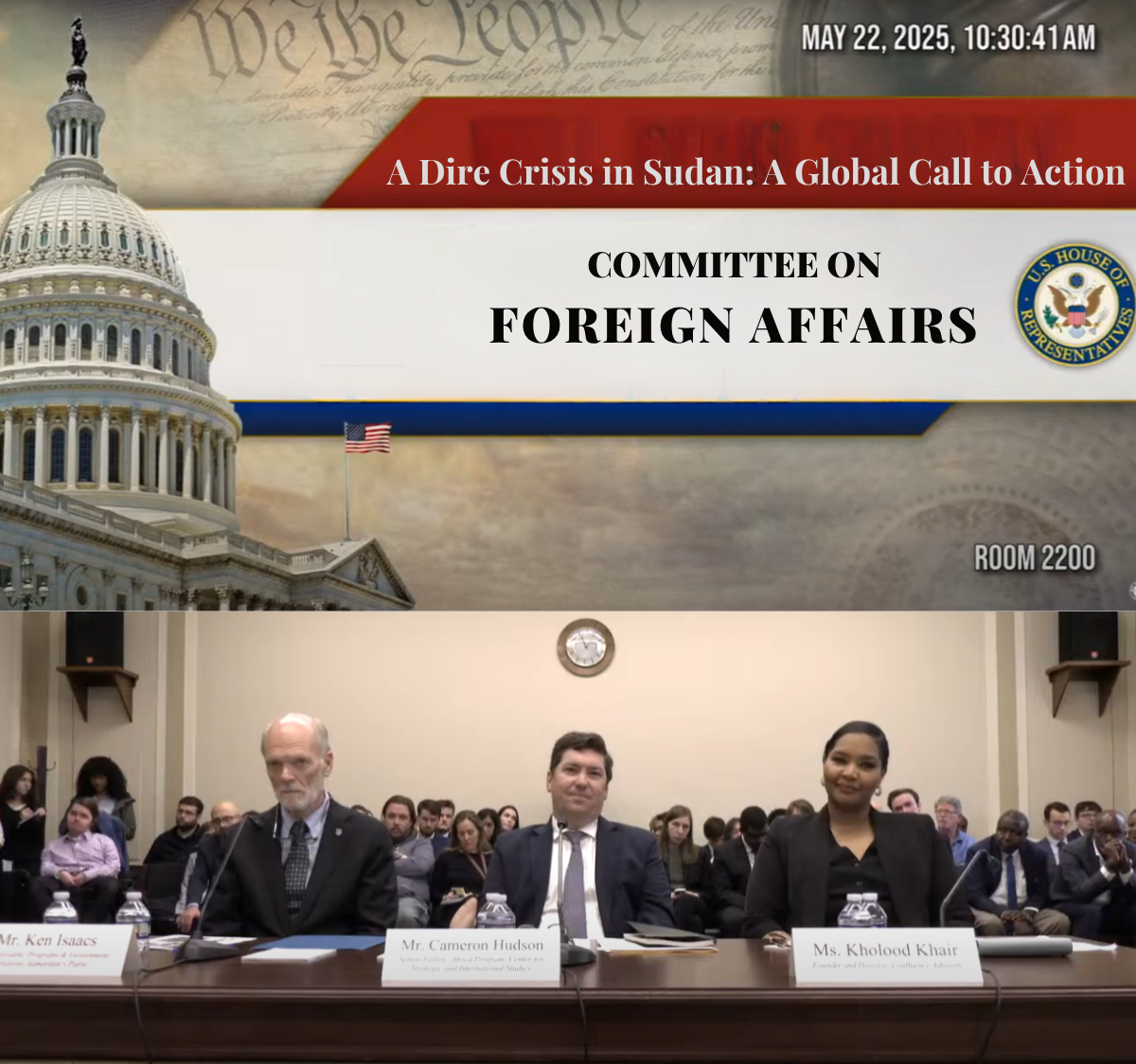
Mr. Ken Isaacs, Vice President of Programs & Development, at Samaritan’s Purse, delivered the sole testimony grounded in both legal principle and operational realism. He reinstated the foundational asymmetry between a sovereign national army and an externally sponsored militia. He reminded the hearing that, despite its institutional imperfections, the SAF remains the only command-capable body capable of coordinating humanitarian access, preserving territorial cohesion, and protecting civilians.
His intervention was not just a correction—it was a revelation. It showed that the collapse of legal categories was not an inevitable outcome but a deliberate choice. Other frameworks were available, but they were intentionally excluded from the dominant narrative.
Mr. Ken Isaacs did not salvage the hearing’s trajectory. But he did preserve the possibility of legal clarity, offering one final record of dissent before the law was overruled by language. His actions instill hope and determination in the face of narrative manipulation.
B. Allegations Without Evidence
The congressional hearing did not merely host testimony; it activated a reengineering of legal consequences through the vehicle of an uncorroborated narrative. Most witnesses advanced a calculated erosion of legal categories, collapsing the distinction between a sovereign military and a foreign-sponsored militia. Among them, Ms. Kholood Khair’s testimony was emblematic.
She alleged the use of chemical weapons by the SAF—a grave charge advanced without verification from the Organisation for the Prohibition of Chemical Weapons (OPCW), without satellite or forensic evidence, and confirmation from an independent monitor. Yet this claim, untethered from evidentiary rigor, was rapidly codified into U.S. sanctions legislation through the invocation of the 1991 Chemical and Biological Weapons Control and Warfare Elimination Act (CBW Act).
The narrative thus became juridically operative. Allegation displaced adjudication. The evidentiary threshold that international law demands was bypassed in favor of strategic insinuation.
Ms. Khair went further, accusing the United Nations of violating humanitarian neutrality by recognizing the SAF as Sudan’s de facto authority. This recognition, she claimed, not only conferred illegitimate power on the army but also directly exacerbated the country’s food crisis. According to her narrative, famine was not a consequence of war—it was a weapon of war, allegedly manufactured by the SAF while disclaiming responsibility.
Again, no independent monitors, humanitarian agencies, or satellite assessments substantiated this claim. No evidentiary threshold was met. Yet the rhetorical gravity was immense, and the narrative was allowed to stand unchallenged.
This was not simply a critique—it was a strategic inversion of culpability. Responsibility was abstracted from those credibly accused and reassigned to the one institution still resisting national collapse. The RSF—a militia with a documented record of systemic agricultural destruction—was conspicuously spared.
The RSF’s war crimes include the torching of seed banks, the looting of farming equipment, the burning of villages, and the dismantling of World Food Program (WFP) convoys. These are not accidental collateral effects—they are deliberate acts designed to collapse the civilian food chain. Yet in this hearing, the force manufacturing starvation was exonerated; the force resisting disintegration was indicted.
This inversion is not an anomaly—it follows a pattern in U.S. foreign policy, where speculation has repeatedly outrun substantiation. The 1998 bombing of Sudan’s Al-Shifa pharmaceutical factory and the 2003 invasion of Iraq, both justified by unverified claims, illustrate how suspicion—once amplified in elite forums—mutates into legal doctrine. The result is not just a flawed analysis; it is the reconstitution of law around the architecture of perception.
C. Reframing Resistance: Delegitimizing Civilian Defenders
This narrative distortion extended beyond the realm of state responsibility—it reached the moral heart of community resistance. Ms. Khair’s testimony excluded all reference to Sudan’s Joint Forces, which are civilian-based formations that arose not from political ambition but from the necessity of survival.
These forces—many of them originating in Darfur—did not emerge to rival the state but to preserve it against annihilation. The Shield of Sudan in Al-Gezira Forces, the Al-Baraa Ibn Malik Brigade, and others formed in coordination with the SAF to defend territory and protect their communities. Their mobilization was not ideological—it was existential.
Yet in Ms. Khair’s account, any armed actor aligned with the SAF is summarily designated a “militia,” stripped of legitimacy, and equated with insurgency. In contrast, legitimacy is implicitly reserved for groups aligned with donor-endorsed civil society networks or the former, Hamdok-led civilian administration.
Nowhere does her framing grapple with the central moral question: What are civilians to do when confronted with RSF militia incursions—when homes are razed, infrastructure torched, women raped, and families exterminated?
To conflate grassroots defenders with unlawful militias is not merely inaccurate—it is a profound moral reversal. It recasts resistance to genocide as political sabotage and erases the moral agency of communities who refused to be erased themselves.
Legitimacy, in this context, is not a theoretical abstraction; it is a tangible reality. It is written in the patterns of civilian flight. Sudanese families do not flee toward RSF-controlled zones. They escape from them and into SAF-held areas. Resistance is not mobilized under militia command—it is organized in cooperation with the one institution still capable of state protection.
This is not a civil war. It is not a binary clash between generals. It is a proxy war waged by a foreign-sponsored militia, chiefly financed and armed by the United Arab Emirates (UAE), targeting Sudan’s Sovereignty and its national fabric.
To recast those defending their homes and their cohesion as unlawful actors is not simply a distortion of language. It is a desecration of moral judgment.
D. Projection and Double Standards
The narrative inversion deepened with ideological projection. Sudanese community-based defense groups were portrayed—often implicitly, sometimes overtly—as jihadist formations merely because they referenced Islamic identity. This framing is not only analytically incoherent, but it is also geopolitically dangerous.
Coordination with the SAF affirms their legal and constitutional alignment. It does not diminish their legitimacy. Not every armed group aligned with a national army is a militia. Not every group rooted in Islamic values is a jihadist organization.
Religious framing—particularly when it leans on Islamophobic tropes—adds nothing to legal analysis. It imports bias under the guise of objectivity. Christian political parties flourish across Western democracies without inciting suspicion. Israel, a Jewish state by definition, is not pathologized for its religious identity. Yet in Sudan, Islamic reference points trigger immediate doubt, suspicion, and narrative exclusion.
This asymmetry is not just hypocritical—it is corrosive. It distorts global norms by importing ideological filters into legal frameworks.
And if concerns about jihadist infiltration are to be taken seriously, they must be anchored in historical and evidentiary truth. Numerous investigations have shown that groups like Al-Qaeda trace aspects of their formation to Cold War-era intelligence operations conducted by Western powers. Later, ISIS followed a similar trajectory, emerging from the remnants of U.S.-era interventions in Iraq. Likewise, credible reports have linked insurgent activity in the Sahel—including the rise of groups like Boko Haram—to foreign enablers, with particular attention to financial and logistical ties involving French networks in the region.
These precedents underscore a critical principle: the integrity of international legal discourse depends on evidentiary foundations, not ideological projection or selective outrage.
To equate Sudan’s community-driven, locally organized defenders with transnational terrorist entities—absent structural analysis, motive, or legal context—is not only irresponsible. It replicates the very disinformation tactics used to justify foreign intervention under the guise of counterterrorism.
And in doing so, it eviscerates the moral credibility of the international order it claims to uphold.
III. Juridical Collapse — Reengineering International Law
A. Hudson’s Framework of Equivalence — From Law to Diplomacy
Mr. Cameron Hudson advanced a technocratic framework that reframed Sudan’s war not through the lens of legality, sovereignty, or state responsibility, but through a behavioral and geopolitical parity model. In his testimony, the SAF—the constitutionally mandated military of a recognized sovereign state—were cast as morally and militarily equivalent to the RSF, a UAE-sponsored militia credibly accused of genocide, systematic atrocity crimes and the recruitment of child soldiers.
To sustain this narrative of equivalence, Hudson juxtaposed the SAF’s diplomatic and military ties with Egypt, Saudi Arabia, and Turkey against the RSF’s backing by the UAE. These were not presented as qualitatively different forms of engagement, but as a balanced regional dynamic, as though formal interstate cooperation and covert militia sponsorship were interchangeable expressions of influence.
This framing overlooks a fundamental principle in international law: that sovereign state militaries, such as the SAF, possess the legal right to engage in bilateral defense relations, military coordination, and strategic alliances. Such partnerships operate within recognized international frameworks and treaties. Militia sponsorship, by contrast, exists outside the bounds of legality—it is not diplomacy, but complicity in rebellion.
Hudson’s construct did not assess legitimacy by reference to constitutional authority or legal mandate, but by battlefield optics and donor sentiment. It replaced legal standing with narrative parity.
This is not analytical subtlety—it is the erosion of the international legal order. By flattening the distinction between a state’s armed forces and an outlawed militia group, Hudson’s framework normalizes insurgency, validates proxy warfare, and recasts war crimes as policy differentials. It is not just a distortion—it is the laundering of illegality through the rhetoric of balance.
B. The Legal Core Erased
The most profound consequence of the hearing was not rhetorical but jurisprudential. What transpired was the deliberate collapse of the legal distinctions enshrined in the Geneva Conventions, the UN Charter, and customary international law governing armed conflict.
Under international legal doctrine, the SAF is the military extension of a recognized sovereign government. It operates under codified chains of command, is subject to institutional accountability, and enjoys sovereign protection under the laws of war. The RSF, by contrast, is a UAE-backed, non-state armed group—without a constitutional mandate, without lawful authority, and with a demonstrable record of war crimes, including sexual violence, ethnic cleansing, and the systematic use of starvation as a weapon.
To equate the two is not balanced—it is betrayal. It does not clarify the law; it weaponizes diplomacy against it.
C. Rhetoric as Obfuscation — Moral Absolutism and the Rebranding of War
Representative Chris Smith’s description of Lt. Gen. Abdel Fattah Al-Burhan and RSF leader Mohamed Hamdan Dagalo (Hemedti) as “the twin butchers of Darfur” exemplifies a troubling turn in international discourse—one in which moral absolutism supplants legal precision.
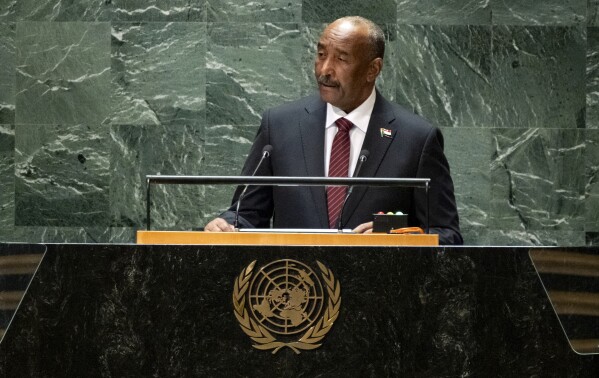
While emotionally potent, such language does not advance principled diplomacy. Instead, it collapses critical distinctions between lawful state actors and non-state perpetrators of atrocity. By casting a constitutionally mandated military leader in the same moral frame as the commander of a militia credibly accused of genocide, Representative Smith’s rhetoric flattens the legal asymmetry on which the international order depends.
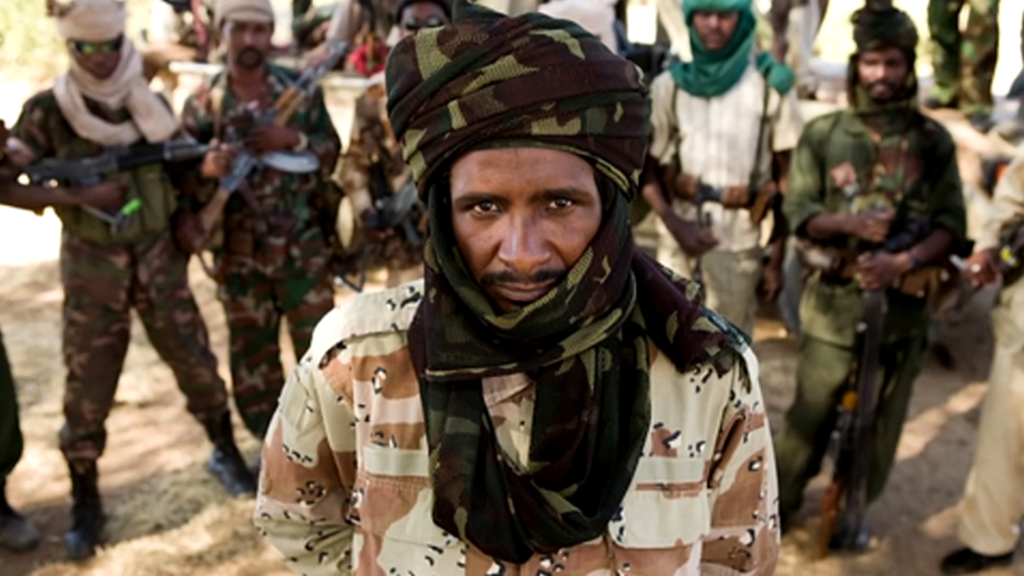
In the process, it undermines not only the SAF’s legitimacy but the very principle that state institutions—however flawed—exist within a framework of accountability that militias systematically evade.
Representative Sara Jacobs compounded this collapse by characterizing Sudan’s conflict as a mere proxy contest among Gulf states. This framing obfuscated the RSF’s agency, downplayed its domestic and regional criminality, and sanitized the war’s origins.
To portray the violence as a peripheral contest among external powers is to disregard the core fact: this is a war driven by a foreign-sponsored militia against a recognized sovereign state. In casting both parties as instruments of external influence, Rep. Jacobs erased the structural asymmetry between a national army defending territorial Sovereignty and a non-state actor engaged in systemic atrocity. The war was not reframed for clarity. It was rebranded for convenience.
IV. Diplomatic Subversion — Elevating the Aggressor
Mr. Hudson carried this logic into the realm of diplomacy. In advocating for “equal engagement” with all regional actors, he extended his narrative of symmetry from the legal domain to the diplomatic table. Presented as neutrality, this policy prescription had the practical effect of excluding Sudan’s legitimate government, while including the UAE, a declared aggressor state, as a central stakeholder.
Mr. Hudson failed to acknowledge that Sudan had already severed diplomatic ties with the UAE and formally designated it as a hostile party. Under international norms, such a designation is not symbolic—it is foundational. Yet his framework ignored this fact, proposing a peacebuilding architecture in which the aggressor is a partner and the sovereign is an absentee.
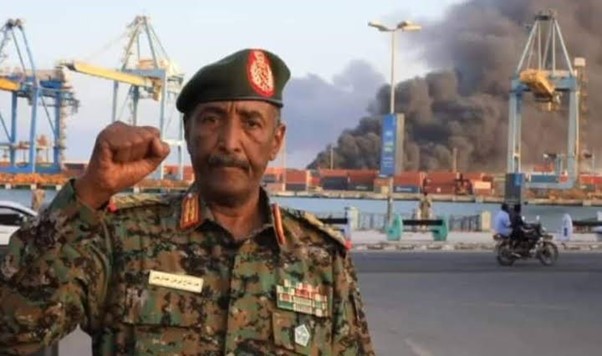
This rhetorical inversion—treating the RSF as a participant in governance and the SAF as a party to be bypassed—transformed diplomatic engagement into a mechanism of legitimizing collapse. What masqueraded as impartiality was, in substance, a doctrine of equivalence that marginalized sovereignty and rewarded subversion. Mr. Hudson did not demonstrate respect for the Sudanese state—on the contrary, he treated it as a diminished entity, deprived of sovereign agency and in need of custodianship through a Western lens. This is precisely the archetype of Western arrogance: the presumption that states which defy donor orthodoxy must be managed, not engaged; supervised, not respected.
V. The Undoing of Sovereignty — From Recognition to Erosion
The implications of such framing are profound. It risks conferring legitimacy upon external actors whose role is not to mediate peace but to architect instability. The UAE’s extensive and well-documented involvement in financing, arming, and logistically sustaining the RSF cannot be construed as diplomatic neutrality. It constitutes active participation in a proxy war.
Equating Abu Dhabi’s role with that of state actors such as Egypt or Saudi Arabia—who engage Sudan’s sovereign institutions through recognized diplomatic frameworks—obscures responsibility under the guise of regional parity. It replaces accountability with plausible deniability and justice with geopolitical convenience.
More fundamentally, the logic of “equal engagement” undermines the core tenets of the international order. Sovereign states, regardless of internal imperfection, are bound by legal obligations, treaty responsibilities, and institutional accountability. Sponsors of militias, by contrast, operate outside these regimes, exploiting the spaces between diplomacy and deniability.
To place both on equal footing is not an act of neutrality. It is a distortion of international law. It rewards the subversion of legal statehood, disincentivizes resolution through constitutional authority, and normalizes proxy warfare as a legitimate instrument of foreign policy.
In doing so, it rebrands destabilization as engagement and erodes the very architecture that was established to protect nations under threat.
Narrative supplanted law. Destabilization became diplomacy.
VI. Strategic Outcomes — What the Hearing Achieved
The strategic reframing advanced through selective testimony and codified in congressional discourse accomplished three pivotal outcomes:
- It conferred narrative legitimacy on the RSF, a militia credibly accused of atrocity crimes, including genocide, sexual violence, and the weaponization of starvation;
- It cast the SAF as morally equivalent, thereby disqualifying Sudan’s sovereign military institution from international diplomatic frameworks;
- It shielded the UAE from accountability, effectively neutralizing Sudan’s formal legal complaint and removing a principal aggressor from scrutiny.
The implications are far-reaching. When legal distinctions give way to narrative architecture, diplomacy detaches itself from the law. Recognition becomes conditional. Insurgency is no longer condemned—it is incentivized. Sovereignty is rendered expendable the moment it ceases to align with donor consensus.
In this new paradigm, law is made elastic, Sovereignty becomes negotiable, and states are managed while proxies are empowered. Justice does not proceed from the law—it yields to perception.
VII. Strategic Imperatives — A Legal Roadmap Forward
Sudan does not require externally curated transitions or donor-brokered political tracks. What it needs is a reconstitution of the legal order and a principled return to the foundational tenets of international law.
Policy Recommendations:
- Reaffirm the legal asymmetry between state and militia, as enshrined in the Geneva Conventions and the UN Charter;
- Reject all diplomatic frameworks that equate the RSF with the SAF, whether in peace negotiations, ceasefire agreements, or power-sharing proposals;
- Anchor international engagement in the explicit recognition of Sudan’s sovereign government and constitutionally mandated institutions;
- Formally designate the RSF militia as a terrorist organization and the UAE as its principal state sponsor—a position no longer based on accusation but on a compendium of credible investigations, intelligence leaks, satellite verification, and survivor testimony.
Sudan has already lodged a formal legal complaint before the UNSC concerning the UAE’s material support to the RSF. The Security Council’s failure to act is not due to a lack of evidence. It is the result of deliberate obstruction, most notably by the United Kingdom in its role as penholder on the Sudan file.
This is not justice denied. It is justice suppressed—procedurally, diplomatically, and deliberately.
VIII. The War Beneath the Narrative — Prelude to Part III
What unfolded on May 22, 2025, was not a typical congressional hearing. It was the codification of narrative as a tool of lawfare—a strategic realignment of international posture, designed to neutralize sovereignty through perception.
But beneath the rhetorical scaffolding lies a deeper, more dangerous architecture: transnational logistics, covert financing, arms supply chains, and donor-driven “peacebuilding” mechanisms that function not as vehicles of resolution, but as façades for dismantling the Sudanese state.
This war is not Sudan’s alone. The battlefield may be Sudanese, but the orchestration is external. It is enabled by Gulf financiers, European contractors, regional intermediaries, and diplomatic actors who obscure war behind the language of neutrality.
In Part III: The Architecture of Proxy War — Weapons, Aid, and Narrative, we will trace:
• The transnational arms corridors that sustain RSF military operations;
• The donor conditionalities that institutionalize political imbalance under the pretext of humanitarian aid;
• The diplomatic façades that mask a geopolitical campaign to dissolve Sudanese statehood through narrative manipulation and procedural delay.
This war is not confined to Sudanese soil.
It is sanctioned in Western capitals, legitimized in multilateral assemblies, and operationalized through policies disguised as impartiality.
And it is time to name it. And in Part III, we will name it.
🔎 New to this Series?
Start with the introduction to understand how Sudan’s war was redefined through narrative, not just arms.
👉 Read the Series Introduction – “Narrative as Strategy: How the U.S. Reframed the Sudan’s War”
👉 Read Part I: The Fiction of Parity
Examines how the U.S. congressional hearing falsely equated Sudan’s national army (SAF) with the RSF militia, erasing legal distinctions and reframing the war through narrative manipulation, undermining Sudan’s sovereignty under the guise of neutrality.
About the Author
Sabah Al-Makki is a Sudanese writer and Assistant Editor at Brown Land News. Her work explores political violence, international law, cultural resistance, and social awareness through the lens of Sudan’s unfolding realities. She challenges dominant narratives by centering the voices of Sudanese citizens—both within the country and across the diaspora—whose perspectives are often excluded from global discourse.
Her writing interrogates the definitions of war, peace, and justice, insisting that true change begins with dismantling colonial paradigms. Sabah confronts the structures that sustain conflict, silence, and imposed transitions through cultural, cognitive, and philosophical resistance.
She writes from within the storm.
Exclusively published by Brown Land News.
Where sovereignty is not negotiable, and truth defies revision.
Our Land. Our Voice. Our News