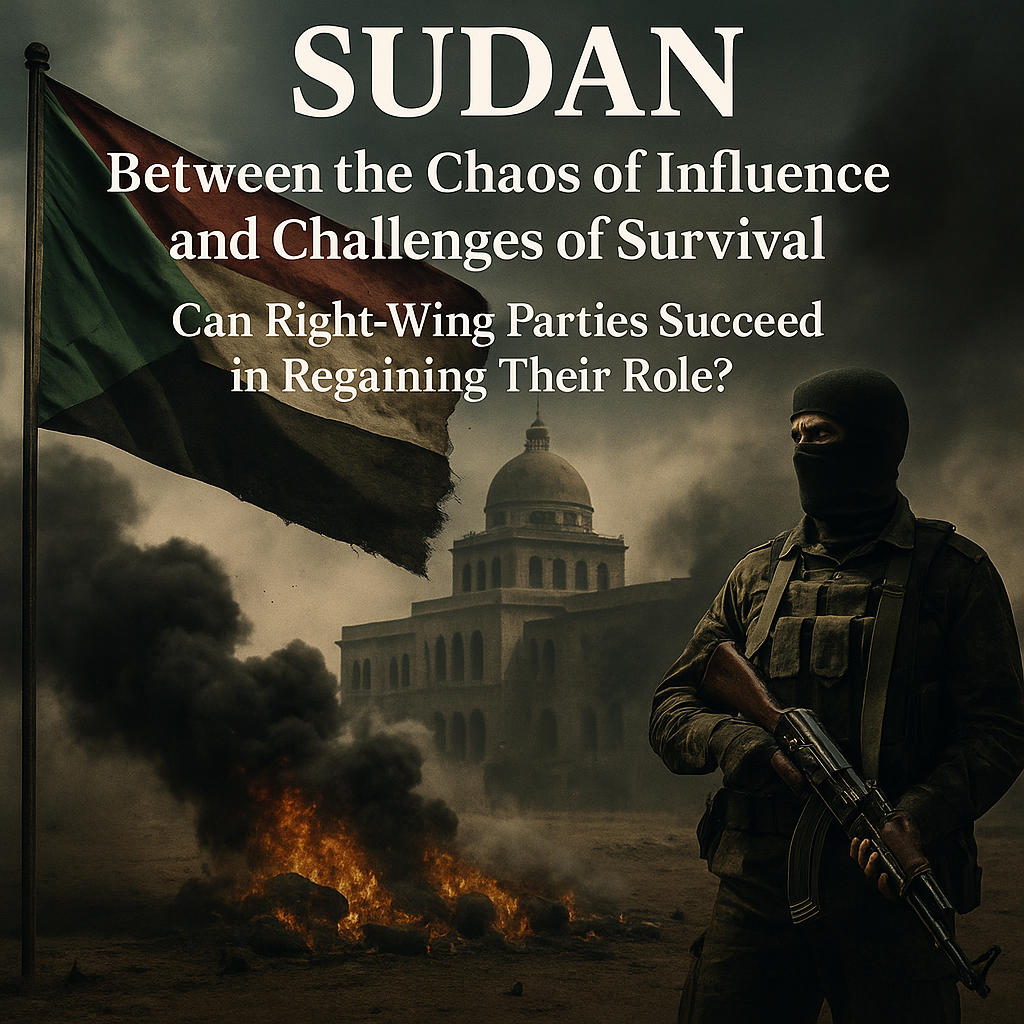
Sudan Between the Chaos of Influence and the Challenges of Survival
Can Right-Wing Parties Regain Their Role?
By Engineer Tarig H. Zain El Abdein
Head of the Foreign Relations Sector, National Congress Party – Sudan
July 8, 2025

Political and Security Context
Sudan is experiencing an unprecedented phase of political and security fluidity. Armed conflict continues between the Sudanese Armed Forces (SAF) and the rebellious Rapid Support Forces (RSF) militia, while competing centers of power are emerging at the expense of central state authority. In this volatile climate, regional and international agendas intersect sharply, with clear competition among Washington, Moscow, and several regional powers to shape influence in the country.
This contest is accompanied by systematic efforts to reshape Sudan’s political landscape, often by sidelining right-wing parties and forces affiliated with the former regime under banners such as “renewing political life” and “combating extremism.” At the same time, new civil forces—some externally supported—seek to monopolize the public sphere, while the ability of traditional parties to shape events is noticeably weakening.
Challenges to the Survival of Right-Wing Parties
Right-wing parties, led by the National Congress Party, face existential threats—including legal and political exclusion, targeted media defamation, and denial of access to resources and public platforms. Despite these challenges, such parties maintain a substantial popular base, particularly in rural areas and outlying states, and possess decades of accumulated organizational experience.
However, hoping for a swift return through elections seems unrealistic amid ongoing political engineering aimed at producing an alternative elite and fostering an electoral environment lacking genuine competitiveness. Relying solely on passive waiting or claims of “revolutionary legitimacy” risks more profound marginalization and a continued loss of political initiative. One of the most pressing challenges is the need to renew political and intellectual discourse, especially in the face of growing external hostility—particularly from within the Arab world—toward Sudan’s political right following the December revolution. Renewal entails articulating a moderate, relevant message that resonates with the Sudanese vanguard, including youth, intellectuals, and regional communities.
Strategic Roadmap: Practical Recommendations for Right-Wing Parties
• Conduct a Comprehensive Critical Review:
Undertake a bold and honest evaluation of past governance experiences, acknowledge past missteps, and formulate a renewed discourse that rebuilds public trust—transition from a defensive “victim” narrative to one of proactive political innovation.
• Build Broad-Based National Alliances:
Forge inclusive alliances with forces affected by exclusionary policies—such as youth groups and grassroots movements—moving beyond narrow ideological lines. Engage meaningfully in national dialogue and commit to transparent and just political processes.
• Enhance Popular and Media Presence:
Invest in community-level service initiatives and rebuild influence networks, particularly in peripheral and rural areas. Leverage modern media tools to counter defamation campaigns and promote a rational, balanced discourse.
• Prepare for Multiple Scenarios:
Anticipate a potentially extended period of peaceful opposition, while remaining ready to engage in fair political settlements when opportunities arise—anchor efforts in an independent national project free from foreign influence or conditionalities.
• Invest in Cadre Development and Leadership Renewal:
Inject new energy into party leadership by training a new generation of cadres equipped to understand Sudan’s evolving realities and navigate rapidly shifting political dynamics.
Conclusion
Flexibility and Readiness Are the Keys to Survival
Sudan’s current political reality demands that actors adjust to shifting power balances and interest-based politics. There is no room for traditional gambits or passive waiting. Suppose right-wing parties—led by the National Congress—wish to remain relevant and avoid political obsolescence. In that case, they must redefine their roles, adopt a realistic approach, forge new alliances, and consistently regain the initiative.
In a volatile landscape where the rules are constantly changing, flexibility and readiness are not optional—they are essential for survival and future influence.
Exclusively published by Brown Land News.
Where sovereignty is not negotiable, and truth defies revision.
Our Land. Our Voice. Our News