Sudan’s War: International Lobbies and the Power of Political Money
By Nisreen Al-Nimr

Since the secretive meeting between Sudan’s Sovereign Council leader, Abdel Fattah al-Burhan, and U.S. envoy Massad Paulos in Switzerland, speculation has mounted over what was discussed and proposed—and, more importantly, what Washington’s next steps might be.
Key questions arise: Has the United States begun wide-ranging consultations that bypass the “Quad” (U.S., UK, Saudi Arabia, UAE) by drawing in Egypt and other players, in order to design an American-driven roadmap to end the war? And are the urgent decisions being made inside Sudan, coupled with the intensified fighting on the ground, linked to these wider international arrangements?
The short answer is yes. Sudan’s war has entered a decisive phase—militarily, politically, and diplomatically. The battlefield escalation has been matched by frantic international maneuvering, shifting alliances, and sharp contradictions.
On the ground, the fighting has reached fever pitch in Kordofan and Darfur. The army, backed by allied groups, has launched large-scale operations, reinforced with precision airstrikes. Meanwhile, the RSF is locked in a desperate bid to seize the strategic city of El Fasher in Darfur.
According to Sudanese military figures, the army has “neutralized” some 2,500 key RSF field commanders since April 15, 2023—700 of them in Kordofan and Darfur. For its part, the RSF and its regional backers are determined to capture El Fasher by the end of August, under pressure from their main patron, the United Arab Emirates. Abu Dhabi’s initial strategy involving Chad was shelved, and new arrangements were struck with Libyan warlord Khalifa Haftar. As a result, some 2,000 military vehicles, equipped with heavy weaponry—including anti-aircraft guns, drones, armored carriers, and mercenaries from Libya and Colombia—were dispatched for the assault.
This looming battle underscores a grim truth: civilians are paying the price as both sides fight for leverage ahead of inevitable negotiations—talks that will be imposed on the Sudanese people whether they like it or not.
At the same time, an intense international struggle is unfolding among competing interest groups. This has been reflected in the confusing and sometimes contradictory stances of Sudan’s external partners. A recent statement by the so-called Alliance for Life and Peace in Sudan (ALPS), comprising the U.S., Saudi Arabia, UAE, Egypt, Switzerland, along with the UN and the African Union, is a case in point. The declaration, which some see as an exercise in “card-shuffling,” attempts to reset the trajectory of mediation efforts.
Viewed in context, the ALPS statement reveals the growing fractures among international stakeholders themselves. Over time, these tensions will ebb and flow depending on how close each actor comes to achieving its goals.
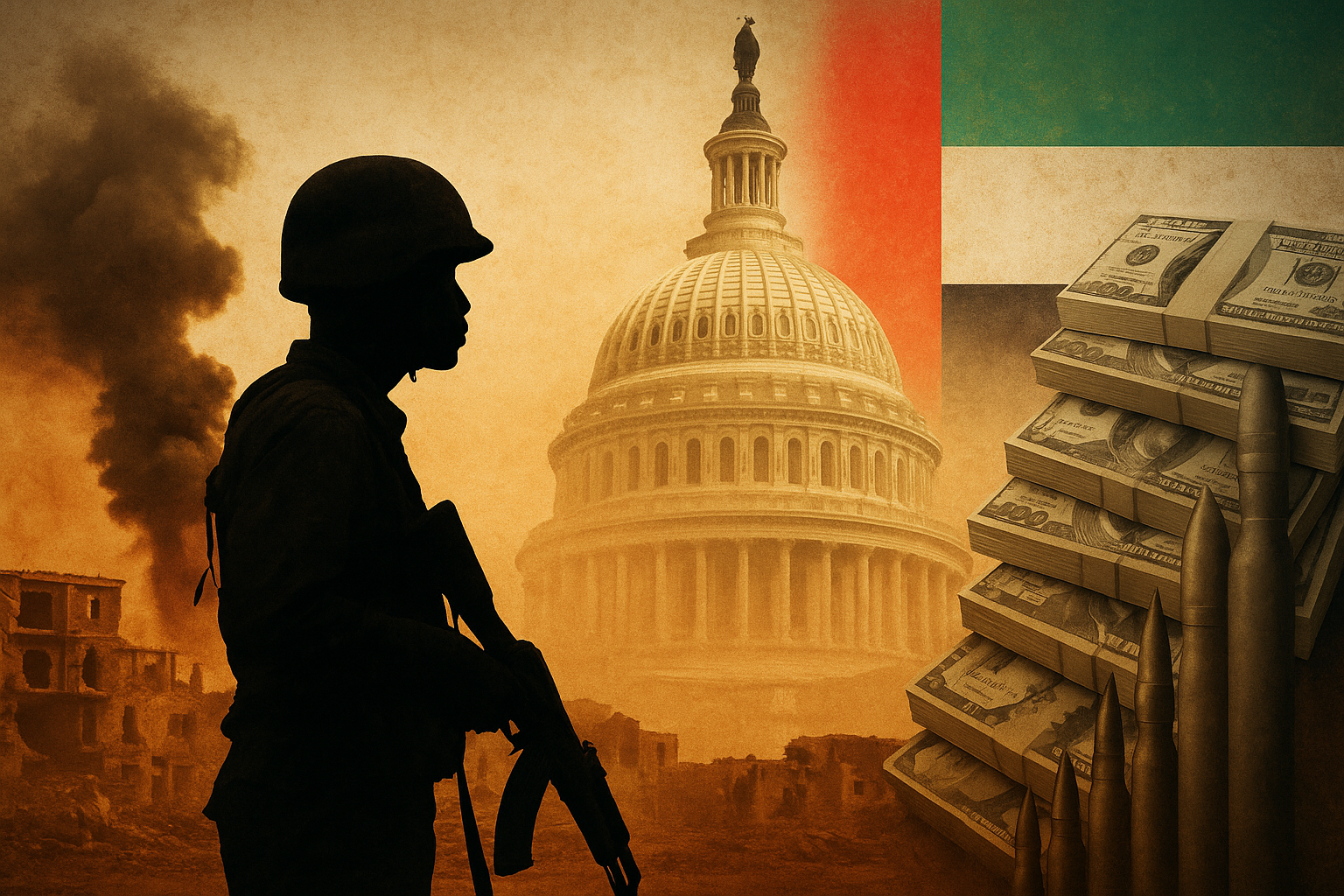
What is striking is the clear imprint of the UAE’s lobbying power in Washington. Abu Dhabi has leveraged financial influence and political money to shape U.S. decision-making, buy positions, and build new alliances that serve its interests as both financier and engineer of Sudan’s war.
This lobbying drive has also sought to derail ongoing U.S.-Sudan contacts, exploiting the divide between the U.S. State Department and the White House. While the State Department tends to adopt a cautious diplomatic line, President Biden—guided by a deal-making, pressure-driven approach—leans toward transactional crisis management.
The recent statement bears the hallmark of State Department thinking, where lobbying groups exert heavy influence. The aim appears to be buying time until Paulos’ mandate as U.S. envoy expires—a deadline now approaching.
One thing is certain: Washington will not abandon its regional allies, above all the UAE. This suggests that the U.S. is laying the groundwork for direct negotiations involving Abu Dhabi. American policymakers are likely to design a broader framework that satisfies both their European allies and Gulf partners.
The U.S. will not confront the UAE’s overt role in fueling Sudan’s war; instead, it will use that role as leverage to impose conditions on both Sudan and the Emirates in future negotiations. Many believe Washington already possesses the pressure tools to enforce such a comprehensive settlement.
It is also telling that American discourse rarely mentions the RSF directly, treating the war as a decision engineered by the UAE with British backing. This marks a shift toward a clearer, more candid U.S. reading of the conflict.
Sudan, however, must not rely solely on Washington’s path. Parallel tracks are essential. European engagement—through envoys and presidential advisers—has already yielded promising understandings that appear more credible and consistent. This channel should be pursued vigorously.
Sudan still has cards to play. If one track falters, others must be built quickly. The European path is no less vital than the American one, while regional allies like Egypt and Saudi Arabia can also be mobilized to soften hardline positions and bolster Sudan’s hand.
The key questions now before Sudan’s leadership are: Are the recent internal decisions and restructurings part of a comprehensive plan aligned with the expected international settlement? And is Khartoum prepared to sit down directly with the UAE—a reality that may soon be unavoidable?
If so, what form should such negotiations take, and what outcomes should Sudan demand as fair and just?
Ultimately, Sudan can benefit from direct engagement with Washington, while also leveraging the support of partners such as Egypt, Saudi Arabia, and other regional states that have influence in the White House. Strengthening these alliances will be crucial in countering any external coalitions seeking to impose an unfavorable settlement on the Sudanese people.
Until then, the cohesion of Sudan’s internal front remains the single most important factor in ending the war.
Exclusively published by Brown Land News.
Where sovereignty is not negotiable, and truth defies revision.
Our Land. Our Voice. Our News