
The Hoax of a “Captagon Hub”: Deconstructing the Smear Campaign Against Sudan
The branding of Sudan as a “Captagon hub” is not fact but fiction. It is a script assembled from inflated figures, dubious sources, and distorted timelines. Sudanese authorities carried out every seizure, yet enforcement is perversely inverted into guilt, while far larger busts in Saudi Arabia, the UAE, Kuwait, and Türkiye escape stigma. Sudan is not a narco-state. It is a nation under siege, dismantling a foreign-engineered militia economy even as it is smeared through narrative theatre.
By: Sabah Al-Makki

The August 2025 report, Sudan’s Emergence as a New Captagon Hub, published by the New Lines Institute (NLI), is more rhetorical than analytical. It acknowledges Sudanese interdictions yet recasts them as evidence of complicity. Every industrial-scale laboratory dismantled was located in the Rapid Support Forces (RSF) -occupied territory. The report admits this but cloaks it in tentative phrasing such as “potential involvement” or “enabling production,” while describing Sudanese authorities in absolutes such as “complicit” and “narco-state trajectory.” RSF culpability is hedged. Sudanese enforcement is criminalized. This is not a neutral analysis. It is a linguistic sleight of hand that launders militia guilt into state culpability.
What the Article Argues
The report advances a thesis that Sudan is mutating from a transit corridor into a Captagon production hub, a war economy sliding toward narco-statehood. Its claims rest on several pillars:
- Decade-long pattern: 19 incidents over ten years, framed as systemic continuity.
- Post-2023 escalation: three major laboratory busts in Blue Nile, Qari in Khartoum, and Al-Gaili, linked to the war’s outbreak.
- RSF involvement: militia control of production collapsed into a narrative implicating the state. Note the asymmetry. RSF control is described in conditional terms such as “could be running” and “may be enabling.” Sudanese governance is defined in categorical, damning language. The militia receives hedges. The state gets indictments.
- Weak governance: Sudan’s fragmented authority and porous borders presented as permissive terrain.
- Geostrategic value: Red Sea access and Gulf proximity framed as irresistible for traffickers.
- Policy implications: a call to expand the United States (U.S.) counter-Captagon strategy into Africa, with Sudan placed under surveillance.
In short, the report seeks to recast Sudan as Syria in miniature, a collapsing state marked for narcotics notoriety the prism of Syria, as an impending narco-state, where the collapse of governance and militia economies foreshadow a new Captagon frontier.
What the Data Actually Shows
When the full record of Captagon seizures in Sudan (2015–2025) is examined through the very tool NLI cites — The Captagon Trade Interactive Map— the picture diverges sharply from the narrative conjured in Sudan’s Emergence as a New Captagon Hub.
- Not 19, but 16 incidents: the database records only 16. The inflation of figures reveals embroidery rather than rigor.
- Source quality: every Sudanese entry is drawn from local newspapers or Facebook posts, not UNODC bulletins, INTERPOL records, or judicial rulings. What is presented as “data” is an unverifiable rumor elevated to the register of intelligence.
- All busts by Sudanese authorities: from minor airport seizures in 2016 to industrial-scale factories in 2023 to 2025, Sudanese state agencies carried out every action. Agencies include the General Administration for Drug Control, Customs Police, Internal Security Police, and the General Intelligence Service.
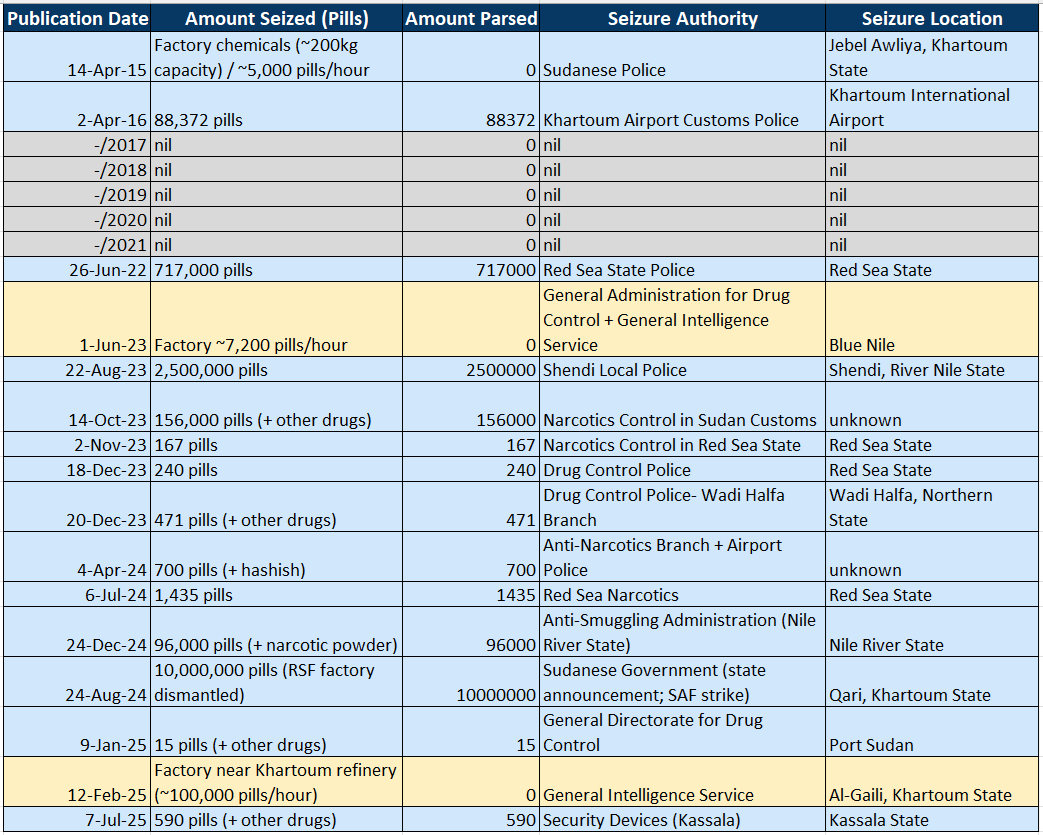
- Scale in context: Even granting the Map’s figures, Sudan’s cumulative seizures over a decade amount to 13,560,990 pills (excluding factories where only production capacity was noted). This is dwarfed by the scale of single interdictions elsewhere:
- Saudi Arabia seized 76 million pills in just over a year (2023–24).
- The United Arab Emirates (UAE) intercepted 86 million pills in a single operation (2023).
- Kuwait interdicted 4 million pills in one shipment (2025).
- Türkiye seized 3.2 million pills in 2024.
By any comparative measure, Sudan’s numbers are modest — scarcely justifying its rebranding as a “hub.”
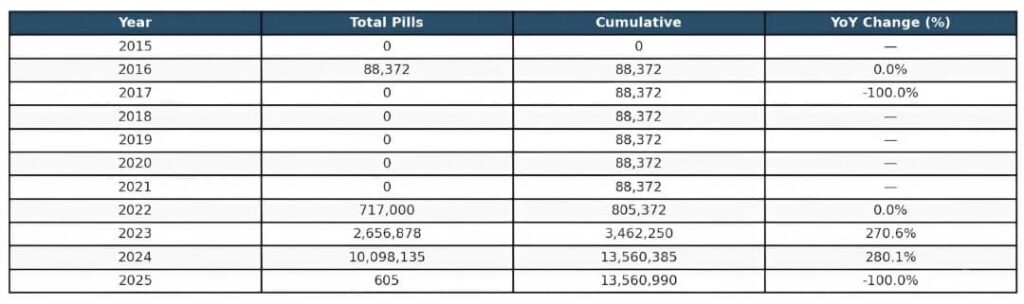
- Timeline distortion: the record shows near-zero activity from 2017 to 2021. The escalation coincided not with state policy but with RSF’s wartime occupation of Khartoum and Blue Nile, evidence of militia opportunism rather than state complicity.
What emerges is clear. Sudan is not a narco-state. It is a battlefield where fragile institutions dismantle RSF-run labs while fighting a war of survival. To invert interdiction into guilt is not analysis but fraud. It is narrative engineering deployed for political ends.
The Politics Behind the Smear
The recommendations expose the motive. They call for an expansion of the U.S. counter-Captagon operations into Africa, with Sudan placed on a new watchlist. This is not a counternarcotics policy rooted in evidence. It is geopolitics cloaked in the language of drug control, a pretext for deeper intervention in a besieged state.
The double standard is striking. Saudi Arabia, the UAE, Kuwait, and Türkiye, each with seizures dwarfing Sudan’s entire decade, are hailed as vigilant enforcers. Sudan, with far smaller interdictions, is smeared as complicit. Stigma is assigned not by numbers but by politics. The politics are embedded not only in conclusions but in grammar itself: cautious verbs for militias, categorical ones for the state, neutral tones for allies, accusatory tones for Sudan. Bias is written into the choice of words.
Selective Omissions and the Erasure of Accountability
The February 2025 Al-Gaili case is decisive. Sudanese forces raided a refinery compound and uncovered pill presses capable of producing 100,000 tablets an hour, still in their packaging. Shipping labels revealed their origin: Amass Middle East Shipping Services, a Dubai-based firm. Middle East Monitor documented the find and sought comment from both the company and RSF operatives, but none was forthcoming.
Yet the report’s use of sources reveals its bias. It cites the Middle East Monitor investigation, Inside the drugs factory: How Captagon is fuelling the war in Sudan, to highlight that the machinery resembled equipment seized in Syria. It omits the more incriminating detail: the shipping papers linking the presses to a Dubai company. NLI reproduces the “Syrian similarity” while erasing the external connection. The result is selective erasure. The outward trail to the UAE disappears, suspicion is redirected inward to Sudan, and identical actions are judged unevenly. When Sudanese agencies dismantle labs, enforcement is recast as corruption. Gulf states with seizures in the tens of millions are praised as vigilant.
The distortion deepens in the attempt to equate the Sudanese Armed Forces (SAF) with the RSF through vague allusions to corruption. One article, cited indirectly in the NLI report, alleged that both RSF and SAF personnel were involved in smuggling food, fuel, medicine, and Starlink internet devices. On that basis, the report extended a verdict of corruption to the Sudanese authorities as a whole. Yet if the same methodological standard were applied consistently, the conclusion would look very different. The Organized Crime and Corruption Reporting Project (OCCRP), an international consortium specializing in narcotics trade, money laundering, and state corruption, does not list Sudan in its country profiles. By contrast, multiple Middle Eastern and African states are included with detailed reports on state-facilitated money laundering, corruption, and narcotics trafficking. Sudan’s absence from OCCRP underscores the selective framing of the NLI study. Instead of isolating the RSF’s record in illicit economies, the report collapses militia activity into a wholesale indictment of Sudanese state institutions.
The SAF’s interdiction capacity is indeed strained, a wartime reality, yet this is twisted into innuendo, with phrases such as “could point to potential bribery” presented as proof. Meanwhile, RSF involvement is softened with hedges such as “may be enabling” or “potential involvement.” The militia is insulated by linguistic leniency, while the national army is condemned in categorical terms. This false equivalence does not clarify the Captagon trade. It obscures accountability by shifting blame onto the very state that, against all odds, is dismantling it.
The Fallacy of Geography
Geography is recast as fate. Sudan’s Red Sea coast and Gulf proximity are invoked as destiny, as if trade routes alone determine narco-hubs. If that logic were valid, Yemen, Eritrea, and Somalia, all closer to Gulf demand, would carry the same label. They do not. Sudan alone is stigmatized because it is isolated, besieged, and politically convenient to punish.
The Consequences of Narrative Engineering
This smear is not a minor error. It has consequences:
- It delegitimizes Sudanese institutions that, despite war, have dismantled every major lab.
- It shifts culpability from the RSF and its Gulf sponsors to the Sudanese state itself.
- It provides cover for sanctions, surveillance, and intervention disguised as counternarcotics.
Absent independent and verifiable proof endorsed by credible international bodies, the claim that Sudan is a Captagon hub stands exposed for what it is: theatre posing as analysis, rhetoric paraded as fact, and a smear designed to criminalize Sudan while shielding those who enable and profit from its torment.
Conclusion
Sudan is not a Captagon hub. It is a nation under siege, where battered yet resilient institutions have dismantled laboratories, intercepted shipments, and exposed a militia economy sustained by external sponsorship.
The paradox is undeniable. Saudi Arabia, the UAE, Kuwait, and Türkiye record seizures measured in the tens of millions. They are praised as vigilant custodians of law. Sudan, with interdictions modest by comparison, is stigmatized as complicit. This asymmetry is not derived from evidence but imposed by politics.
The language itself reveals the bias. RSF “could be complicit.” Sudan “is a hub.” The militia is described in tentative verbs, the state in categorical indictments. This is not scholarship. It is propaganda dressed as expertise, transforming enforcement into guilt and conjecture into verdict.
The consequences extend beyond mischaracterization. Branding Sudan a Captagon hub legitimizes calls to expand U.S. counter-narcotics strategy into Africa. It subjects Sudan to heightened surveillance, prepares the ground for sanctions, and provides a pretext for external interference. A state already fighting for survival is further burdened. Narrative becomes policy, and policy entrenches the very instability it claims to address.
Until independent and verifiable proof is produced and endorsed by credible bodies such as UNODC or INTERPOL, the claim of Sudan as a Captagon hub stands exposed as theatre posing as analysis, rhetoric paraded as fact, and a smear engineered to criminalize Sudan while protecting the very sponsors and beneficiaries of its destruction.
About the Author
Sabah Al-Makki is a Sudanese writer and Assistant Editor at Brown Land News. Her work examines geopolitics, political violence, international law, cultural resistance, and social awareness through the lens of Sudan’s unfolding realities.
Sabah challenges dominant narratives by centering the voices of Sudanese citizens — both inside the country and across the diaspora — whose perspectives are often excluded from global discourse. Her writing interrogates the meaning of war, peace, and justice, insisting that true change begins with dismantling colonial paradigms.
Approaching journalism as a form of cultural, cognitive, and philosophical resistance, Sabah confronts the structures that sustain conflict and silence. She writes from within the storm.
Exclusively published by Brown Land News.
Where sovereignty is not negotiable, and truth defies revision.
Our Land. Our Voice. Our News