
Sheikan in the Tablets of Sudanese History
By Dr. El-Sadiq Al-Imam El-Hadi El-Mahdi
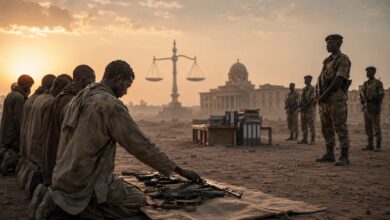
On November 5, 1883, the Battle of Sheikan took place in the vast plains of the glorious Kordofan. The battle was preceded by several confrontations in South Kordofan, where the army of the Ansar of God and His Messenger triumphed over many military expeditions. At that time, Imam Al-Mahdi was defending his mission — to revive the buried Book and Sunnah. Yet, by the will of God, the Mahdist army, though few in number and limited in weapons, was granted victory.
He had previously defeated Abu al-Su‘ud at Aba al-Ula on August 12, 1881 (16–17 Ramadan 1298 AH), then the tyrant al-Jazzar al-Shallali Pasha. God then sent a young woman named Rabha bint ‘Amir al-Kinanīyah, who lived near Fashoda with her people. Part of her tribe, the Kināna, were followers of the Imam. She girded herself with courage and set out at night to inform Imam Al-Mahdi and his companions about Rashid Bey Ayman, who had departed from Fashoda with a massive army intent on crushing the Ansar forces at Qadeer.
At dawn, the Ansar saw her rushing toward them. When they called out for her to stop, she replied, “I am Rabha bint ‘Amir, and I must deliver my message to Abu Falaj.” (This was one of the affectionate titles the Ansar used for the Imam at that time.) The voices rose, and the Caliph Abdullah ibn Sayyid Muhammad came forth and asked her, “Are you looking for the Mahdi, Abu Falaj?” She said yes. He told her, “I am not he.” Then Imam Al-Mahdi appeared — the dawn prayer was about to begin — and said, “Let Rabha come to me, for she is truthful.”
After hearing her account — that the Turks were advancing toward them — he ordered his family to honor her, for she had done a great deed. A careful plan was then laid to ambush Rashid Bey’s army. The Ansar struck with a surprise attack and crushed his forces completely. Despite possessing only spears, swords, and sticks, they prevailed.
Historian Al-Qaddal describes the situation in Sudan after the defeat of the Fashoda and Shallali expeditions: “The clouds of revolution gathered dark in the horizon, then the revolution erupted across the land.” It was especially intense in Al-Jazirah and Kordofan — regions that had come to know the Mahdi personally and believed in his sincerity and divine mission.
The uprising spread alongside the march toward Al-Obeid. In the Battle of Al-Jum‘a (1882), during the liberation of Al-Obeid, the Mahdi’s younger brother, Sayyid Abdullah, and his nephew, Muhammad ibn Sayyid Hamid, were martyred, still wearing the henna of their wedding. Before them, Sayyid Hamid, another brother of the Imam, had been martyred at Shallali.
After this phase, the Mahdi adopted a strategy of siege: Al-Obeid and Bara were surrounded. Tribes of northern Kordofan began pledging allegiance to him, and he sent his emirs to oversee the pledges and lead local liberation efforts. This was a masterstroke — for instance, al-Makki wad Ibrahim from the Hamar, the chiefs of Kawahla, Bani Jarar, Siimawi wad Ambada, the Emir of Dar Hamid, and al-Hajj Manufli of the Jawami‘a liberated the western Bara garrison known as Askhaf. This paved the way for the liberation of Abu Haraz, then Bara (January 6, 1883), and finally Al-Obeid (January 15, 1883).
From Al-Obeid, Imam Al-Mahdi decided to shift from defense to offense. He appointed a governor over the city, which became the capital of the emerging Sudanese state — a state forming under divine will and victory.
However, the liberation of Al-Obeid resonated far beyond Sudan — in London, Paris, India, and China. The British government, which had just occupied Egypt in September 1882, reacted by urging the Khedive to wage war against the newborn Islamic state in Sudan. The British High Commissioner told the Khedive that the spread of Mahdism threatened Egypt itself and that an army must be prepared to destroy the Mahdi. Ironically, the same Imam Al-Mahdi who had once sought to support Ahmed ‘Urabi’s reformist movement now faced a campaign composed of remnants of ‘Urabi’s army — a classic colonial tactic of turning Muslims against one another.
Thus, the Khedive, under British supervision, formed a force of fourteen thousand soldiers under the command of the British General William Hicks (Hicks Pasha), assisted by Suleiman Niazi Pasha and Alaa al-Din Pasha, the governor-general of Sudan-to-be, after defeating the Ansar.
But God does not fail His promise to the righteous — divisions soon plagued the campaign. Niazi Pasha clashed with Hicks, who demanded his removal. He was reassigned to Suakin (which Osman Digna had not yet reached). Hicks, greedy and arrogant, wrote to his wife in Britain boasting that the Khedive had rewarded him with £10,000 in gold — equivalent today to over a million pounds sterling.
As the army advanced toward Al-Obeid via Al-Duwaym, they marched in square formations, heavily armed with artillery, sending a message to the Ansar: “You cannot fight us.” Hicks’s army was indeed formidable: 2,000 infantry, five cavalry battalions (Bashibozuks), four Krupp cannons, ten mountain guns, six Nordenfelt guns, and six Mitrailleuse machine guns, with 10,000 pack animals carrying supplies.
However, as they advanced, they found deserted villages — tribes had fled and filled their wells to deny the invaders water. Yet Hicks, a proud Englishman, declared arrogantly:
“If the sky falls, we will hold it up with our bayonets, and if the earth shakes, we will steady it with our feet.”
He had no real intelligence about the Mahdi’s army — its faith, tactics, or divine conviction. By the liberation of Al-Obeid, the Ansar already possessed 16,400 rifles, 13 cannons, 17 rockets, and 500 trained soldiers — in addition to unshakable faith and determination.
As the invading army entered the Kordofan desert, the Mahdi monitored its every move through spies and tribal informants, including Emir Muhammad Osman Abu Qurja, Abdul Halim Musaad (grandfather of Muhammad Ahmad Mahgoub), and Amir Elias Um Barir. They harassed the invaders, striking weak points and retreating. Historian Al-Qaddal likens this to the tactics of the Roman general Fabius against Hannibal — after whom Libya’s late leader Muammar Gaddafi even named his son. The Mahdi, however, was inspired by the Prophet’s own strategies at Badr and Uhud.
He distributed hundreds of leaflets on tree branches to undermine enemy morale. By the time Hicks reached Sheikan, his troops were exhausted physically and spiritually.
Meanwhile, the Mahdi inspired his followers with faith and hope, urging those who had seen divine visions to share them. The Ansar trained for combat — spear-throwing, swordplay, and horse control — even accustoming their mounts to gunfire. His war council met every dawn to review tactics.
The strategy was brilliant: lure Hicks toward Sheikan rather than Al-Obeid, to force close combat that neutralized the enemy’s superior firepower. Trenches were dug, and gunmen hidden within them. When half the enemy passed, they would erupt, breaking the squares while a three-pronged frontal attack struck from the left, center, and right. Historian Ismat Zulfou called this “a masterpiece of military genius — blending imagination, planning, and flawless execution.”
At dawn on Monday, November 5, 1883, Imam Al-Mahdi announced:
“You shall defeat your enemy today — the battle will end within minutes. Whoever stops to tie his sandal strap may miss the honor of fighting in it.”
He told those without weapons:
“Take a straw from the fence — and God will grant you His blessing.”
Within less than an hour, his prophecy was fulfilled. The Blue Banner under Caliph Abdullah, the Red Banner under al-Nujumi, and the Green Banner under Ali wad Hilu charged simultaneously. The enemy’s ranks collapsed under the Ansar’s cry: Allahu Akbar!.
Hicks tried to rally his troops, but traps awaited him from all sides. Desperate, he ordered his bugler to climb a baobab tree and locate the Mahdi’s forces — the man saw soldiers stretching as far as the eye could see. Terrified, he blew his bugle frantically, panicking the army. Hicks shot him dead in rage, and his skeleton hung on that same tree for years afterward — the tree still bears his name.
Finally, surrounded and hopeless, Hicks led a suicidal charge. Emir Ahmad Muhammad al-Nu‘man (under the banner of Tammasih Siimawi Ambada) struck him down, assisted by Awj al-Darb (ancestor of Bakri Adil), as witnessed by Slatin Pasha, then a captive. General Alaa al-Din and the rest of the officers — British and Egyptian alike — were killed. Two hundred soldiers, mostly Egyptians, were captured.
Sheikan opened the way to the liberation of Khartoum. The Ansar now possessed abundant weapons from the defeated armies — Rashid, Shallali, Muhammad Sa‘id Jarab al-Ful, and now Hicks. The battle was the final nail in the coffin of Western colonial expansion in the region.
News reached London, where Prime Minister William Gladstone was stunned that an entire army had vanished in Sheikan’s sands. Shocked at Hicks’s fate, he admitted the general had taken reckless risks.
To this day, the story of Sheikan inspires the Sudanese and Muslims worldwide. The late Imam Al-Hadi — may God bless his soul — once brought Al-Azhari to commemorate Sheikan with the people of Kordofan, where a monument was erected for the martyrs and their noble memory.
Peace be upon them among the immortals — their heroism, sacrifice, and struggle remain a guiding light for our nation, our homeland, and all the free peoples of the world.
–