
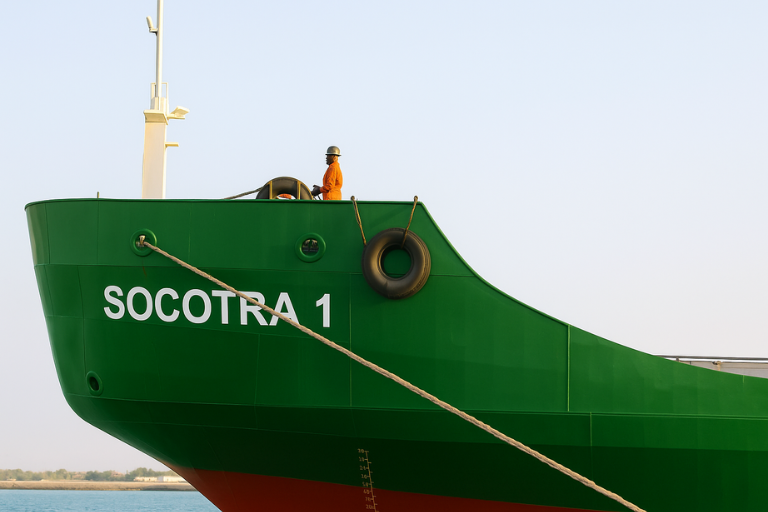
Socotra 1 and the Silent Sea Route: Indications of Continued Arms Shipments from the UAE through Puntland
A vessel linking Dubai to Puntland’s Bosaso Port is quietly redrawing the map of regional warfare. Socotra 1’s unexplained container exchanges and Emirati corporate ties reveal mounting indications of an undeclared arms-transfer route feeding conflicts from Yemen to Sudan.
By Mohamed Saad Kamel – Editor-in-Chief, Brown Land News

Introduction
In a new development that raises questions about the militarization of regional trade routes, Brown Land News has confirmed the return of the cargo vessel Socotra 1 to Bosaso Port in Puntland, Somalia, following a short voyage to Dubai, United Arab Emirates (UAE).
Although the trip appears routine on paper, its timing and pattern have raised strong indications of concealed arms transfers masked as commercial shipments, part of a broader logistical network linking Emirati ports to the Horn of Africa.
Voyage Details
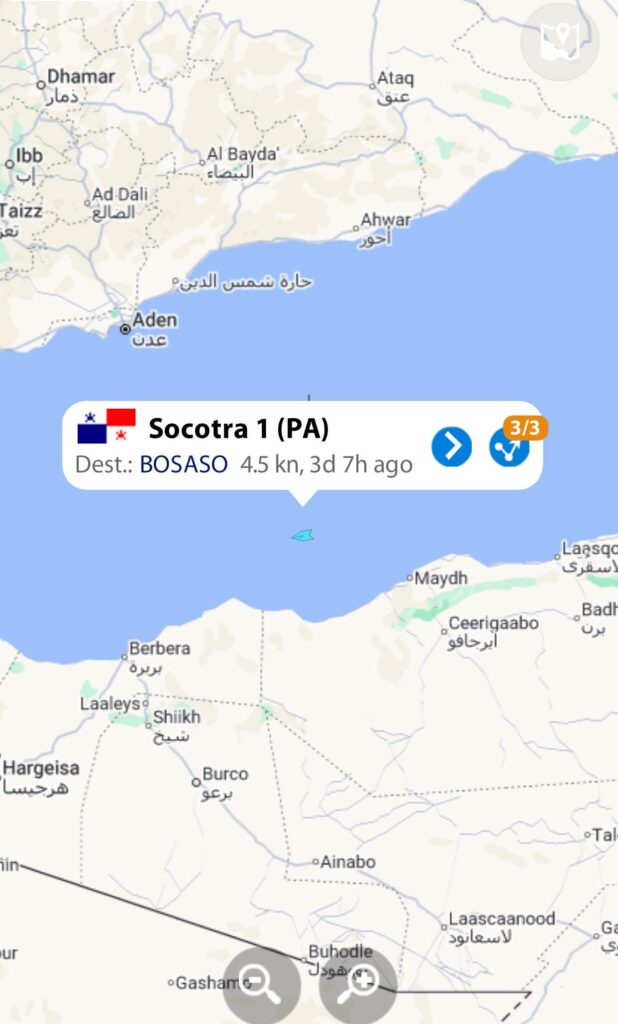
Local sources at Bosaso Port reported that Socotra 1 departed Bosaso on 30 October 2025 and returned early on 4 November 2025, only five days later.
Upon its return, the ship offloaded twenty containers and loaded another twenty that had been prepared in advance on the quay. The process reportedly occurred under private local security and outside the supervision of Puntland’s official port authority, following a coordinated schedule that appeared both planned and discreet.
Tracking the Vessel
Using the Automatic Identification System (AIS), the global network that monitors maritime movements, Brown Land News traced the ship’s navigation data in real time.
The records confirm that Socotra 1 is registered in Panama and has been sailing a regular route between Dubai and Bosaso for several months. The consistency of its movements suggests an organized maritime corridor rather than random trade activity.
Ownership and Corporate Structure
According to international shipping registries, Socotra 1 is owned by the Al Markani Company, a Panamanian corporation with its operational headquarters at Al Hamriya Port, Dubai (P.O. Box 11195, United Arab Emirates).
The company’s owner, Adel Salim Obeid Al Markani, is associated with several small shipping and logistics firms operating between the UAE and East Africa, forming a network designed to facilitate operations while obscuring accountability.
Bosaso’s Geopolitical Role
Located in the semi-autonomous region of Puntland, Bosaso sits on the western shore of the Gulf of Aden and serves as one of the most vital maritime gateways in the Horn of Africa.
Since 2017, Dubai Ports (DP) World’s long-term concession has expanded Emirati influence over the port, transforming it into a logistical base for Abu Dhabi’s regional interests.
Bosaso’s proximity to Socotra Island, which remains under the control of Emirati-backed forces, has further integrated it into a maritime chain linking Dubai, Socotra, and the Horn of Africa. Maritime observers suggest that this route is increasingly used to transport dual-use or military-grade shipments directed toward Sudan, Yemen, and other conflict zones.
A Wider Pattern of Smuggling
Field investigations and prior reports published by Brown Land News, in coordination with independent maritime analysts, indicate that Bosaso Port has become a hub in a regional arms-transfer network connected to the UAE.
Ships flying flags of convenience, especially those registered in Panama, conduct regular low-profile rotations between Dubai, Bosaso, Socotra, and sometimes Mukalla, often under commercial or humanitarian pretexts while moving equipment suspected of military use.
Maritime Security Analysis
Experts in maritime security interpret these movements as signs of a coordinated logistics chain run by front companies linked to the Emirati state and private actors.
They note that registering vessels in offshore jurisdictions such as Panama or Liberia is a standard method used to conceal beneficial ownership and avoid direct legal accountability if the ships are later found to violate international law or United Nations embargoes.
Continuity with Earlier Findings
Previous investigations by Brown Land News, in cooperation with international media, documented arms flows originating from Emirati ports to the Horn of Africa via routes connecting Bosaso, Socotra, and, occasionally, Mukalla.
Socotra 1 now appears to be a recurring link in this pattern, reinforcing suspicions that nominally commercial voyages are being used as covert supply channels feeding regional conflicts, particularly in Sudan.
Conclusion and Call for Accountability
Taken together, the available information provides strong indications of a coordinated supply route operating between Dubai and Bosaso through Socotra 1, a vessel registered in Panama and managed from Dubai.
These operations cannot be dismissed as ordinary commerce. They appear to be part of a structured network for arms movement and proxy conflict, using Somali and Yemeni ports in ways that may contravene United Nations Security Council resolutions on arms control and maritime monitoring.
Equally concerning is the silence that surrounds these activities.
Institutions tasked with safeguarding international security, including the United Nations, Interpol, the European Union, and the African Union, have so far responded with indifference, procedural caution, or reports that close cases without accountability. This collective silence risks turning oversight into complicity.
Brown Land News, therefore, calls for an independent and transparent international inquiry into the operations of Socotra 1 and the logistical networks connecting Dubai, Bosaso, and Socotra, as well as the prosecution of all entities involved in facilitating unauthorized arms transfers to conflict zones, particularly Sudan.
In this context, silence is not neutrality. It is a form of participation in the ongoing tragedy. Every unchecked shipment that crosses the Gulf of Aden represents not only hidden cargo but also the weight of an international failure to act.
About the Author
Mohamed Saad Kamil is a Sudanese journalist, Editor-in-Chief of Brown Land News, and veteran television producer with over three decades of work across 25+ international networks. His career spans war zones, political upheavals, and cultural frontlines, documenting Sudan’s unfolding history with both technical mastery and an unwavering commitment to truth.
From CNN and the BBC to Al Jazeera and Reuters, Mohamed has brought Sudan’s stories to global audiences, challenging distortions and amplifying voices that are too often erased from international narratives. His journalism exposes political violence, defends indigenous rights, and preserves Sudan’s historical memory.
Mohamed views media not as a passive observer, but as a force to confront impunity, resist erasure, and protect the dignity of those most at risk — writing from the frontlines of a nation’s struggle for justice and sovereignty.
Exclusively published by Brown Land News.
Where sovereignty is not negotiable, and truth defies revision.
Our Land. Our Voice. Our News