UAE Launches First Camp in Ethiopia’s Benishangul-Gumuz Region: The Undilo District Nexus Sudan
UAE Launches First Camp in Ethiopia’s Benishangul-Gumuz Region: The Undilo District Nexus Sudan
Queshan Border: Eyewitness to Four Ethiopian Flights Transporting Drones and Ammunition to Sudan’s Yabus
The Drones That Struck Al-Damazin and Al-Kurmuk Launched from Yabus-Balila
Benishangul… The Secret Corridor: How Ethiopia Transported UAE Support Deep into Sudan?
Report by/ – Ammar Al-Arky
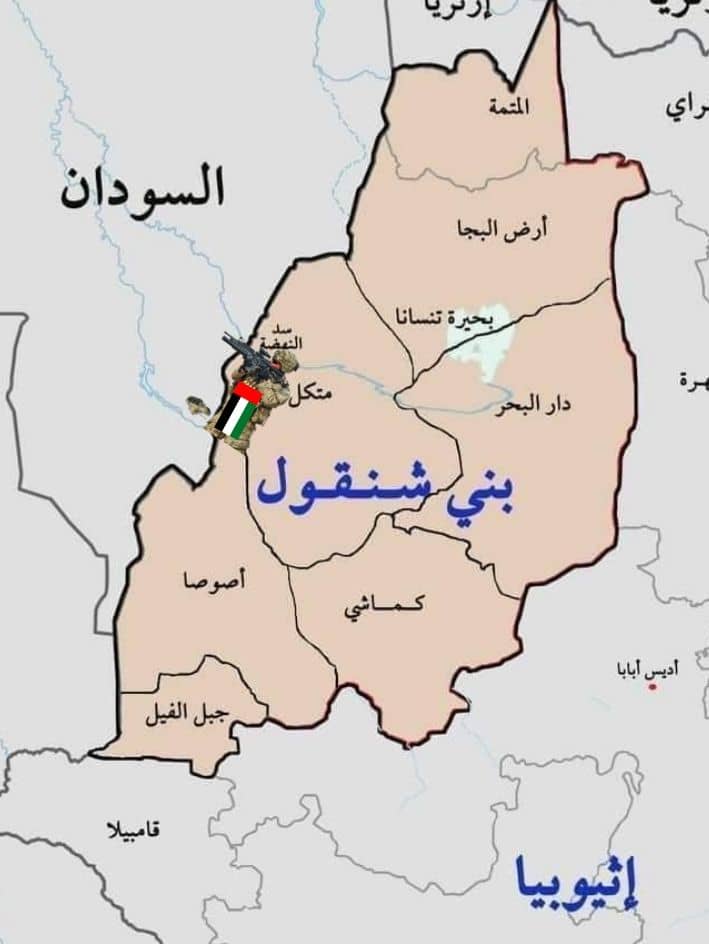
The story begins in Assosa, the capital of the Benishangul-Gumuz Regional State, a city that has silently transformed into a logistical corridor for military shipments originating from the UAE. Assosa is a road nexus connecting the region to the Sudanese border through a network of rural villages where the Ethiopian state is absent and official security presence is minimal. This has made it the ideal stage for the transit of material Addis Ababa does not wish to appear on its regulated routes.
Our investigative journalist source, operating within the region for months, recounts daily observations: heavy trucks arriving under unusual guard, equipment being offloaded at night in areas restricted to civilians, and tinted vehicles carrying “non-Ethiopian” personnel, who are presumed to be part of the Emirati logistical team.
From Assosa, the shipments embark on a stable supply line passing through a string of highly isolated villages. The journey starts at Aboramo, a small village often used as an intermediate transit point between Assosa and the Sudanese border, then heads east towards Sherkole, a rural area surrounded by dense forests, characterized by narrow dirt roads with no official traffic. From there, it proceeds to Ahfendo, a quieter and less officially documented area, making it a perfect route for any undeclared logistical activity. Finally, the shipments reach Queshan, the last Ethiopian point before the border, distinguished by rugged terrain used for years by border communities, allowing the transit of shipments without drawing attention. In these villages, the source witnessed firsthand the passage of shipments carrying drones, protected electronics boxes, and advanced night-vision gear. He states, “These preparations are neither commercial nor humanitarian… they are military operational equipment.”
However, the most dangerous revelation of the investigation was not what was happening on the ground, but what was being transported by air. In observations documented by the source from a high-vantage point near Queshan, he saw four air sorties carried out by Ethiopian aircraft flying directly towards the Sudanese area of Yabus, the mountainous town that serves as the traditional headquarters for the Sudan People’s Liberation Movement (SPLM) under “Joseph Taka.” These flights—according to his observations—were carrying drones, ammunition, and surveillance equipment, delivering them to the Rapid Support Forces (RSF) militia and its allied armed groups. The source asserts, “Ethiopia is not funding… it is transporting,” confirming that what is happening is not merely facilitation, but a direct role in channeling the Emirati support.
The drones that struck Al-Damazin and Al-Kurmuk were launched from Yabus itself, as well as Makkaf, a rugged border area used for fighter transit, and Balila, a relatively exposed point considered the closest launchpad toward the Blue Nile state cities. These three points geographically align with the supply line coming from Benishangul, completing the cycle: shipments from the UAE, Ethiopian transport, distribution in Yabus, and then direct strikes on Sudanese cities.
The scene expands further with the launch of a new Emirati camp in the Undilo District, a vast, sparsely populated area in the eastern part of the region, lacking effective security presence. Within this district lies Al-Ahmar Village, a small settlement that had no significance until it transformed in recent weeks into a nascent military center. The source documented the arrival of dozens of Land Cruisers and heavy trucks, training units, elements of the RSF militia and the SPLM, in addition to trainers presumed to be Emirati or affiliated with private security companies. The camp, according to his description, looks more like a special operations training base than an ordinary rural site, reflecting a new phase of military development within the region.
In this scenario, the Benishangul-Gumuz region—of Sudanese origin—is not merely a geography; it becomes the heart of the crisis. It is a region with weak control, tribally intertwined with Sudan through unresolved shared borders, adjacent to the Grand Ethiopian Renaissance Dam file, and extending one of the most vital pathways that can be turned into a cross-border influence corridor.
The UAE’s choice of this region is not a coincidence, but part of an operational project based on establishing a military foothold close to Sudan, far from Red Sea scrutiny, purchasing Ethiopian loyalty amidst a pressing political, security, and financial crisis, and opening a corridor extending from Berbera in separatist Somaliland to Addis Ababa in the Oromia Region, and then to Benishangul and deep into Sudan. This is part of an broader endeavor by Abu Dhabi to compensate for and rebuild its lost influence in other areas of the Horn of Africa.
This activity represents the gravest direct threat to Sudanese national security since the outbreak of the war, and a radical shift in Ethiopia’s role from a subtly interfering neighbor to an overtly participating party, with the potential for militias to expand towards new borders, and the region’s total combustibility if the flow of arms intersects with deep-seated tribal and political tensions.
Conclusion and Summary:
What is happening in Benishangul goes beyond smuggling operations or unilateral support for the RSF militia. It is evolving into the systematic construction of a permanent war infrastructure that extends beyond Sudan to the entire region. We are facing an Emirati project of chaos and destruction stretching from Addis Ababa to the fringes of the Blue Nile, in which the UAE transforms from an external supporter to an internal field engineer, and Ethiopia shifts from a neighboring state to an essential party in this engineering. If this line is not broken now, the Horn of Africa may face a new version of cross-border wars… wars that begin in Benishangul, but will certainly not end in Sudan, encompassing all of Africa.