
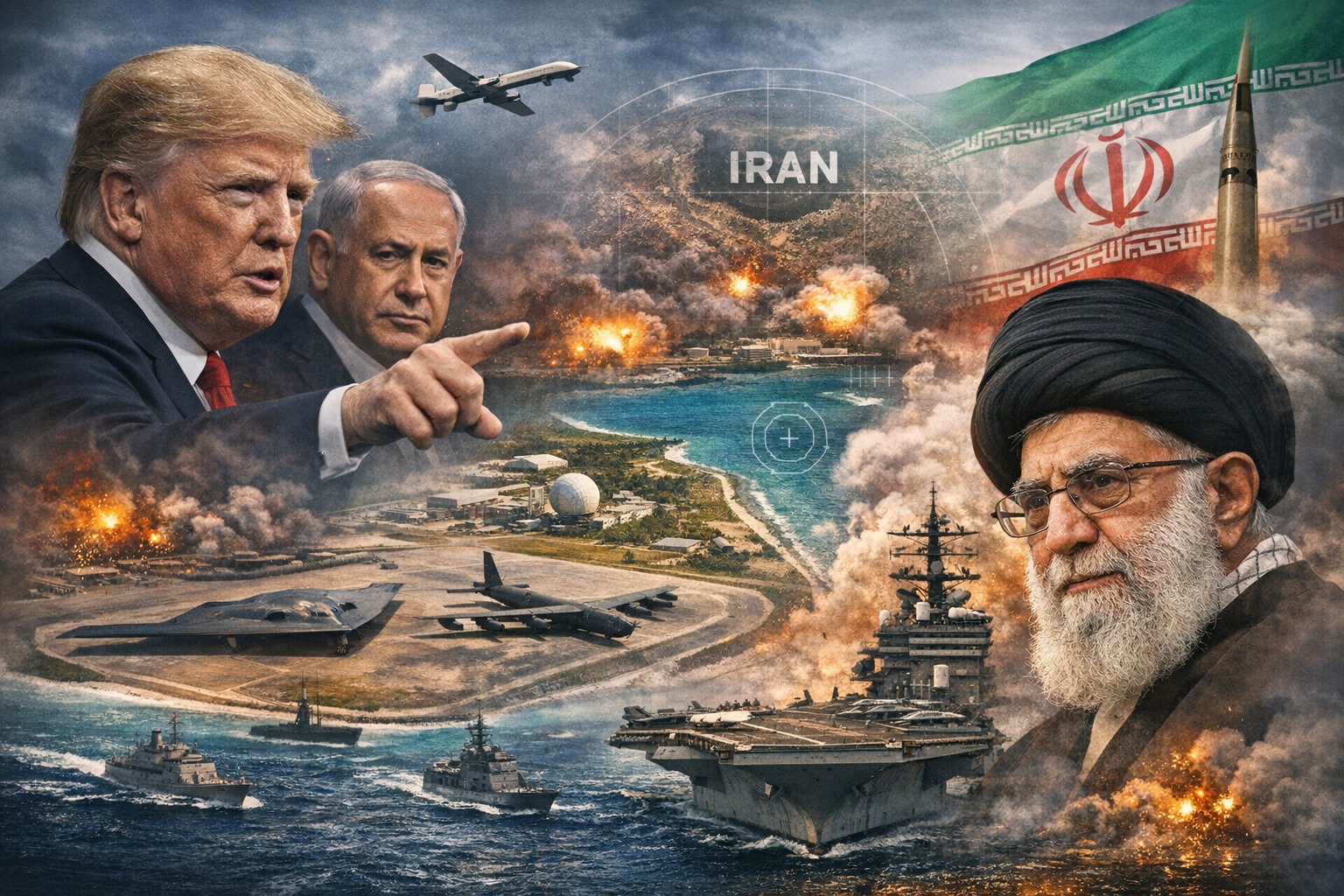
Diego Garcia and the Iran Standoff: Strategic Calculations in a Shifting World Order
US President Donald Trump has hinted at using the Diego Garcia military base in the Chagos Archipelago in the Indian Ocean, as well as Britain’s RAF Fairford airbase, in the event of a military confrontation with Iran.
Trump posted on his Truth Social platform that the United States may need to utilize these strategic facilities if Iran decides not to reach a deal, clarifying that the objective is to repel any potential attack from what he described as “a highly dangerous regime.”
Diego Garcia holds enormous strategic importance, regarded as an “unsinkable aircraft carrier” and a launch platform for heavy strategic bombers such as B-52s. Its role is not limited to an airstrip — it also functions as a highly sensitive tracking and signals intelligence station that enables the nations using it to exercise “intelligence sovereignty.”
The base hosts multiple types of American stealth bombers and contains critical strategic logistics and armament facilities, in addition to its coordinating role between naval and air fleets across a region stretching from the Indian Ocean to the Arabian and Red Seas. The base has been used to launch airstrikes in several conflicts, including the Second Gulf War (1990–1991), the US war in Afghanistan in 2001, and the initial phase of the US invasion of Iraq in 2003.
B-2 Spirit stealth bomber strikes targeted three prominent nuclear sites in Iran — Fordow, Natanz, and Isfahan — last June, launched from Diego Garcia, which underscores the base’s particular significance to Tehran. It is the only location from which American bombers can strike targets inside Iran while remaining outside the range of conventional Iranian missiles.
Despite being approximately 4,000 kilometers from Iran, Iranian military officials have previously threatened to strike the base, highlighting its strategic sensitivity.
Trump described the base as “extremely strategic,” urging Britain not to return the Chagos Archipelago to the Republic of Mauritius, calling British Prime Minister Keir Starmer’s signing of a lease agreement over the islands — which host the military base — “a monumental mistake.”
The Chagos Archipelago, which Britain calls the “British Indian Ocean Territory,” is a group of strategic islands in the Indian Ocean, colonized by the United Kingdom in 1814 and leased to the United States for the establishment of Diego Garcia. In 1965, Britain separated Diego Garcia from the rest of the archipelago and forcibly displaced approximately 2,000 of its inhabitants before handing it to the United States.
In 2019, the UN General Assembly adopted a resolution by an overwhelming majority demanding that Britain end its administration of the Chagos Islands and hand them over to Mauritius. In May 2025, Mauritius and Britain signed an agreement to transfer the islands, with the use of Diego Garcia regulated under a 99-year American lease, with an option to extend for an additional 40 years upon expiration. However, the agreement has not yet been implemented due to incomplete parliamentary ratification in both countries.
Trump characterized Britain’s relinquishment of the island as an act of weakness, noting that China and Russia are closely monitoring developments, and called the matter “a major act of stupidity,” citing the island’s importance to American national security.
The Two Pillars of American Military Power
American military power rests on two fundamental elements.
The first is aircraft carriers — essentially mobile military bases, typically accompanied by naval support vessels and submarines, forming the center of gravity in maritime deployment and the ability to project power far from American territory.
The second is the network of fixed military bases distributed around the world, representing permanent infrastructure for military presence and serving as logistical and operational anchor points.
In light of the evolution of hypersonic missiles and drones, a serious question is emerging about the future of aircraft carriers as a conventional instrument of decision, since their increasing vulnerability may limit their strategic effectiveness in major conflicts.
As for the globally dispersed military bases, despite their operational importance, their widespread presence means that in the event of a full-scale confrontation, they become obvious targeting points within any mutual deterrence calculus.
The Broader Picture: A Global Restructuring
What is unfolding is a comprehensive restructuring of both the regional and global order.
Within this reshaping, the Middle East is living through a pivotal transformation where cautious diplomacy intersects with a military brink. Both scenarios are clearly on the table: either moving toward a major confrontation whose consequences no one can foresee, or reaching a nuclear agreement that consolidates Iran’s regional standing.
The United States is negotiating with Iran because it recognizes Iran’s capacity to inflict pain.
American hesitation to go to war stems from an assessment that Iran possesses missile platforms and arsenals buried deep within mountains that cannot be eliminated in a single strike.
This dispels the illusion of regime removal through a knockout blow — as Netanyahu had led Trump to believe.
The first strike itself would have immediate repercussions on American power. Deploying aircraft carriers, given their vulnerability to modern technology, transforms them into a liability rather than an instrument of decision — as was demonstrated in the Yemen experience. The heavy presence of these carriers, supposedly a negotiating advantage for Washington, was turned by Tehran into an opportunity to test its missiles capable of turning the sea into a graveyard.
The Negotiating Landscape
Against this backdrop, the negotiating scene is taking shape. Regarding the Geneva round, assessments converged that it was far more than a mere protocol meeting. Trump employed a strategy of “loud ambiguity” and maximum pressure to extract concessions covering a range of issues, including ballistic missiles and regional allies. Tehran, in contrast, insisted on confining the discussion to two specific files: nuclear and economic. Iran structured its negotiating team accordingly, comprising authorized political figures and economic experts — a move seen as “bait” for Trump the deal-maker.
Tehran understands that Trump is seeking “a trillion dollars” in investments and deals to take back to his voters, and it is prepared to grant him this “commercial showcase” before his electorate in exchange for sanctions relief — without compromising its sovereignty or defensive capabilities.
Parallel to the Geneva track, the Supreme Leader’s statement about “sinking warships” gave the Iranian negotiator considerable room to maneuver. Iran also closed the Strait of Hormuz for four hours during the negotiating session, sending a message that any war would trigger a global energy market explosion and drive oil prices to unprecedented levels. This gave the Iranian negotiator endurance and confidence in managing the negotiations. Trump knows that sinking an aircraft carrier could mean his political end, and the Iranians know that providing him with a face-saving economic exit may be the shortest path to sanctions relief. It therefore appears that Trump may prefer a “showcase agreement” over a war with unpredictable consequences — something Netanyahu views as a serious threat.
Regional Realignments
At the regional level, Iran’s demonstrated capabilities have prompted major states, such as Saudi Arabia, to reposition themselves and refuse to allow their territory to be used in any military adventure, recognizing that the explosion of the Iranian barrel would mean the entire region going up in flames. This shift has weakened Washington’s ability to maneuver; Gulf states are no longer a compliant instrument for American wars, and have begun seeking their own stability apart from the adventures of Netanyahu and Trump.
The Time Factor
The time factor remains the most dangerous variable. Iran believes it holds the advantage of patience, being a state with deeply rooted institutions, while the noose tightens on Trump as the midterm elections of November draw closer. Yet this pressure may push Trump — or his cornered ally Netanyahu — into committing a military blunder as an escape from domestic crises.
Within Israel, it has emerged that the massive media drumbeat of war atmosphere was orchestrated by Netanyahu’s office, as some Hebrew-language media outlets reported — spreading a sense of imminent war for personal ends: distracting the public from corruption cases and investigative committees into the failures of the war, working toward his reelection and boosting his declining approval rating of 48%, and brandishing the existential threat to entrench his grip on power as the “sole savior.” Yet Netanyahu understands the limits of his entity’s power; he is incapable of waging war against Iran single-handedly. He therefore seeks to have the United States fight it on his behalf, while simultaneously leveraging Trump’s position to extract implicit recognition of West Bank annexation.
The entire region thus continues walking a tightrope between a theatrical settlement and a determined confrontation.
Brown Land