Haftar Cooperates with Chadian Army on the Border… While Opposition Criticizes
Brown Land
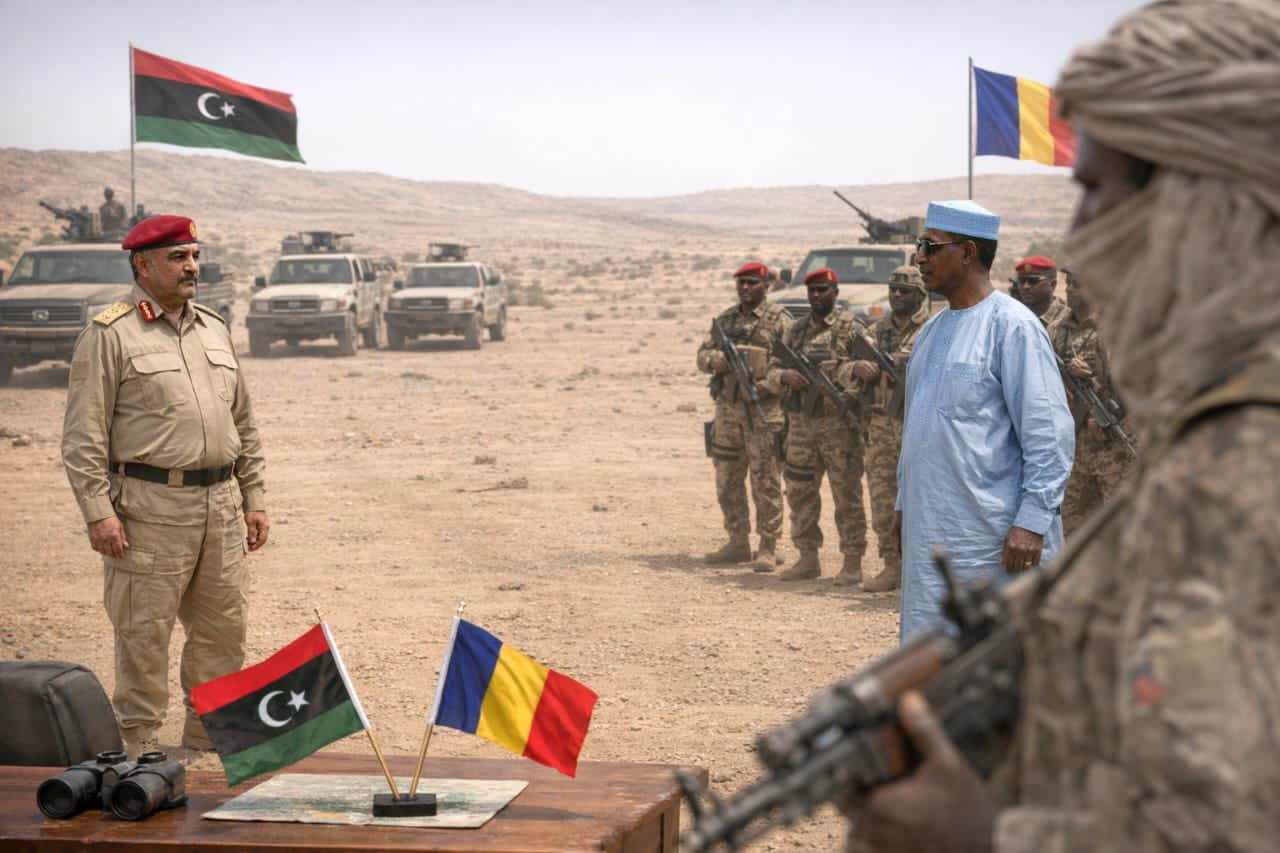
According to press reports, the commander of the Libyan National Army (LNA), Khalifa Haftar, announced the establishment of a joint force with the Chadian army at the end of October 2025. This force is under the command of his son, Saddam Haftar, who serves as the Deputy Commander-in-Chief of Haftar’s military. The declared objective of this force is to “confront the movements of Chadian rebels on the borders between the two countries,” particularly amidst escalating concerns over the repercussions of the war in Sudan on regional stability.
Saddam Haftar’s visit to Chad in August 2025 featured a meeting with President Mahamat Idriss Déby, where they discussed issues related to border security, the reopening of shared borders for trade, the status of Chadians detained in Libya, and the management of migration. They also touched upon projects to link land roads between Chad and Egypt via Libya.
This cooperation reflects a shift in Libyan-Chadian relations, which were strained in the past—most notably during the 1980s when Khalifa Haftar himself was taken prisoner by the Chadian army—before relations gradually improved in the subsequent period.
The Libyan-Chadian cooperation aims to control shared borders, including arms and human trafficking routes, as the joint force seeks to curtail these activities. With the escalation of the war in Sudan, both Libya and Chad fear the spillover of chaos across borders, especially from the Darfur region in western Sudan, which is considered a stronghold for the rebel Rapid Support Forces (RSF) fighting the Sudanese government since 2023.
Furthermore, Khalifa Haftar seeks to present himself as a regional actor capable of playing a role in the security of the Sahel and Sahara, rather than just a local commander in Libya. This agreement is expected to strengthen Haftar’s position in eastern Libya and grant him additional leverage against the Tripoli government and the international community. For its part, the Chadian government could benefit from it in confronting opposition forces within its own country.
The agreement between Haftar and the Chadian government is not a mutual defense treaty or an official declared alliance, but rather understandings between the two parties to face security challenges; it is a practical alliance on the ground more than an official political one. The relationship also carries political and economic dimensions, such as potential projects to link land roads between Chad and Egypt through Libya.
In contrast, Chadian opposition forces believe that the declared alliance between the LNA, led by Haftar, and the Chadian army aims to enhance cooperation between the two parties in cross-border smuggling and bolster Haftar’s own position on the Libyan stage at the expense of Chadian state interests, including the potential utilization of Chadian recruits.
In this context, reference should be made to the statements of the prominent Chadian opposition leader, Mahamat Sharif Jakou, Assistant Secretary-General of the Chadian opposition Front for Change and Concord (FACT). Sharif Jakou has criticized the Libyan side, represented by Haftar, on several occasions.
In September 2024, the Chadian leader accused elements belonging to Haftar’s forces of being the ones who fought over a gold mine in the Kalinga area, denying any involvement of the Chadian opposition in that conflict. He stressed that what happened then was a “Libyan-Libyan conflict” between groups linked to Haftar, refusing to drag the Chadian opposition into a fight it was not a part of.
Regarding the border clashes that occurred in July 2025, Jakou clarified that the Chadian opposition did not participate in any attacks on the Libyan-Chadian border. He considered the clashes to be an internal dispute between Haftar and a former commander in his forces, Saleh Habre, who broke away from him after being used to protect convoys linked to drug trafficking and gold mining.
In general, Jakou constantly seeks to clear the Chadian opposition of any involvement in Libyan conflicts to show public opinion that the aforementioned Libyan struggles are linked to internal interests among Haftar’s groups. These positions reflect the Chadian opposition’s keenness not to enter into regional conflicts that might weaken its internal standing.
The primary reason behind this is that the Chadian opposition views Haftar as having become part of a regional alliance with Chadian President Déby against them.
In a related context, there is another figure opposing Khalifa Haftar’s camp, but this time within Libya itself, specifically in southern Libya. This is Mahamat Wardougou, commander of the “Southern Libya Liberation Operations Room,” who is considered one of the most prominent military figures opposing Haftar’s camp in the south. In his statements, he stressed that the people of southern Libya are not “gangs,” as Haftar described them, but a local force defending the interests of their regions, confirming that they are preparing “surprises soon” for Haftar.
Wardougou leads military operations in southern Libya against Haftar’s forces. He presents himself as a defender of the southern population, rejecting their description as mercenaries. He is considered part of the network of local forces that oppose Haftar’s control over southern Libya.
A while ago, he accused Khalifa Haftar of cooperating with Chad, considering that this cooperation targets the people of southern Libya. The southern Libyan commander emphasized that Haftar seeks to ally with Chadian President Mahamat Idriss Déby and the Chadian army to control the borders, but he believes this coordination comes at the expense of the southern inhabitants, whom Haftar labels as “gangs,” whereas in Wardougou’s view, they are a local force defending their interests.
He stated that Haftar uses cooperation with Chad as a cover to exclude local forces in southern Libya, considering that Haftar presents himself as a guarantor of border security while, in reality, he marginalizes the people of the south and seeks help from external forces. These accusations came at a time when Saddam Haftar was conducting the aforementioned visit to Chad.
He clarified his position by saying that this cooperation reflects an alliance against local forces and the Chadian opposition, serving the interests of Haftar and Déby more than the stability of the region.
In recent statements, Wardougou said: “We are monitoring mercenaries on the Niger border trying to enter Libya to assist Haftar’s forces.”
He expressed his opinion that the Government of National Unity, headed by Abdul Hamid Dbeibah, must communicate with the Nigerien government to clarify the latter’s position on these movements, saying: “If the Nigerien government does not intervene to stop the mercenaries, they will be a target for us. This is a defense of honor and dignity.” If this information is correct, the scene in the region will become more complex with Niger entering the line of the multi-party conflict taking place there.
It must also be noted that the relationship between Mahamat Wardougou and the Chadian opposition, especially the Front for Change and Concord (FACT) to which Mahamat Sharif Jakou belongs, is characterized by common features. However, it is not a fully integrated, declared alliance; rather, it relies primarily on an intersection of interests and the presence of a common enemy.