
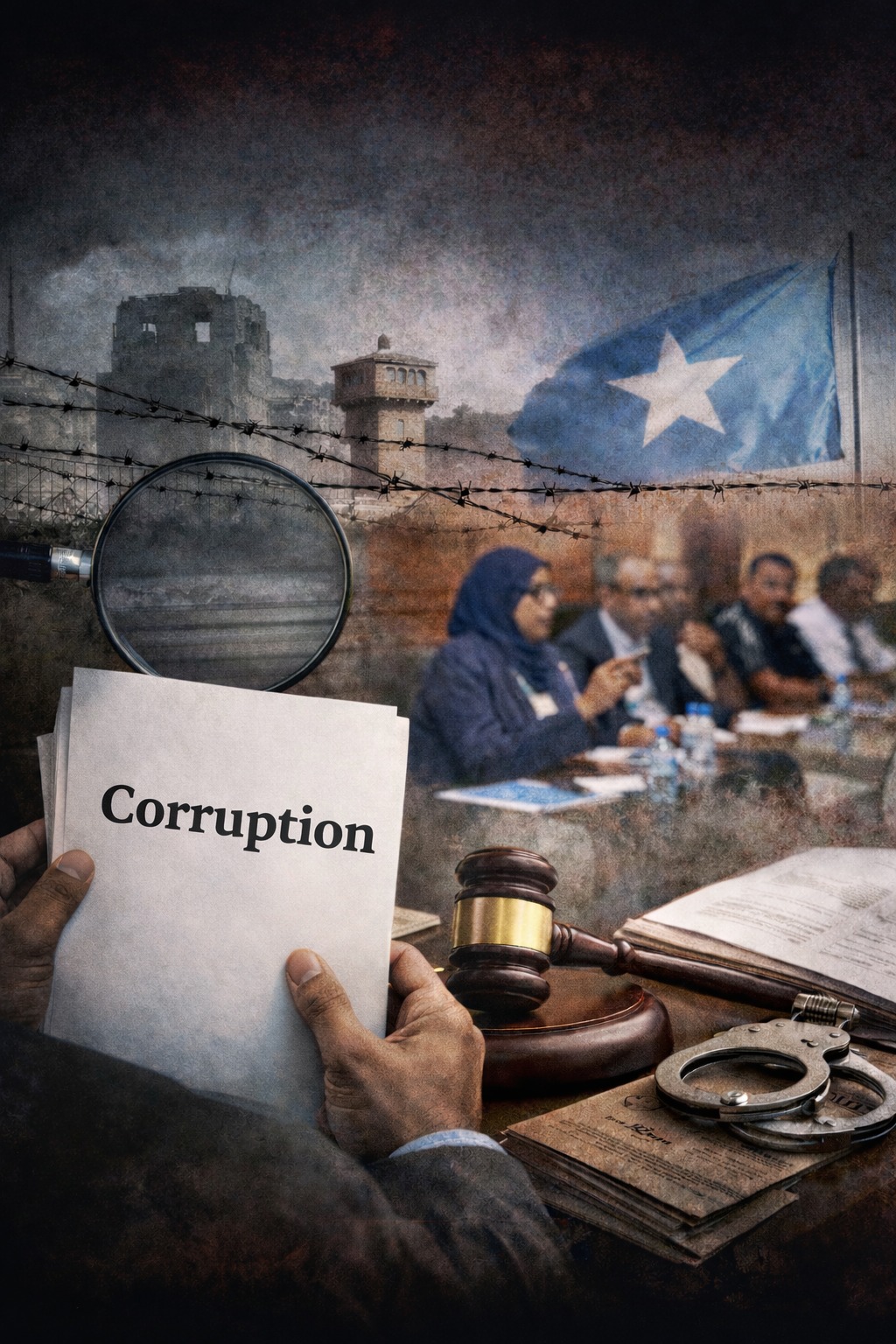
Investigative Report | Legal and Institutional Scrutiny of the National Human Rights Commission in Somalia
Brown Land
The National Human Rights Commission in Somalia is witnessing increasing legal and institutional scrutiny, following developments that have sparked widespread debate within legal, media, and research circles about the Commission’s compliance with the constitutional and legal framework governing its work, particularly Founding Law No. (16) of 2026, which clearly defines the Commission’s structure, powers, and decision-making procedures.
The Legal Framework Governing the Commission’s Work
Legal and governance specialists confirm that this law is based on a fundamental principle stating that the Commission is managed as a collective institution, not through unilateral decisions, and that substantive decisions, especially those related to appointments to senior positions, must be made according to transparent and competitive procedures. These begin with public announcement of vacancies, then evaluation of candidates according to clear professional criteria, with results subsequently presented to the full Commission membership for deliberation and collective decision-making. Legal analysts believe that this procedural framework does not merely represent internal administrative organization, but constitutes a legal obligation aimed at protecting the Commission’s independence, ensuring the integrity of its decisions, and enhancing public confidence in its work.
From General Governance Concerns to Specific Procedural Questions
Recently, the discussion has shifted from general observations about governance and independence to a more specific level, following questions raised about recent administrative appointments within the Commission, including the position of Director General. According to what has been circulated in institutional circles, these decisions have been attributed to the Commission’s leadership under Dr. Maryam Qasim, amid legal debate about whether all procedural steps stipulated in the law were completed, or whether these decisions were fully presented to the nine-member Commission for discussion and voting.
Limits of Authority and the Concept of Procedural Violation
Legal experts believe that the authority to make such decisions, according to the founding law, is a collective competence of the Commission and not of any individual party. They point out that if bypassing the specified procedures is proven, this may constitute a procedural violation, regardless of the soundness of the decision in terms of content or the intentions behind it, as procedural form in administrative law is considered an integral part of the decision’s legitimacy itself.
Internal Divergence and Its Impact on Institutional Effectiveness
Parallel to these questions, circulating information indicates the existence of divergent positions within the Commission regarding management style and decision-making. Governance experts believe that such divergence, if not managed within legal and institutional frameworks, may negatively affect the Commission’s effectiveness, because independent bodies depend for their strength on internal consensus, collective work, and respect for legal procedures, more than on formal powers.
Transparency in Confronting Rumors and Interpretations
With the escalation of public debate, discussions have emerged in media and research circles about the possibility of ideological polarization, external influences, or concerns about extremism in discourse within national institutions. However, analysts warn against being drawn into such undocumented claims, emphasizing that dealing with them must be done through objective verification and official procedures, not through speculation or accusations circulating in the public sphere. Specialists point out that institutional transparency, clear communication, and provision of documentation represent essential tools for addressing these concerns and limiting the spread of rumors that may harm institutions and public trust simultaneously.
The Administrative and Financial Dimension of Governance
In the same context, public administration experts emphasize that the integrity of any administrative or electoral process within national institutions is linked to the clarity of financial and administrative procedures, disclosure, and avoidance of conflicts of interest. They confirm that the absence of these standards opens the door to questioning the soundness of decisions even in the absence of proven legal violations.
International Assessment and Independence Standards
According to diplomatic observers, international partners monitor the performance of national human rights institutions over the medium and long term, focusing on the extent of commitment to constitutional principles, respect for national laws, and compliance with international standards, foremost among them the Paris Principles governing the work of these institutions, which emphasize independence, transparency, and good governance.
Treatment Pathways and Institutional Crossroads
Legal and governance experts agree that addressing this institutional controversy does not pass through denial or media escalation, but through clear internal review, strict adherence to procedures stipulated in the law, and when necessary, conducting an independent investigation. They believe that these mechanisms protect both the institution and individuals, as they ensure that results are based on evidence rather than impressions.
As Somalia continues to consolidate its institutions, observers agree that the credibility of oversight bodies, foremost among them the National Human Rights Commission, will ultimately be determined by the extent of strict compliance with the law, management transparency, and actual independence in practical implementation, not in texts alone.
Brown Land will continue to follow this file through subsequent verification and investigation processes, as part of a series of materials based on documented facts, which will allow for a more comprehensive picture as the data develops.