
After three heavy years of war, absence, and the enforced silence imposed on the capital’s skies, the sound of a Sudan Airways aircraft landing once again at Khartoum International Airport returned—carrying civilian passengers and, with them, a meaning far deeper than a simple “arrival.”
It was the first flight to reach Khartoum since a war ignited by the Janjaweed militia—a war that sought to strip the city of its pulse, the state of its symbols of sovereignty, and citizens of their sense of safety. Yet Khartoum, as it has always been, does not fall out of memory, nor is it erased from geography.
The arrival of the first Sudan Airways (“Sudanair”) flight is a moment of pure sovereignty. It expressed, in the clearest possible way, what every authentic Sudanese feels: the return of the national carrier to the capital’s airport means the state is still here. Despite the damage inflicted by war and the hatred of those who wished otherwise, its institutions remain capable of rising again and reclaiming their natural and leading role in serving the people and reconnecting the land with its sky.
This flight represents the return of hope and spirit, and the restoration of a sense of security that did not come out of nowhere. It was written in the blood and sacrifices of the Armed Forces and the supporting forces in all their forms—those who stood against chaos and paid a heavy price so that life could return step by step, landmark by landmark, facility by facility.
Khartoum International Airport, Sudan’s aerial gateway and the entrance to the capital of the “Three No’s,” has reopened through firm national will and a clear equation: no security without sacrifices, no stability without protection, and no civil aviation without a present and capable state.
The return of civil aviation to the capital sends a message inward before outward: Sudan is recovering, Khartoum is returning once again to what it was, and the state—despite its wounds—is regaining its vital joints. It is also a message of loyalty to those who protected the land and dignity, advancing on land, sea, and air, until the sky itself today bears witness to their steadfastness.
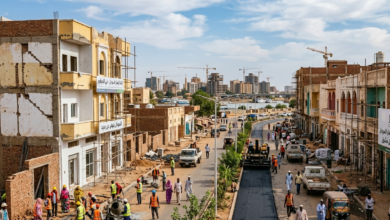
The return of the national carrier is only the first step on a long road toward reconstruction, restoring confidence, and repairing what the war shattered—a step sufficient to say that Sudan was not defeated, and that Khartoum remains capable of welcoming life again… through the airport gate and aboard this auspicious bird.
A salute of love to all who contributed to Khartoum’s return.
Long live Sudan. Long live the Sudanese Armed Forces.