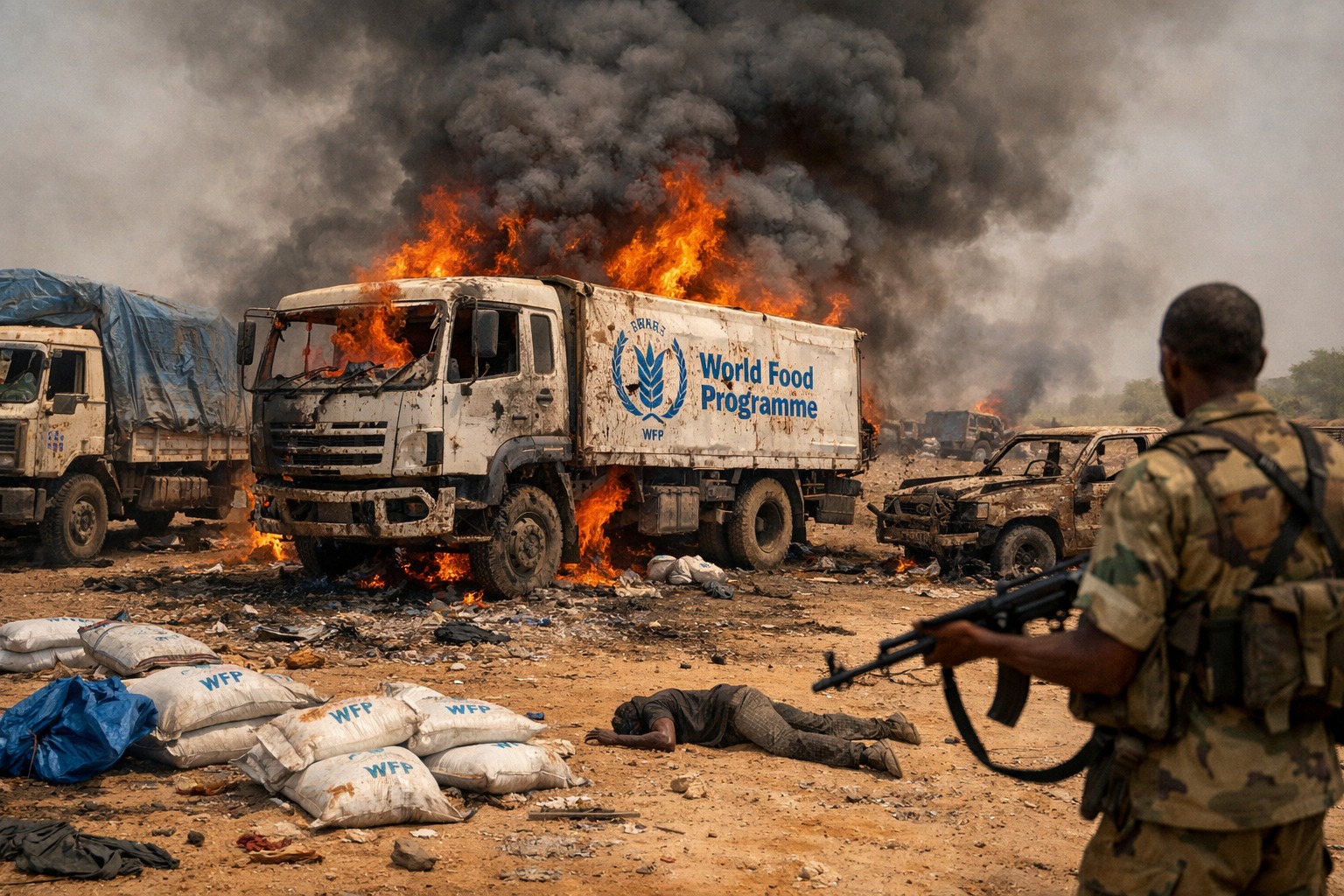
Targeting of World Food Programme Humanitarian Aid Convoys in Sudan
On Friday, February 6, 2026, the Rapid Support Forces militia targeted several trucks loaded with life-saving humanitarian aid belonging to the World Food Programme with drones in the “Allah Karim” area on their way to the city of El-Obeid, the capital of North Kordofan State. The attack resulted in the death of at least one person and the injury of several others, in addition to the destruction of relief materials designated for the humanitarian response.
The attacks occurred along the main road connecting the state capital El-Obeid with the city of Kosti in the neighboring White Nile State. The trucks were transporting food aid to affected areas in Al-Sumeih, Al-Rahad, and the city of Um Rawaba. In Um Rawaba, three drones struck a transport truck and a fuel tanker, causing further civilian casualties.
The Sudanese government issued an official statement condemning the terrorist attack by the Rapid Support Forces militia, describing the conduct as “barbaric and immoral,” affirming that the militia’s targeting clearly demonstrates its disregard for the principles and provisions of international humanitarian law, international human rights law, and relevant regional standards and treaties.
The government stated in its announcement that Article 14 of the Second Additional Protocol of 1977 to the Fourth Geneva Convention prohibits the starvation of civilians and the destruction of humanitarian aid as a method of combat. It confirmed that targeting relief convoys and humanitarian objects constitutes a grave violation of the principles of international humanitarian law, particularly the Geneva Conventions, and represents a deliberate undermining of efforts to deliver humanitarian assistance to those in need.
This attack came after another drone strike earlier in the week on a World Food Programme facility in Yabus in Blue Nile State, which resulted in the injury of an employee, indicating a recurring pattern of targeting humanitarian work.
The Government of Sudan drew the attention of the international community that this attack does not represent an isolated incident, but rather a continuation of an approach the terrorist militia has followed to obstruct humanitarian work and use food deprivation as a means of pressuring civilians. It added that this is happening under the sight and hearing of the international community, which has remained silent in the face of war crimes that require accountability.
The US Senior Advisor for Arab and African Affairs, Massaad Boulos, condemned the attack, saying: “The destruction of food intended for those in need and the killing of humanitarian workers is disgusting.” He added: “The Trump administration absolutely does not tolerate this destruction of lives and US-funded aid; we demand accountability and offer our condolences to all those affected by these unjustified events and the terrible war.”
The Sudanese Doctors Network described the attack as “a flagrant violation of international humanitarian law” and a war crime, calling for an independent investigation and stronger international measures to protect humanitarian workers and infrastructure.
The delivery of humanitarian aid in Sudan faces catastrophic challenges as a result of the ongoing conflict, with obstacles including the targeting of relief workers, direct fighting, and looting of supplies, which hinders the delivery of aid to the Kordofan and Darfur regions in particular. Sudan faces an unprecedented humanitarian crisis, with more than 30 million people in need of humanitarian assistance, with estimates indicating that more than 21 million Sudanese face acute food insecurity.
The Geneva Conventions and their Additional Protocols protect persons who do not participate in combat, including civilians, health workers, and relief workers. Serious violations of international humanitarian law are considered war crimes, as the UN Office for Human Rights has documented the killing of at least 30 humanitarian and health workers over a six-month period, including in targeted attacks.
The Sudanese government called on the international community to clearly condemn these practices and take the necessary measures to ensure accountability for the terrorist Rapid Support Forces militia and its supporters. The Government of Sudan renewed its commitment to full cooperation with the United Nations and its humanitarian agencies, and to do everything necessary to secure the delivery of aid to its beneficiaries without obstacles.
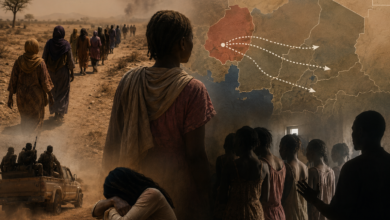
This image is generated using artificial intelligence and is for illustrative purposes only; it does not represent a real event.