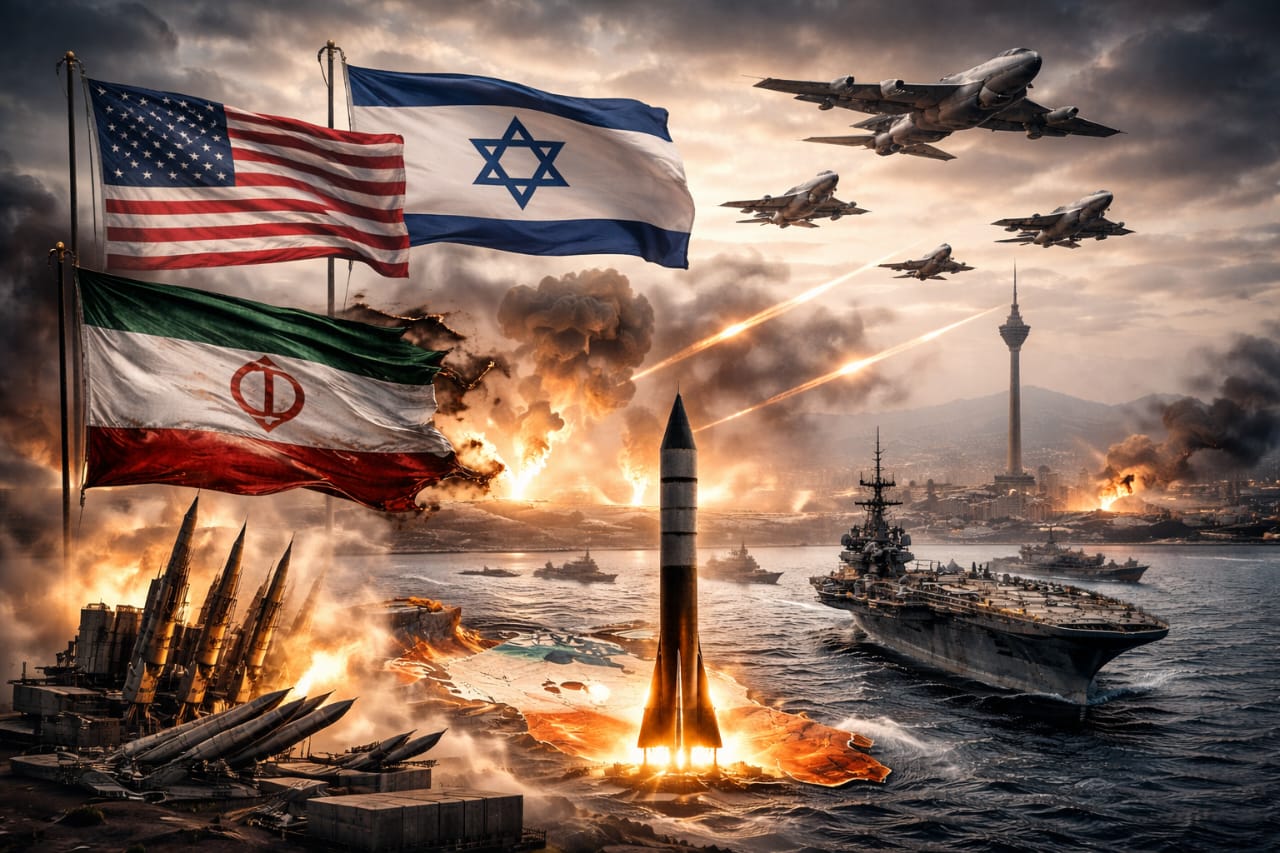
The likelihood of military action against Iran is increasing, despite all the optimistic reports regarding the prospects of successful negotiations
Brown Land
In this context, Trump is also coming under pressure due to criticism directed at him following his hasty calls to Iranian protesters. The protests are gradually rekindling, and every incident of suppression or killing during demonstrations brings his tweets back into the spotlight — tweets in which he urged Iranians to take to the streets and promised them swift support.
The pressure of the Israeli lobby is also becoming visibly evident, pushing in the direction of new strikes.
On the other hand, Iran’s insistence on refusing to discuss restrictions on its missile program or halt its support for regional allies is narrowing the room for maneuver. Given current circumstances, any possible agreement — taking into account Tehran’s hard-line stance — would either closely resemble the “Obama deal” concluded roughly a decade ago, or be even less advantageous. This raises an obvious question: why did Trump withdraw from the previous agreement during his first term if he was going to conclude a worse one on lesser terms?
There are no guarantees that Iran will not exploit any period of calm to enhance its military, missile, and potentially nuclear capabilities, laying the groundwork for a new crisis — one that could coincide, for instance, with the next American elections.
Or Tehran might seize a favorable opportunity to destabilize the region, at which point all bets on the “strong president” narrative would dissolve — especially if Iran continues to promote its narrative of victory in its domestic discourse while its security apparatus persists in suppressing protests.
On the other side of the equation, the risks of launching a military operation without clear prospects of success — and perhaps without precisely defined criteria for what success even means — are also considerable. Yet events sometimes proceed according to their own escalatory logic.
A wide spectrum of possible scenarios has been discussed at length — the positive ones, which assume Iran’s transformation into a modern, civil state, and the negative ones, which could lead to the country’s fragmentation and a struggle among competing political and national forces. I will not repeat them here.
What remains is that avoiding catastrophic outcomes is the responsibility of State Department experts and American intelligence agencies. The question is: are enough competent professionals still in place after last year’s wave of cuts? The answer will become clear soon.
Considering the scale of American forces already transferred to the region, with the possible participation of the Israeli Air Force at minimum, strikes could begin at any time. It is believed that execution may be delayed until after the holy month of Ramadan — that is, until the third week of March — yet the resurgence of protests in Iran remains an influential factor. The traditional commemoration of the fortieth day after the deaths of those killed, forty days after their passing, tends to give rise to new waves of protest and confrontations with security forces, providing additional media material and renewed calls for American intervention.
Accordingly, everything could begin at any moment. We can only watch and wait. As for faith in miracles or in the sudden emergence of surprise solutions and lasting peace agreements — that is gradually fading.