War on Civilians: Crimes Without Punishment
Dr. Maimouna Saeed Adam Abu Raqab
In every armed conflict, the true conduct of any military force is measured by its commitment to protecting civilians and preserving civilian infrastructure. Respect for human life in times of war is not a moral luxury, but rather the minimum standard that separates legitimate military action from descending into organized crime. In the Sudanese context, the repeated practices of the rebel Rapid Support Forces reveal a dangerous pattern of violations. Bombing civilians and targeting residential areas has become a retaliatory tactic used after every failure or defeat on the battlefield, a stark expression of an unprecedented moral and humanitarian decline.
The Rapid Support Forces’ direct targeting of civilians cannot be separated from a mentality of collective revenge. Unarmed civilians become alternative targets when these forces fail to achieve military gains. The indiscriminate bombing of markets, homes, and populated areas has no military value; rather, it reflects a desire to spread terror, break the will of society, and punish it for actions in which it bears no responsibility. This behavior is not only a grave violation, but also indicative of a complete breakdown of discipline and accountability.
From a religious perspective, these actions represent a blatant departure from the values that prohibit the killing of non-combatants and forbid attacks on innocent civilians. Divine laws have established clear rules for times of conflict, protecting women, children, and the elderly, prohibiting the destruction of homes and property, and affirming that human life is sacred and may not be taken unjustly. Therefore, the Rapid Support Forces’ bombing of civilians and terrorizing of innocent people cannot be justified under any pretext; rather, these practices directly contradict both religion and morality.
From a humanitarian perspective, the actions of the Rapid Support Forces reflect a resounding collapse of all notions of human dignity. Civilians, who are supposed to be protected, become fuel for armed conflict, and their pain and suffering are used as tools of pressure and revenge. Transforming military defeats into acts of reprisal against society reveals a mentality that views human beings as mere numbers or tools, devoid of souls with the right to life and security. This pattern of violence not only destroys the present but also sows long-lasting resentment and closes off any prospect for genuine social reconciliation.
This decline is exacerbated when the Rapid Support Forces’ attacks extend to bombing humanitarian aid convoys and obstructing international efforts to provide relief to those affected. Aid trucks have been targeted, food and medicine warehouses destroyed, and humanitarian organizations prevented from reaching those in need—behavior that reveals a clear intent to use starvation and deprivation as weapons of war. Attacking aid not only intensifies the suffering of civilians but also constitutes a direct assault on the very idea of saving lives and an attempt to subjugate society through hunger, disease, and slow death.
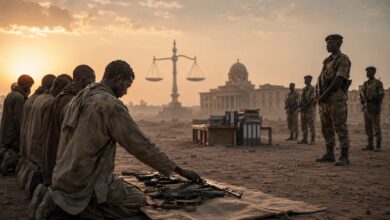
Under international humanitarian law, the Rapid Support Forces’ actions clearly constitute war crimes. International law mandates the principle of distinction between civilians and combatants and prohibits indiscriminate attacks, collective reprisals, and the targeting of civilian objects, aid convoys, and humanitarian personnel. It also holds commanders and perpetrators individually criminally responsible for these crimes, regardless of justifications or circumstances. Therefore, what is happening is not a series of isolated incidents, but rather a systematic pattern of violations that warrants international accountability.
Despite the gravity of these crimes, the international community often remains content with timid verbal condemnations that lack any real deterrent effect. Statements of condemnation do not stop the bombing, rebuild a destroyed home, or save a child deprived of medicine. The continued absence of accountability has emboldened the Rapid Support Forces to persist in their actions and entrenched a sense of impunity. Hence, the urgent need to move from condemnation to accountability through the imposition of strict sanctions, the activation of international justice mechanisms, and the protection of humanitarian work from targeting.
The crucial ethical question remains: How can a society accept a force that perpetrates murder, starvation, and terror against its own people? Legitimacy is not built on the ruins of homes or the remains of civilians, but on respect for human life and the preservation of human dignity. And as the Rapid Support Forces continue this approach, they confirm their moral isolation and prove that the path of blind violence leads only to historical condemnation and accountability, where the suffering of civilians will remain an undeniable and unjustifiable witness.