Blue Nile: From Peripheral Front to Regional Pressure Node
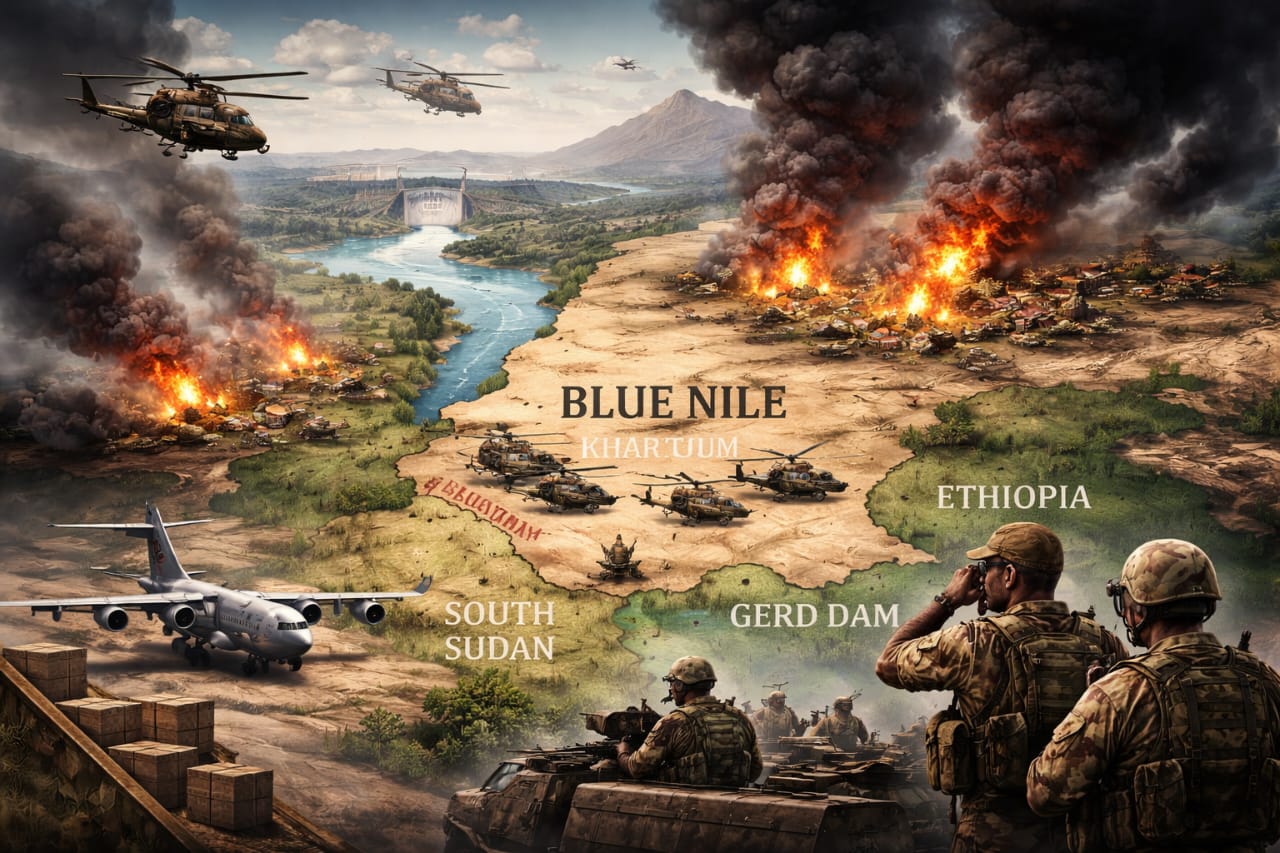
Sudan’s Blue Nile State is no longer a secondary front in the country’s war. It is rapidly emerging as a strategic crossroads where domestic conflict intersects with regional power competition, reflecting a deeper shift in how the war is unfolding across East Africa.
Escalating Military Dynamics
The current wave of escalation began on January 11, 2026, when the Sudanese Armed Forces (SAF) carried out airstrikes targeting a convoy in Yabus, Blue Nile State. This marked the first direct military response following accusations of external support to the Rapid Support Forces (RSF). Additional strikes followed on January 22, expanding into areas within al-Kurmuk locality.
By January 25, the conflict entered a new phase with the first direct ground confrontation involving:
The Sudanese Armed Forces
The Rapid Support Forces
The SPLM-N faction led by Abdelaziz al-Hilu
Clashes took place in al-Slik, Malkan, and Ahmir. Although the SAF regained control of some areas within a day, fighting persisted. On February 3, hostilities intensified further, with reports of drone usage and partial territorial gains by RSF-aligned forces in al-Kurmuk.
📊 According to data from the Armed Conflict Location & Event Data:
February 2026: 19 air and drone strikes, 68 fatalities
January 2026: 3 strikes only
➡️ This sharp increase indicates a transition toward higher-intensity, technology-driven warfare.
Cross-Border Supply Networks and Alliances
A defining feature of this escalation is the growing role of regional actors. Sudanese authorities have accused Ethiopia of:
Allowing RSF fighters to train across its borders
Facilitating the use of its airports to transfer fighters and military equipment
There are also reports suggesting that the United Arab Emirates has supported RSF operations through regional logistics networks—claims that Abu Dhabi officially denies.
In response, Egypt and Saudi Arabia have taken countermeasures, including:
Closing their airspace to flights linked to these operations
Targeting smuggling routes, notably with an Egyptian airstrike on January 13, 2026, near the Sudan–Libya–Egypt border
Additionally, the UAE’s withdrawal from Somalia has disrupted a key supply corridor through Bosaso, forcing a search for alternative routes—potentially through Blue Nile via Ethiopia.
Strategic Importance: Gateway to Central Sudan
Blue Nile’s geographic position makes it a critical prize. It:
Borders Sennar State, a key entry point into central Sudan
Connects to conflict zones in Kordofan
Links Sudan to Ethiopia and South Sudan
Control over the state could:
Open pathways toward central and eastern Sudan
Or sever critical supply lines for opposing forces
The RSF’s alliance with al-Hilu’s faction under the “Tasis Alliance” has strengthened its position by providing:
Local manpower and terrain familiarity
Military experience
The ability to leverage local ethnic and border dynamics
Blue Nile and the GERD: A Strategic Overlay
The escalation cannot be separated from the broader dispute over the Grand Ethiopian Renaissance Dam.
Tensions between Egypt, Ethiopia, and Sudan over the dam have long shaped regional alignments. In this context:
Cairo seeks indirect leverage against Addis Ababa
Ethiopia views Blue Nile as a buffer zone protecting the dam
Sudan becomes a potential arena for proxy confrontation
With the dam now completed, the likelihood of direct military strikes has decreased. However, indirect pressure mechanisms—including territorial influence and proxy dynamics—are becoming more central.
Redrawing the Conflict Map
What is unfolding in Blue Nile reflects a broader transformation:
From a domestic power struggle between the SAF and RSF
To a multi-layered conflict shaped by regional intervention, logistics control, and shifting alliances
Analytical Conclusion
Blue Nile is no longer just a battlefield. It has become:
A critical logistical corridor
A balancing point for regional influence
A strategic lever in Nile water politics and GERD negotiations
As such, control over the state may not only shape the trajectory of Sudan’s war, but also influence the broader balance of power across East Africa.
Written by ROGAIA ELJAILANI