
Iran’s Missile Program and Diego Garcia: What’s the North Korean Connection?
Brown land
The news that emerged at the beginning of Eid al-Fitr, which we mentioned in a previous report, about Iran launching a missile strike on Diego Garcia, an island located more than 4,000 kilometers from the launch site and home to a British military base used by the United States in warfare, came as a great surprise to many.
The American press was the first to report this news. It’s noteworthy that official sources haven’t commented much on it, which only adds to the mystery surrounding the matter.
In this context, we would like to point out that the Iranian missile program is, to a certain extent, an extension of the North Korean program, according to some experts. Therefore, North Korean missile models, after development, later become either prototypes for new Iranian missiles or near-complete copies of them, sometimes bearing Iranian designations, according to their opinion.
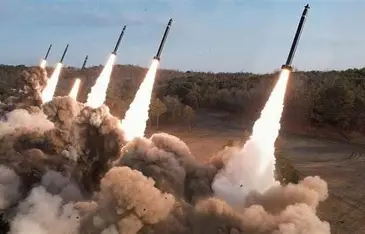
From this perspective, the Khorramshahr-4 missile, tested in Iran in 2023, is based on the North Korean Hwasong-10 missile, which entered service in North Korea in 2016.
This missile is equipped with a 500 kg light warhead (for a maximum range of approximately 4,000 km) and a 1,200 kg heavy warhead (capable of striking targets at ranges exceeding 2,000 km). Iran was primarily interested in the heavy warhead version, as the 2,000 km range was sufficient, while the 1,200 kg warhead offered a clear advantage when striking targets in Israel compared to the lighter version.
For this reason, this version was officially adopted for the Iranian Revolutionary Guard Corps’ arsenal, with the addition of Iranian modifications, while the “light warhead” version was largely ignored, as was widely believed among experts. However, it is likely that this version of the missile had already entered Iranian military stockpiles some time ago. In the aforementioned mysterious operation, several of these missiles were probably used against the military base.
At the same time, it should be emphasized that Iran produces this type of missile (and others) itself, as well as its own mobile launchers, making it practically independent of North Korean experts, except for any technical advice they might provide.
But another point must be noted. In 2017, North Korea introduced the Hwasong-12 missile. Its development came after significant difficulties encountered by North Korean specialists in improving the Hwasong-10, a project that took a long time to develop. Its first unsuccessful tests were conducted in 2006, and it only entered service in 2016, according to available information.
During that period, North Korea achieved a significant technological leap, possibly with Russian assistance, as some experts believe. This led to the development of a more powerful engine within the same class as the Hwasong-10 missile, equipped with an additional fuel tank. This directly increased the range of the new Hwasong-12 missile, exceeding 3,000 km with a heavy warhead and reaching approximately 6,000 km with a light warhead.
It appears that, should Iran wish, it could, through a relatively simple modernization of its Khorramshahr-4 missiles and their launchers, and with the assistance of North Korean experts if necessary, develop a new version capable of reaching a range of 4,000 km or even 6,000 km, if it hasn’t already acquired such a capability. Given that Iran, after the attack, effectively withdrew from its nuclear commitments, and that it maintains close ties with Kim Jong-un, who possesses a nuclear weapon that could, theoretically, be adapted for these missiles, and given the failure of attempts to subdue Tehran with a single strike, as Netanyahu and Trump had hoped, the level of concern in the West and Israel regarding Iran’s military capabilities is likely to rise further.
This is especially true since the recent experience demonstrated Iran’s ability to maintain secrecy and its capacity to conceal some of its capabilities for an extended period.