Russia Gets Closer to Iran: What Does the Shifting Russian Rhetoric Mean in the Conflict with the West?
Ukraine Opens a Counter-Front
Brownland
Statements by the Russian Ambassador to London, Andrei Klin, have sparked widespread debate in Western diplomatic circles after he confirmed that Moscow does not view the current conflict with Iran from a position of neutrality, but rather from a political perspective that sees Western policies in the region as contributing to escalating tensions. This stance reflects a notable shift in Russian rhetoric, as Moscow has become more explicit in its political support for Tehran and its criticism of the approach taken by the United States and its allies.
This development comes within the context of a tense international environment where several geopolitical crises intersect, from the war in Ukraine to strategic competition in the Middle East. Therefore, Moscow views any major confrontation with Iran as part of a broader conflict with the West, not merely an isolated regional crisis.
In this context, some Western reports point to signs of increasing military and technological cooperation between Russia and Iran, particularly in the areas of drones and reconnaissance systems. According to these assessments, Russian technical expertise in electronic warfare and sensor technology could contribute to developing the capabilities of some Iranian systems, a matter being followed with increasing interest by Western military experts.
Security analyses also point to the possibility of a level of information coordination between the two sides within the framework of the strategic cooperation that has developed in recent years. However, these assessments remain largely within the realm of intelligence analysis or political speculation, as there is no conclusive public evidence proving direct Russian involvement in any military operations against American or British targets in the region.
Nevertheless, the mere increase in cooperation between Moscow and Tehran adds a new layer of complexity to the regional landscape. The West views this rapprochement as part of the formation of a political and military axis seeking to counterbalance Western influence in several regions of the world, while Russia sees strengthening its relations with Iran as part of reshaping international balances in an era characterized by the decline of unipolarity.
In light of this, the conflict surrounding Iran appears to be no longer merely a limited regional confrontation, but rather an arena where competition between major powers intersects. In such complex environments, major powers often avoid direct confrontation, preferring to manage conflict through political and economic pressure or by providing indirect support to their allies.
According to CNN, a Western security official reported that Russia has already begun providing more detailed support to Iran in the field of drone warfare. This support includes transferring tactics developed during the war in Ukraine, which helps Iran target its positions in the region more effectively.
The assistance reportedly includes operational strategies for using Shahed drones, based on Russia’s experience in warfare and in countering Western air defense systems. This includes specific recommendations on attack methods, such as launching drones in coordinated waves and altering their flight paths to evade air defense systems.
Russia’s Permanent Representative to the United Nations, Valery Nebenzia, also stated that US military sites and infrastructure in the Gulf region are legitimate targets for Iran under its right to self-defense.
This statement carries two significant implications. Firstly, Russia believes that Iran has the right to attack any American targets in the region within the framework of the current confrontation, based on self-defense, thus justifying Tehran’s military actions in this manner. Secondly, the Russian official may have hinted that his country considers itself free to support its strategic ally against the American adversary, as this does not constitute unjustified military aggression by Tehran, but rather a means of protecting its security from attacks initiated by the US and Israel. In other words, these actions are defensive, not hostile.
The question that remains in strategic circles is: to what extent will this Russian-Iranian rapprochement develop, particularly in the military, security, and intelligence spheres?
In parallel, Ukraine, which views Russia as a bitter enemy following the 2012 war, opened a front against Russian-Iranian cooperation in the Gulf confrontation, aligning itself with the American-Israeli alliance.
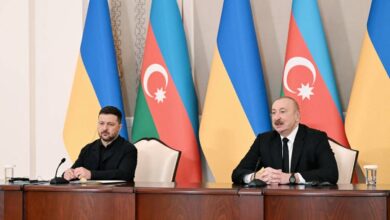
Ukrainian authorities dispatched teams of drone experts to Saudi Arabia, Qatar, and the UAE to assist these countries in countering Iranian drone attacks. This deployment was part of security cooperation with the Gulf Arab states amidst escalating tensions. Ukrainian President Volodymyr Zelenskyy confirmed that this move came at the request of the United States and aimed to bolster air defense capabilities in the region.
The Ukrainian initiative involves three teams comprised of Ukrainian engineers and military personnel who have already begun working in the three countries, drawing on their relevant expertise gained during years of conflict with Russia. Ukraine offered domestically produced interceptor drones and proposed exchanging them for the US Patriot PAC-3 missile system. Washington, in turn, requested Kyiv’s contribution of its expertise in countering Iranian drones, reflecting trilateral coordination between the United States, Ukraine, and the Gulf states.
Ukrainian President Volodymyr Zelenskyy stated that his country possesses “the world’s most extensive experience” in countering Iran’s Shahed drones, which he described as “the greatest challenge” in the region. He explained that Kyiv had received requests from several Gulf states to benefit from its expertise, and that he had held direct talks with the Emir of Qatar, Tamim bin Hamad Al Thani, and the President of the UAE, Mohammed bin Zayed Al Nahyan. His Foreign Minister also spoke with his Kuwaiti counterpart.
Zelenskyy revealed that the Secretary of the Ukrainian National Security and Defense Council, Rustam Umerov, had traveled to these countries to discuss the details of cooperation directly.
When considering the strategic implications of this move, it is important to note that Ukraine is not limiting itself to its direct confrontation with Russia, but is also exporting its military expertise to other regions (as it has done in several African countries in recent years, sending technical experts and drone shipments to counter the influence Russia and its local allies have gained). Ukraine’s participation in these activities also reflects a clearer alignment with the United States and its allies against Iran and Russia.
Sending Ukrainian experts to the Gulf represents a new security move that links the war in Ukraine to the regional conflict in the Middle East from the perspective that both wars are in fact largely a confrontation between the world’s major powers.