The Future of Gulf Neutrality Amid the Iranian-American Crisis
A Crisis Imposed, Not Chosen
The Gulf Cooperation Council states have found themselves in a position they never sought. Rather than playing their traditional role as a bridge for de-escalation between warring powers, they suddenly found themselves at the heart of the battle, absorbing damage without being party to the confrontation. GCC Secretary-General Jasim Al-Budaiwi captured this reality with rare candor when he emphasized that the Council’s member states are entirely removed from this conflict.
In the aftermath of the American-Israeli strike on Tehran on February 28, 2026, Iran launched sweeping attacks targeting sites across six Gulf states, insisting its objectives were limited exclusively to American military installations. Yet the reality on the ground told a different story, as the strikes extended to residential areas and facilities of critical strategic importance.
The Gulf as Iran’s Surrogate Battlefield
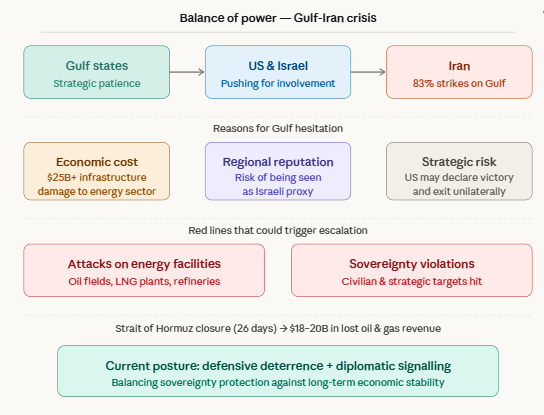
Tracking Iranian strikes since the war began reveals a striking pattern: approximately 83% were directed at Gulf Arab territories, while Israel’s share did not exceed 17%. This ratio reflects an Iranian calculus built on leveraging the Gulf environment as a tool to raise the cost of regional support for American operations, rather than engaging in direct confrontation with Washington or Tel Aviv.
Strategic Restraint: A Deliberate Choice or an Imposed Necessity?
Faced with this reality, Gulf states adopted what has come to be known as strategic patience — a policy built on repelling attacks through air defense systems while refraining from any offensive military counter-operations. Al-Budaiwi affirmed on multiple occasions that his country would not participate in any military action against Iran, stressing that this position stems from full awareness of the warring parties’ attempts to draw the region into their fight.
Yet the policy carries visible internal tensions. Saudi Foreign Minister Prince Faisal bin Farhan issued a pointed warning that his country’s capacity to absorb Iranian aggression has a ceiling. Meanwhile, Kuwait, the UAE, Bahrain, Saudi Arabia, Qatar, and Jordan jointly issued a statement reaffirming the right to self-defense under Article 51 of the UN Charter — a move analysts read as legal groundwork for a potential retaliatory option.
Diplomatic Escalation and Field Signals
On the diplomatic front, Qatar expelled Iranian military and security attachés, with Saudi Arabia taking similar measures, while the UAE froze its diplomatic representation in Tehran and recalled its ambassador. On the operational level, the Wall Street Journal reported, citing informed sources, that Riyadh authorized American forces to use King Fahd Air Base for strikes against Iran, and that Crown Prince Mohammed bin Salman was on the verge of deciding to enter the war. The same investigation indicated that some ground-launched missile operations targeting Iran were fired from Bahraini territory, while the UAE began tightening its grip on Iranian assets within its borders.
When Does Neutrality Break?
Analysts broadly agree that Gulf involvement in the war is not inconceivable — it is contingent on crossing certain unspoken thresholds. Ali Bakir, professor of political science at Qatar University, argues that escalating Iranian attacks on energy infrastructure will generate mounting pressure on GCC states to shift from a defensive to an offensive posture, particularly as interceptor missile stockpiles are depleted. Saudi political analyst Saad Al-Hamid contends that the decisive red line is a direct threat to oil and gas facilities — a line Gulf states will not allow to be crossed without a response.
This trajectory was already evident in the sharpening tone of official reactions. Qatar’s Foreign Ministry described the targeting of the Ras Laffan Industrial City as a flagrant breach of national sovereignty and a direct threat to regional stability.
Why Is War Still Too Costly?
Despite the mounting strikes, Gulf states remain acutely aware of the price they would pay by sliding into open confrontation. On the economic front, Rystad Energy estimated the cost of rehabilitating damaged energy infrastructure at over $25 billion, with an additional $18–20 billion in lost oil and gas revenues resulting from a 26-day closure of the Strait of Hormuz. More damaging than the financial toll is the timeline for recovery: some of this damage cannot be repaired with money alone — restoring full operations at Qatar’s Ras Laffan LNG complex could take up to five years regardless of available resources.
Layered above these economic considerations are deeper strategic dilemmas. Chief among them is the possibility that the American administration could declare victory and exit the field at any moment, leaving the Gulf to face Iran alone. Equally weighty is the reputational damage that military alignment with Israel would inflict on Gulf states’ standing across the Arab and Islamic world. And underlying it all is the fundamental divergence between Gulf priorities — grounded in development and prosperity — and the logic of a war aimed at redrawing the region’s balance of power.
Washington Pushes, the Gulf Calculates
The Trump administration is seeking to use Gulf states as regional cover for military operations against Iran. Reuters sources indicate that Washington is applying direct pressure on GCC members to join the joint military campaign. Indirect pressure is also at work through the nature of the escalation itself: targeting Iran’s internal infrastructure may trigger an Iranian response aimed at Gulf energy facilities, involuntarily pulling these states into the fray.
Yet American pressure is met in turn by quiet Gulf resistance and repeated warnings against allowing the conflict to widen — particularly as its ripple effects have begun to surface on American financial markets, prompting the president to extend escalation deadlines on multiple occasions.
Conclusion: The Fragile Balance Is All That Remains
The situation is perhaps best framed by Khaled Al-Jaber, Director General of the Middle East Council for International Affairs: protecting sovereignty is a non-negotiable duty, deterrence is an indispensable instrument, but being dragged into an open-ended confrontation without sufficient calculation carries a cost heavier than can be borne. Researcher Al-Hawwas Taqia holds that maintaining the defensive posture remains the least damaging option available in the near term, as it keeps open wider margins for Gulf states to reshape their relationships with both Washington and Tehran on more stable foundations.
Ultimately, Gulf states face a brutal equation in which there is no clean victory: silence is painful, and departing from it is more painful still. In moments like these, preserving a precarious balance is itself a choice — and a wager that this storm will pass.
Analytical report prepared by ROGAIA ELJAILANI Middle East Political Affairs — March 2026