Brown Land
The Middle East is experiencing a period of intense turmoil that transcends traditional interstate confrontations and extends to the very structure of the international system. The ongoing conflict between Iran on one side, and the United States and Israel on the other, is linked to broader power dynamics that intersect with the global rivalry between Washington and both Moscow and Beijing. In this context, Iran acquires particular geopolitical significance, situated at a central geographical junction in the network of land and sea routes that China is developing within its Belt and Road Initiative, making its location a crucial factor in major strategic calculations.
Within this equation, the opposing approach has adopted a premise based on targeting the Iranian regime’s top leadership as a means to disrupt its political and military decision-making apparatus, thus paving the way for widespread internal instability. This premise stems from a traditional view in conflict management that strikes at the top of the leadership hierarchy directly impact the entire system’s ability to function. However, the developments in the confrontation revealed that Iran’s decision-making system possesses a high degree of institutional and organizational cohesion. The military and security institutions continued to operate swiftly and consistently, a clear indication of the regime’s ability to absorb major shocks and maintain decision-making continuity.
This cohesion is also linked to the nature of the political culture that has taken shape within the ruling elite since the Islamic Revolution. This culture views the conflict as a protracted confrontation in which political and ideological considerations intertwine, and it places the concept of sacrifice at the heart of the equation of resilience. Therefore, harsh external pressures become a driving force for strengthening political will and solidifying the option of confrontation.
In the military arena, the confrontation takes on a multi-pronged form, based on distributing pressure on the adversary in multiple directions simultaneously. The military structure of the conflict can be understood as a pressure system operating across four main platforms that complement each other to form a comprehensive strategy of attrition. The first axis is the Strait of Hormuz, one of the world’s most important energy arteries. Any threat to navigation in this waterway directly impacts oil markets and the global economy, granting Tehran a broad tool of influence that extends beyond the battlefield.
The second axis concerns the American military bases deployed in neighboring countries. Demonstrating the vulnerability of these bases by targeting radars or associated military infrastructure aims to reshape the deterrence equation and highlight that the American military presence in the region carries direct risks for the host countries.
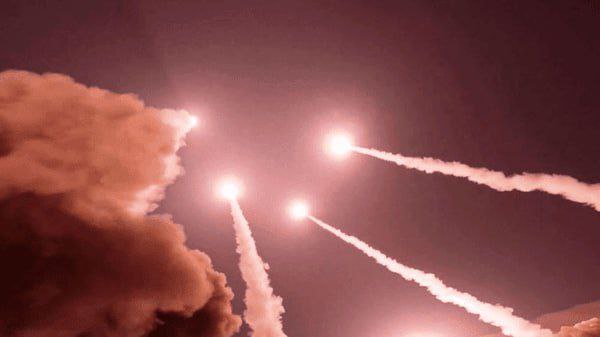
The third axis is evident in the maritime arena, where pressure on American fleets and aircraft carriers is part of an effort to curtail military freedom of movement in the Gulf and surrounding seas. The fourth axis relates to Israel’s strategic depth, where long-range ballistic missiles play a crucial role in exhausting air defense systems and imposing a mutual deterrence equation.
These developments place Arab states, particularly those in the Gulf, before a delicate equation concerning the relationship between security and sovereignty. The presence of foreign military bases on the territory of some of these countries makes them part of the operational environment of the conflict should those bases become direct targets of military retaliation. In this context, a growing debate is emerging about the possibility of neutralizing these countries’ territories from the arena of confrontation by reassessing the role of foreign bases during periods of escalation.
In Lebanon, the situation takes on a unique character due to its sensitive position within the regional balance of power. The missile launches on the northern front reflect deterrent messages aimed at reinforcing the existing rules of engagement. These operations fall within a network of interconnected regional balances, making any existential threat to one of the parties a potential catalyst for wider confrontation.
Ground warfare remains one of the most sensitive scenarios in Israeli military calculations due to the potentially high human cost. Past experience has shown that ground operations in complex geographical and demographic environments often devolve into protracted battles that are difficult to resolve quickly.
Over time, the nature of the war becomes clearer: a war of attrition that depends more on the ability to sustain operations than on achieving a swift victory. Iran’s missile arsenal is countered by the air defense systems of Israel and its allies, transforming the conflict into a race between the offensive’s ability to maintain pressure and the defensive’s ability to withstand it.
The time factor also gains significant importance in strategic calculations. Protracted wars generate increasing political and economic pressures on the parties involved, especially with rising human losses and the expanding effects of economic warfare. A wider international intervention could push the conflict to higher levels of geographical and technological escalation. The region today appears to be at a critical historical crossroads. Current developments carry the potential for a new regional deterrent equation that will redraw the balance of power in the Middle East, and whose effects may extend to the shape of the international order in the coming years. At the same time, the possibility of a protracted war of attrition remains, with all the profound transformations that this entails for the region’s political and security structure.