
Why Do America’s Most Powerful Bombs Fail to Penetrate Iran’s Missile Cities?
Brown land
The United States bombed the Imam Hussein missile base south of Yazd in Iran three times in three weeks (March 1, 6, and 17). On March 20, missiles were launched from the same complex, proving that the base was still operational despite the repeated American bombing and indicating that the damage had not prevented it from carrying out its missions. How did it manage this?
The secret lies in a network of tunnels stretching for hundreds of kilometers, carved hundreds of meters deep into solid granite.
Since the revolution, Iran has faced Western, particularly American, hostility that has prevented it from developing an effective air force or acquiring modern air defense systems. It therefore turned early on to fortifying its defenses with underground infrastructure.
This involved two dimensions: a defensive one to protect strategic installations, and an offensive one to conceal launch sites and long-range missiles. Iran’s missile production facilities, storage depots, and launch sites are not visible buildings that can be destroyed by intensive airstrikes, as the Americans imagined. Rather, they are entire cities with a complex transportation network carved into the heart of the mountains.
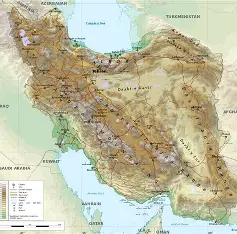
The Revolutionary Guard has spent decades since the revolution excavating hundreds of kilometers of intricate tunnel networks within the mountain ranges south of Yazd, east of Tehran (Khojir and Parchin), and in Shahroud, Isfahan, and possibly other areas (some facilities remain completely unknown to adversaries).
American satellite imagery reveals both hidden and visible entrances, but it fails to detect the complex underground rail systems that transport missiles between dozens of concealed, fortified exits without ever needing to surface.
The Americans have targeted tunnel entrances multiple times, but each time they are frustrated by the resumption of launches from almost the same locations. When a tunnel entrance is bombed, the facility is not crippled; a launch is launched from another exit, and after the launch, activity shifts to a third. Each missile complex has specific missions and designated locations. Each launch complex has dozens of reinforced and camouflaged exits with earthworks to absorb impacts, and the ability to reopen passages from within.
The greatest challenge for Iran was the GBU-57 (MOP) bomb, considered the world’s largest bunker-buster bomb. Theoretically, it could penetrate approximately 60 meters of reinforced concrete or 40 meters of medium-hard rock, with actual penetration varying according to the density and structure of the geological layers and the angle of penetration.
The Americans relied heavily on it due to its superior bunker-buster capabilities. Several of these bombs were dropped in succession on the Fordow nuclear facility during the twelve-day war in an attempt to destroy it, but they failed.
The Iranians had anticipated this scenario early on; their design went beyond simply constructing a network of tunnels, extending them to depths exceeding the known penetration limits of such munitions. In the hard granite of Iran’s mountains, penetration effectiveness is reduced, limiting the impact of these bunker-buster munitions.
The deeper sections of Iran’s “missile cities” are estimated to be significantly deeper than the available penetration capabilities, making direct access to the core of the facilities extremely limited. However, US and Israeli strikes may hit what is visible above ground, such as ventilation shafts and surface platforms, while assembly rooms and missile storage facilities deep within the mountains remain beyond the range of direct impact.
The Iranians have also adopted the tactic of mobile launchers: seemingly ordinary trucks that act as launch platforms emerging from tunnels, launching missiles, and then withdrawing or relocating within minutes. Mobile launchers are difficult to detect, while fixed silos remain more vulnerable to attack.
The resilience of the systems associated with Yazd and other areas stems from the hardness of the deep rock, which in many cases exceeds the penetration capabilities of warheads designed for bunker-buster use.