Colombian Mercenaries “The Desert Wolves Battalion” in Darfur: Foreign Firepower in a Proxy War
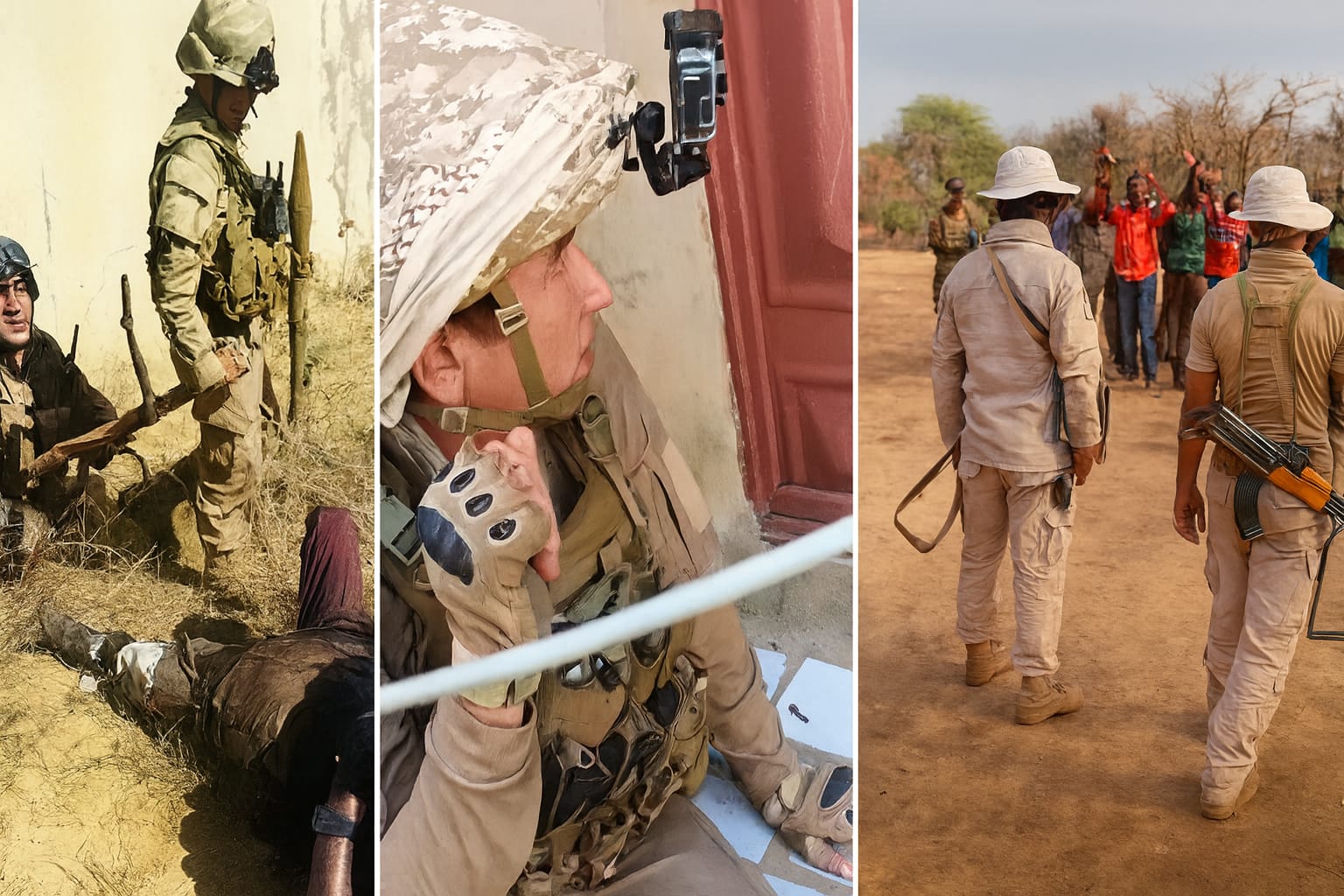
Combat footage recovered from a slain Colombian mercenary exposes foreign fighters embedded with Sudan’s RSF — a militia armed, funded, and deployed by the UAE. This is not a local conflict; it is a foreign-run invasion of Sudan bankrolled in Abu Dhabi and executed on Sudanese soil.
By: Sabah Al-Makki

Outsiders have long portrayed Sudan’s war as a purely domestic feud. Yet mounting evidence — from classified operational orders to recovered battlefield footage — points to a far more dangerous reality: Sudan’s frontlines are increasingly manned by foreign mercenaries, flown in from thousands of miles away to fight in a conflict that is not their own. They serve under the banner of the Rapid Support Forces (RSF), a proxy militia bankrolled, armed, and directed by the United Arab Emirates (UAE). This is the story of one such contingent — the Colombian “Desert Wolves” — and the transnational network that delivered them to the killing fields of Darfur.
Introduction: A Foreign Voice in a Sudanese War
The voice is sharp, urgent, unmistakably Colombian:
“¡Alto al fuego!… la ametralladora que está arriba… ¡pare!”
“Cease fire!… the machine gun up there… stop!”
It is not the voice of a Sudanese fighter defending his home. It is a man from thousands of miles away, his commands salted with Colombian slang — marica, perro, flaco, de chimba — recorded on a battlefield video recovered from the phone of a dead mercenary.
What the footage captures is more than chatter. It is evidence — linguistic, operational, geopolitical — that the RSF’s militia campaign is staffed by foreign mercenaries contracted, equipped, and deployed through Emirati networks.
From Bogotá to El-Fasher: The Imported Combat Footprint
For months, Sudanese sources, UN interlocutors, and independent investigators have tracked a shadow cohort of foreign fighters embedded within RSF ranks. Among them are Colombian veterans — long recruited by United Arab Emirates (UAE)-based private military firms — prized for counterinsurgency skills honed in battles against the Revolutionary Armed Forces of Colombia, Fuerzas Armadas Revolucionarias de Colombia (FARC), and for urban combat expertise forged over decades of war. Their deployment for UAE-linked contractors is well-documented in the Yemen theater and elsewhere; the same recruitment pipeline is now visible in Darfur as security scholar Andreas Krieg notes in The UAE’s ‘Dogs of War’: Boosting a Small State’s Regional Power Projection, such mercenary forces serve as tools for Abu Dhabi to extend its influence far beyond its borders.
The Intercept: A Firefight Under the Desert Sun
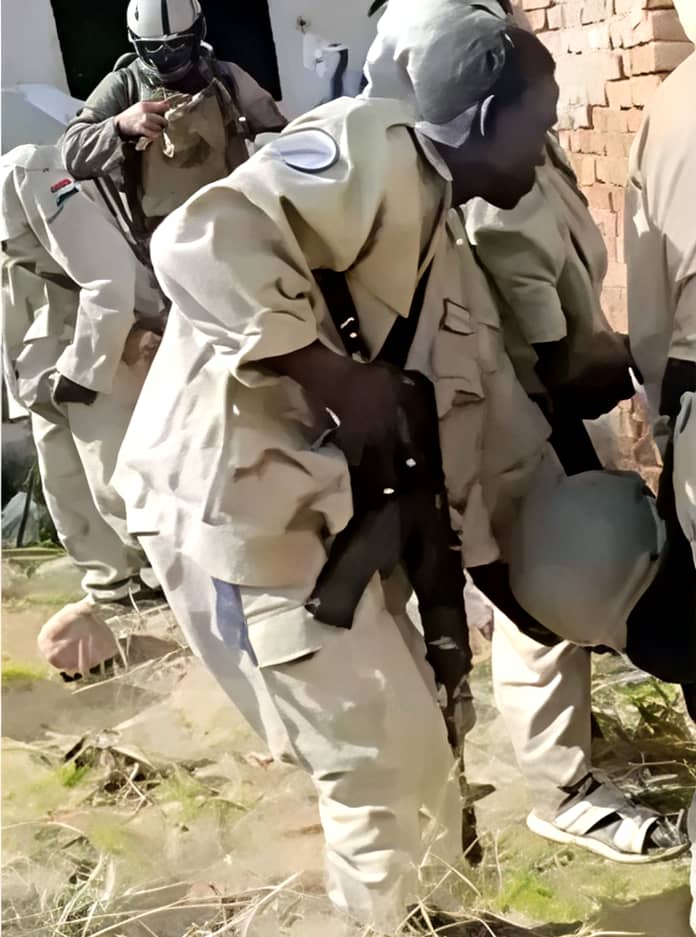
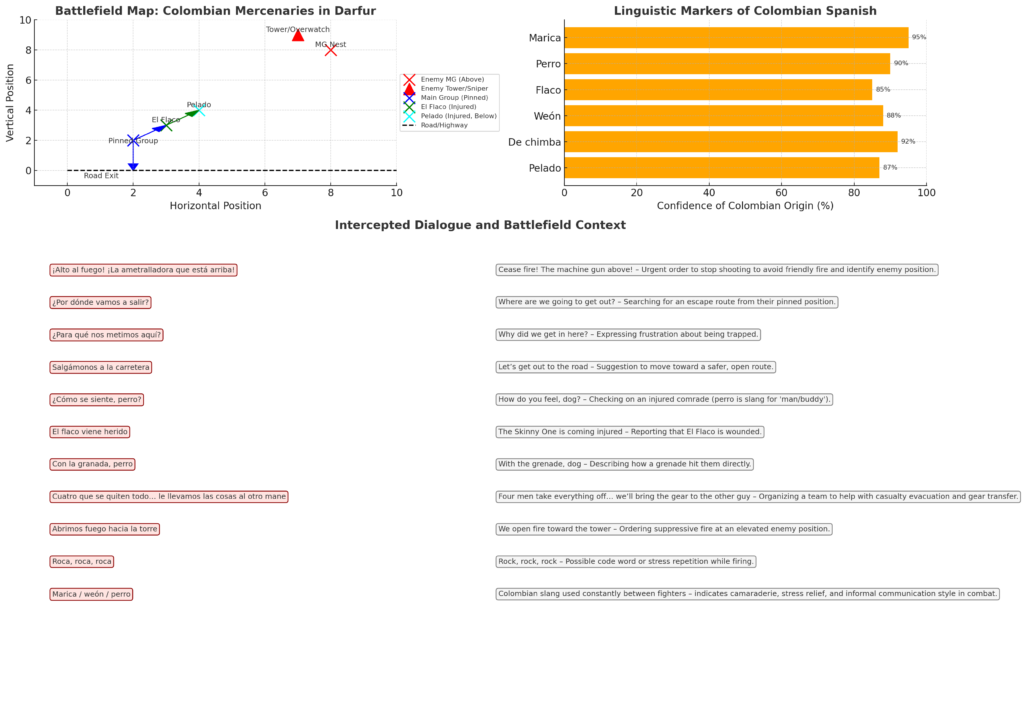
he recovered video places Colombian fighters inside an RSF assault on El-Fasher, Sudan’s last government-held stronghold in Darfur. Pinned by a machine gun nest and a tower sniper, they argue their next move: break toward the carretera (road) or remain trapped; extract El Flaco (“The Skinny One”), badly wounded ahead, and Pelado (“The Kid”), injured “below”; assign who covers, who moves, who carries the gear. A grenade detonates directly on them. Voices loop “bueno, bueno, bueno” and “roca, roca, roca” — stress tics or code words — as fire and movement are coordinated.
Evidence in Three Dimensions
- Tactical reconstruction — Audio yields a clean sequence: suppression from elevation → movement to casualties → evacuation under cover → break toward the road.
- Linguistic fingerprint — Slang such as marica, perro, flaco, weón, de chimba is a high-confidence Colombian marker (85–95%).
- Dialogue context — Real-time casualty management, target ID, suppressive fire, and stress loops all align with live-contact combat conditions.
Leaked Deployment Orders: The Desert Wolves in El-Fasher
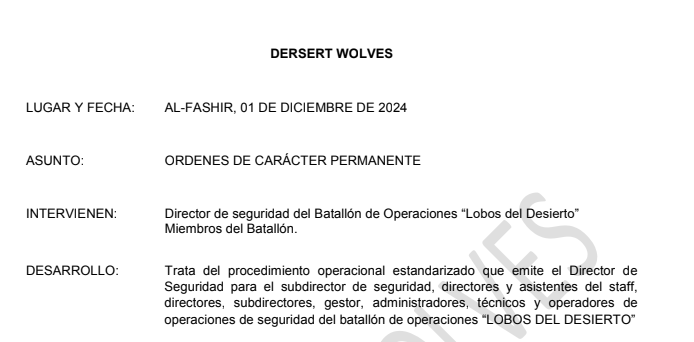
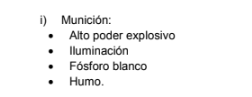
The classified document — 18 pages in Spanish — contains an operational order dated 1 December 2024 from Al-Fashir, outlining the formal deployment of the Colombian mercenary unit Batallón de Operaciones “Lobos del Desierto” (“Desert Wolves Operations Battalion”). The order sets out the chain of command, operational protocols, and mission objectives, confirming the insertion of a contracted foreign mercenary force via UAE-backed networks to fight alongside the RSF during the siege of El-Fasher. On page 16, the document lists the types of fire missions and munitions to be used — including white phosphorus. While some armed actors claim its use for smoke screening or illumination, under International Humanitarian Law (IHL) its deployment in civilian areas is prohibited due to its severe incendiary and burn effects. Protocol III of the Convention on Certain Conventional Weapons (CCW) restricts incendiary weapons like white phosphorus, and its deliberate use in populated zones by mercenaries — who lack lawful combatant status — could constitute a war crime under customary IHL. The inclusion of such prohibited or restricted munitions in a mercenary unit’s operational order — alongside high-explosive rounds and area-fire directives — underscores a premeditated strategy to inflict indiscriminate, disproportionate, and unlawful harm on the civilian population of El-Fasher.
It is clear that the UAE, as the principal enabler of this deployment, is determined to kill Sudanese civilians by all possible means, disregarding every constraint of international law and basic human morality. Under the doctrine of state responsibility, such conduct — involving the financing, equipping, and operational support of foreign mercenaries committing atrocities — exposes the UAE to direct legal accountability for internationally wrongful acts, including genocide and crimes against humanity. This is not reckless improvisation; it reflects a deliberate calculation to operate beyond the reach of justice. It is no coincidence that the UAE, when acceding to the 1948 Convention on the Prevention and Punishment of the Crime of Genocide, entered a reservation on Article IX. This very clause grants the International Court of Justice jurisdiction over disputes relating to the interpretation, application, or fulfillment of the Convention. In politics, there is no such thing as chance; such a reservation suggests a calculated move to shield itself from future accountability. Seen in light of the documented deployment of Colombian mercenaries, the operational use of prohibited munitions such as white phosphorus, and the broader network of support to the RSF, this reservation reads less like a legal technicality and more like an insurance policy for a project long in the making — the making of an “Empire of Mirage and Dust…upon Throne of Crumbling Dunes.”
The UAE Playbook: Proxy Warfare as a Foreign Policy Weapon
As argued in the Foreign Policy Research Institute’s 2022 study Separatists and Spoilers: The UAE’s Way of Proxy Warfare, by Ariel I. Ahram, the UAE has transformed from a Persian Gulf–focused state dependent on U.S. and Saudi protection into an assertive regional actor projecting power deep into the Middle East and the Horn of Africa. Once regarded as a military lightweight, the UAE invested heavily in advanced weapons, military training, and the recruitment of private military contractors — laying the foundation for a distinct style of proxy warfare.
The “Emirati Style” emerged not from a fixed grand design but from years of trial and error, shaped by failed partnerships, emergent threats, and windows of opportunity. Proxy warfare became a complement to the UAE’s growing arsenal — a flexible instrument for advancing its interests when direct state-to-state alliances proved unreliable.
Central to this approach is the cultivation of separatist movements operating in strategically located peripheral territories. These groups, active in Yemen, Iraq, Syria, and Somalia, do not seek to capture the state but to break away from it. By empowering them, the UAE secures a form of negative control — the ability to block what it defines as “adversaries” from consolidating authority. In the Emirati calculus, an “adversary” is not limited to a hostile state but can be any actor — local, regional, or international — whose presence or influence in another country is judged to run counter to Abu Dhabi’s political, economic, or security agenda. This strategy also extends the UAE’s influence over key maritime corridors linking Europe and Asia.
Within this framework, the deployment of Colombian mercenaries to Sudan fits seamlessly into the UAE’s playbook: outsourcing combat to foreign veterans embedded within proxy militias, enabling Abu Dhabi to project power, disrupt rivals, and entrench its influence far from its own borders.
Case Studies: Colombian Mercenaries in the UAE’s Proxy Theaters
Sudan is not an anomaly; it is the latest front in an Emirati doctrine of outsourcing warfare through foreign veterans — overwhelmingly Colombian — in proxy theaters abroad.
- Yemen (2015) — UAE deployed hundreds of Colombian mercenaries to the frontline combat.( The Week, Forbes)
- Libya — The same network surfaced to reinforce UAE-aligned forces and serve as a staging route for later deployments to Sudan. (La Silla Vacía)
- Somalia / Puntland — The UAE has financed and trained the Puntland Maritime Police Force (PMPF), installed radar systems, and embedded Colombian mercenaries in Bosaso.(Middle East Eye, Clash Report)
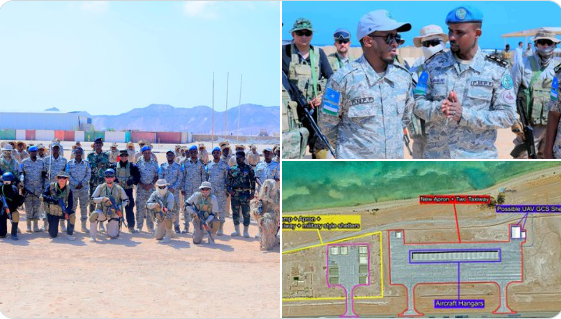
(Source: Clash Report / Richard Teddy)
Why Colombian Mercenaries Are in Sudan?
The incentives are structural:
- Tactical proficiency — Skilled in small-unit maneuver, urban assault, and disciplined battlefield conduct.(Le Monde Diplomatique)
- Cost and deniability — Lower pay rates and plausible separation from UAE state policy.
- Refined supply chain — Recruit, stage, equip, embed — perfected since Yemen and now applied to Sudan.(The Wall Street Journal)
Who Is Álvaro Quijano — The Man Behind the Pipeline?
La Silla Vacía identifies retired Colonel Álvaro Quijano as a principal broker redirecting Colombian ex-soldiers from promised UAE security jobs into Sudan’s battlefields to fight alongside the RSF. Operating from Bogotá, the network runs along a Colombia → UAE → Libya → Sudan axis financed in the Gulf. Family confirmations of fatalities reinforce the existence of a sustained mercenary flow. The UAE denies directing such operations.
Profile:
- Name: Ret. Col. Álvaro Quijano
- Nationality: Colombian
- Role: Coordinator for recruitment and transfer of Colombian ex-soldiers to RSF units in Darfur
- Companies Linked:
- A4SI (Colombia) — Security firm owned by wife Claudia Viviana Oliveros
- Global Security Service Group (GSSG, UAE) — Linked to Emirati national Mohamed Hamdan Alzaabi

(Source: X / OSNIT)
From Foreign Invasion to Transnational Crime
This is not a domestic conflict — it is a foreign-executed invasion waged through an Emirati proxy militia. The logistical trail is visible: arms flights and staging in third countries; systematic recruitment of foreign mercenaries; and combat footage confirming non-Sudanese fighters in RSF assaults.
UN-tracked aviation and multiple investigative reports have flagged sustained UAE-linked air traffic funneling materiel to the RSF via Chad, Libya, Central Africa, Uganda and Kenya — allegations the UAE denies, insisting the flights are humanitarian.(The Guardian)
Investigative Findings
- Recruitment Scheme — 300+ Colombian ex-soldiers recruited under false pretenses of UAE security work.( SOFX)
- Deployment Route — Colombia → UAE → Libya → Darfur staging chain. ( ADF Magazine, Libya Observer)
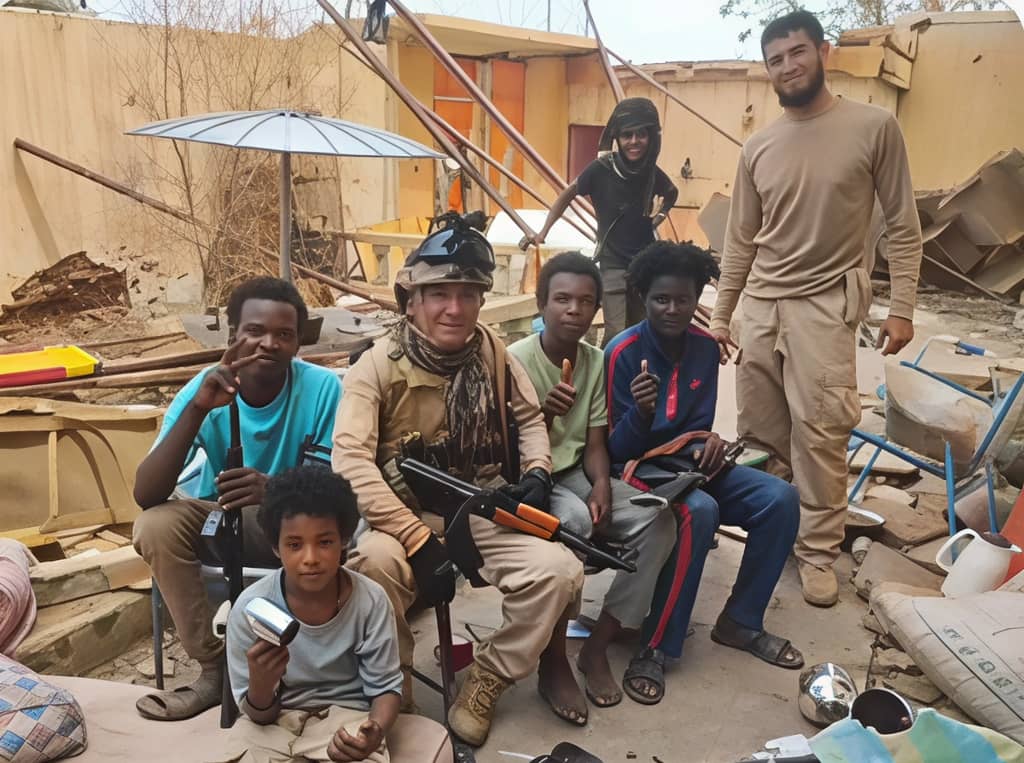
- Child-Soldier Training — Testimonies indicate Colombian mercenaries were tasked with training RSF child soldiers, some as young as 10–12, in camps near Nyala, Darfur.(The Maltese Herald)
- Coercion & Control — Multiple accounts describe mercenaries being misled, having passports confiscated, and facing threats if they attempted to leave Sudan.(Eritrea Focus)
Why This Matters
El-Fasher — the last major city in Darfur under Sudanese government control — has withstood a prolonged siege marked by over 225 aggressive and deadly RSF assaults aimed at seizing the city. Every attempt has failed. The documented presence and deaths of Colombian mercenaries, the operational use of prohibited munitions, and the logistical chain linking Bogotá to Abu Dhabi to Darfur leave no room for ambiguity: this is a foreign invasion-for-hire, not an internal Sudanese war. (AP News)
Humanitarian agencies and international media have repeatedly documented patterns of mass atrocities, famine conditions, and the systematic targeting of displacement camps in and around El-Fasher throughout the siege. (AP News)
Conclusion: A War for Hire
The voices in the recovered video belong to men fighting a war they did not inherit and will never stay to rebuild. They will be paid, extracted, and replaced. Sudanese civilians will remain — burying their dead under the same sun where Colombian slang now echoes across Darfur’s battlefields. The chain that brought these fighters here — recruiters in Bogotá, transporters and financiers in Abu Dhabi, and a proxy militia on Sudanese ground — demands exposure. This is not merely Sudan’s tragedy; it is a marketplace of violence in which foreign veterans are the currency and the UAE is the banker of an invasion-for-hire.
Editor’s Note: Certain documents, videos, and testimonies cited in this investigation are retained on file by Brown Land News and have been reviewed by our editorial team. Some identifying details have been withheld to protect sources and ongoing investigations.
About the Author
Sabah Al-Makki is a Sudanese writer and Assistant Editor at Brown Land News. Her work examines geopolitics, political violence, international law, cultural resistance, and social awareness through the lens of Sudan’s unfolding realities.
Sabah challenges dominant narratives by centering the voices of Sudanese citizens — both inside the country and across the diaspora — whose perspectives are often excluded from global discourse. Her writing interrogates the meaning of war, peace, and justice, insisting that true change begins with dismantling colonial paradigms.
Approaching journalism as a form of cultural, cognitive, and philosophical resistance, Sabah confronts the structures that sustain conflict and silence. She writes from within the storm.
Exclusively published by Brown Land News.
Where sovereignty is not negotiable, and truth defies revision.
Our Land. Our Voice. Our News